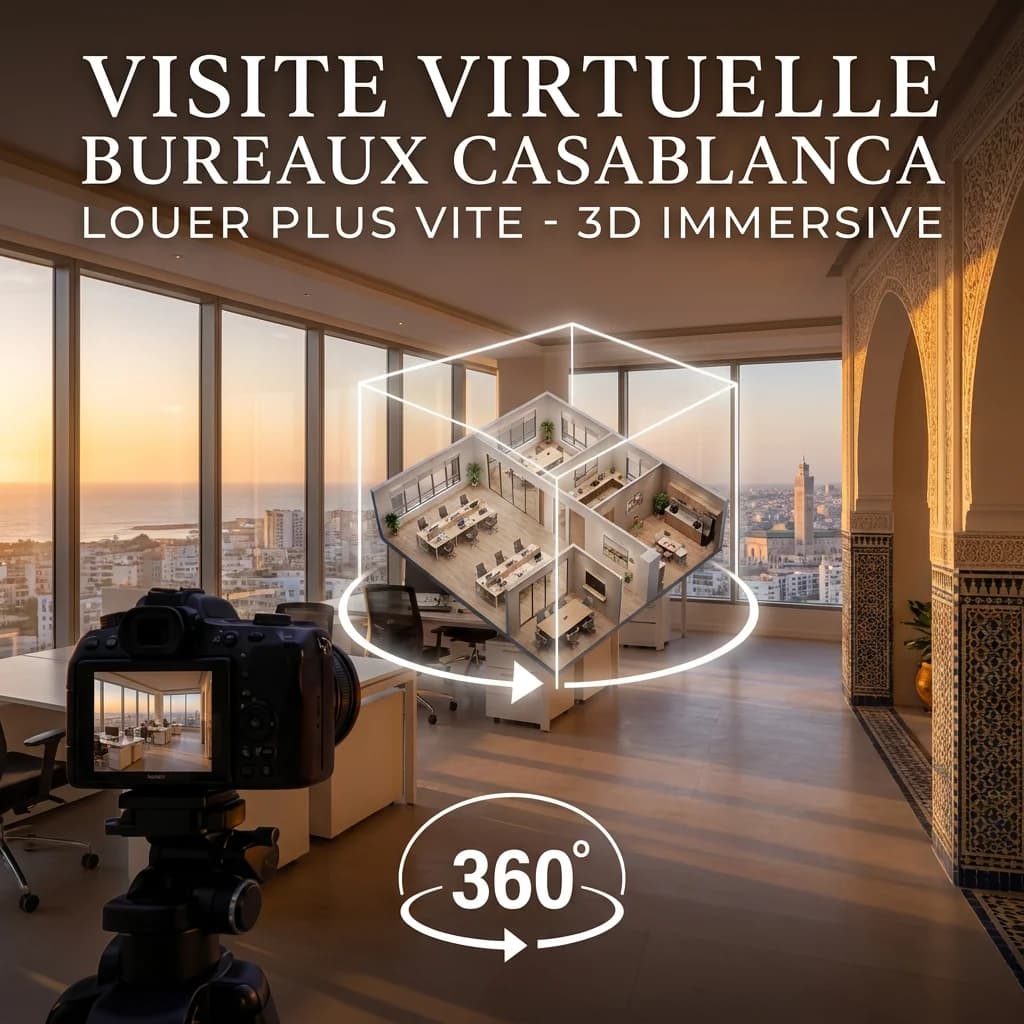
An empty office floor does not just cost the rent nobody is paying. It costs service charges, tax, security, and above all marketing time that nobody invoices but everybody pays for. An office space virtual tour in Casablanca will not fill a floor on its own, but it acts on the most expensive variable in the file: the number of weeks between listing the space and signing the lease.
The reasoning is straightforward. In residential, a buyer views three or four properties before deciding. In commercial, a managing director or head of real estate often views ten to fifteen, each time moving two or three colleagues out of the office during working hours. Every physical viewing avoided upstream is half a day recovered on both sides — and a file that reaches the offer stage faster.
A market where vacancy is paid for every month
Casablanca holds the largest office stock in Morocco, and that stock has seen a marked rise in available supply in recent years. A JLL analysis reported in the Moroccan business press put vacancy at around a quarter of the quality stock at the end of 2021, with Grade A headline rents having fallen across most business districts, and demand concentrated on floorplates below 5,000 square metres. Those figures are dated and the market has moved since, but they describe a structural reality that has not gone away: on this segment, it is supply that has to do the convincing.
A more recent reading of the Casablanca market places market rents in a higher band depending on district, and notes above all that letting timescales vary sharply from one area to another, with liquidity considerably better in established business districts. In other words: in Maarif or Casablanca Finance City, a well-presented floor finds a tenant; elsewhere, the quality of the marketing makes a decisive difference.
That asymmetry deserves serious attention from owners outside the most sought-after addresses. In a market where demand concentrates on a handful of districts, a floor in the city centre or Aïn Sebaâ is not doomed: it simply has to compensate for its address with better legibility. That is precisely what a virtual tour delivers — it lets a tenant seriously assess a property they would never have made time to visit on location alone.
What an office tenant is actually looking for
A prospective tenant does not look at a floorplate the way a private buyer looks at an apartment. They are answering three questions in order: how many desks fit here, is the building presentable enough to receive my clients, and what fit-out budget takes it from its current state to the layout I need.
Capacity, the first question and the first filter
A stated floor area tells you almost nothing about real capacity. Two 300-square-metre floors can hold very different headcounts depending on the façade grid, column positions, depth from the windows and the location of the service cores. A 3D tour paired with a dimensioned 2D plan lets a tenant — or their interior architect — run that calculation from their own desk, measuring directly inside the tool. This is where a virtual tour delivers the most value in commercial property: it turns a question that used to require a site visit into a ten-minute check.
The same tool settles a second question, usually asked immediately afterwards: the fit-out budget. Moving through the floor, an interior architect identifies where the ducts run, the condition of the suspended ceilings, the floor build-up, the position of the existing washrooms — all of which drive the cost of works and none of which survives a listing photograph. A tenant able to estimate that budget before viewing moves towards an offer considerably faster.
Shell space is the hardest thing to sell in a photograph
A floor delivered as bare concrete, or in used condition, photographs badly. The images produce a grey, empty space with no sense of scale and nothing for the eye to hold onto. The result is that office listings all look alike, and the choice comes down to rent and address — the two criteria where you have no room to differentiate.
3D navigation fixes that without cosmetics. Moving through the actual volume, a visitor perceives ceiling height, the real natural light given the orientation, the view from the windows, the width of the circulation routes. A properly captured shell floor is still a shell, but it becomes legible — and a legible space can be imagined, whereas an illegible one gets compared on price alone.
How an office space virtual tour shortens the leasing cycle
The most direct effect is on the structure of the process. A guide for companies searching for premises notes that virtual tours remain relatively uncommon in corporate real estate, while stressing that on exclusively marketed properties they act as a genuine trigger. That is exactly the use to aim for: not replacing the viewing, but eliminating the pointless ones.
An analysis of the corporate property market describes the same shift: rather than spending months touring office space, decision-makers can review properties remotely within days and verify for themselves the features that used to be described to them over the phone. For an agent, the gain is twofold: fewer wasted viewings, and physical viewings held with people already convinced on the fundamentals.
Attracting international tenants and inbound investment
Casablanca regularly hosts companies setting up from Europe, the Gulf or sub-Saharan Africa, often through a head office arbitrating remotely between several cities. In that kind of file, the final decision-maker will not travel for a shortlisting exercise: they will receive a pack, open it in a meeting room in Paris or Dubai, and decide on what they have seen.
Sending a tour link rather than a six-page PDF changes the nature of that meeting. The local team can drive the tour over screen share, show the view from the ninth floor, walk through the building lobby, open the plan to discuss desk layout. It is the same logic we apply to renting residential property remotely, transposed to a longer decision cycle and larger sums.
Coworking, business centres and flexible offices
The flexible segment follows different rules: the decision cycle is short, often a matter of days, and prospects sometimes sign without ever visiting. For a coworking space, a virtual tour is therefore not a shortlisting tool but a direct conversion tool, placed on the pricing page beside the free-trial form.
What matters there is not dimensional precision but atmosphere: the light, the noise level implied by the layout, the quality of the shared areas, whether there are real booths for calls. A prospect who has seen the meeting room and the coffee corner arrives at the free trial with expectations already calibrated, and the conversion rate to a paid membership reflects it.
Operators running several sites gain something extra. A prospect comparing your Gauthier location with your Sidi Maarouf one can do it in a single session instead of two appointments across the city, which in practice means they compare rather than abandon. On a product sold by the month, shortening that comparison from a week to an evening is the whole game.
Showing a proposed fit-out without building a show floor
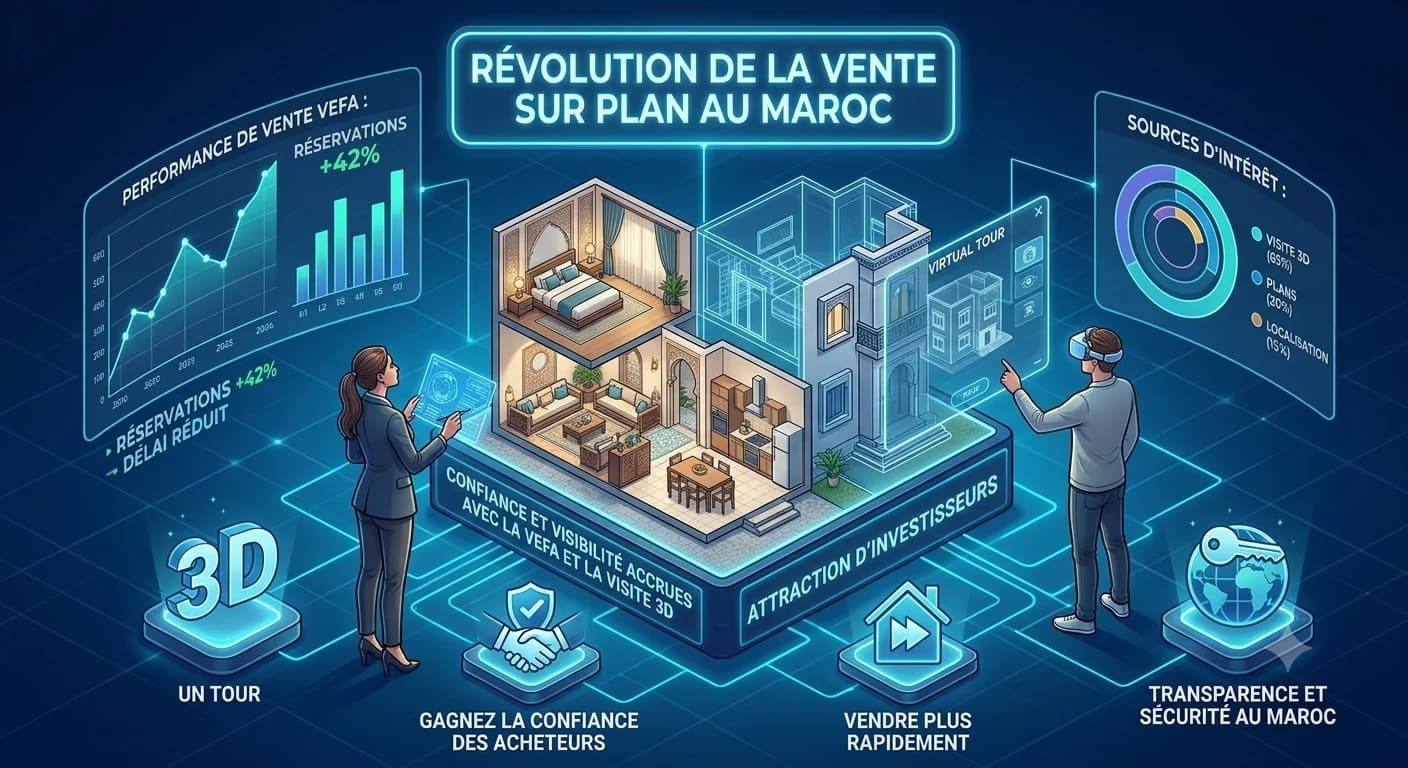
Many new buildings go to market before a single floor has been fitted out. A specialist in commercial virtual tours points out that the format makes it possible to start marketing very early and avoid the cost of a fitted show floor, while allowing several layout hypotheses to be tested on the same space. That is a substantial argument on a building of several thousand square metres, where fitting out a demonstration floor ties up a considerable budget in one configuration.
The honest method is to keep the two registers clearly apart: the real capture of the floor as delivered on one side, proposed layouts on the other, presented as working hypotheses. Tenants understand that distinction perfectly well. What they take badly is discovering on site that the glazed partition they saw online existed only in a designer's file.
What changes when the floor is still occupied
Here is the most practical difficulty in commercial property: a floor being marketed is often still occupied by the outgoing tenant. Scanning an active workplace calls for strict precautions. Nobody in shot, no lit screens, no named documents or dashboards visible, no badge or org chart readable on a wall.
In practice, capture is therefore scheduled outside working hours or over a long weekend, with enough notice for staff to clear their desks. A common alternative is to capture only the neutral zones — lobby, circulation, meeting rooms, washrooms, the view from the windows — and to complete the picture with a 2D plan for the work areas. That compromise gives the prospective tenant most of what they are looking for without exposing the outgoing occupier.
Worth writing into the lease from the outset: many commercial leases already grant the landlord a right of access for viewings during the notice period, but say nothing about photography or scanning. Adding a short clause covering capture, with agreed notice and the confidentiality conditions above, avoids a negotiation at the worst possible moment — when the outgoing tenant has no remaining incentive to cooperate.
What it costs to scan an office floor
For a floorplate of 200 to 600 square metres, 3D capture generally runs between 300 and 750 euros depending on area, number of levels and the complexity of the space. The payback calculation is immediate: on a floor let at roughly 15 euros per square metre per month, a single month of vacancy avoided is worth far more than the cost of the work. For a whole building, capturing several floors in one visit brings the unit cost down sharply, and the common parts are paid for once but serve every lot.
One last factor shapes the budget: how long the tour stays useful. A shell floor captured once remains usable until it is let, which can mean two years, whereas a fitted space needs recapturing after every change of tenant. It is therefore rational to invest more heavily in the properties you expect to take longest to place.
Frequently asked questions about office virtual tours
Can a floor be shown before works are finished? Yes, and it is often sensible: capturing as soon as the structure is delivered lets marketing start before the finishes are complete, provided the state of progress and the capture date are clearly stated.
Does a tour remove the need for a physical viewing before signing? No, and that is not the aim. No serious tenant signs a commercial lease without visiting. The virtual tour exists to reach that stage with a short list and candidates already aligned on the property's characteristics.
Can the tour be embedded in commercial property portals? It depends on the platform. Where external links are not accepted, the workaround is to publish high-resolution stills exported from the tour and point visitors to the property page on your own site.
The bottom line
In the Casablanca office market, the difference between two comparable floors increasingly comes down to the quality of the marketing. A 3D tour paired with a dimensioned plan lets a tenant run their capacity calculation before travelling, cuts unproductive viewings and shortens the time to offer. Our virtual tours for real estate cover office floors as well as off-plan schemes and residential listings. Let's talk about the space you have available and work out which floors would gain most from being scanned first.