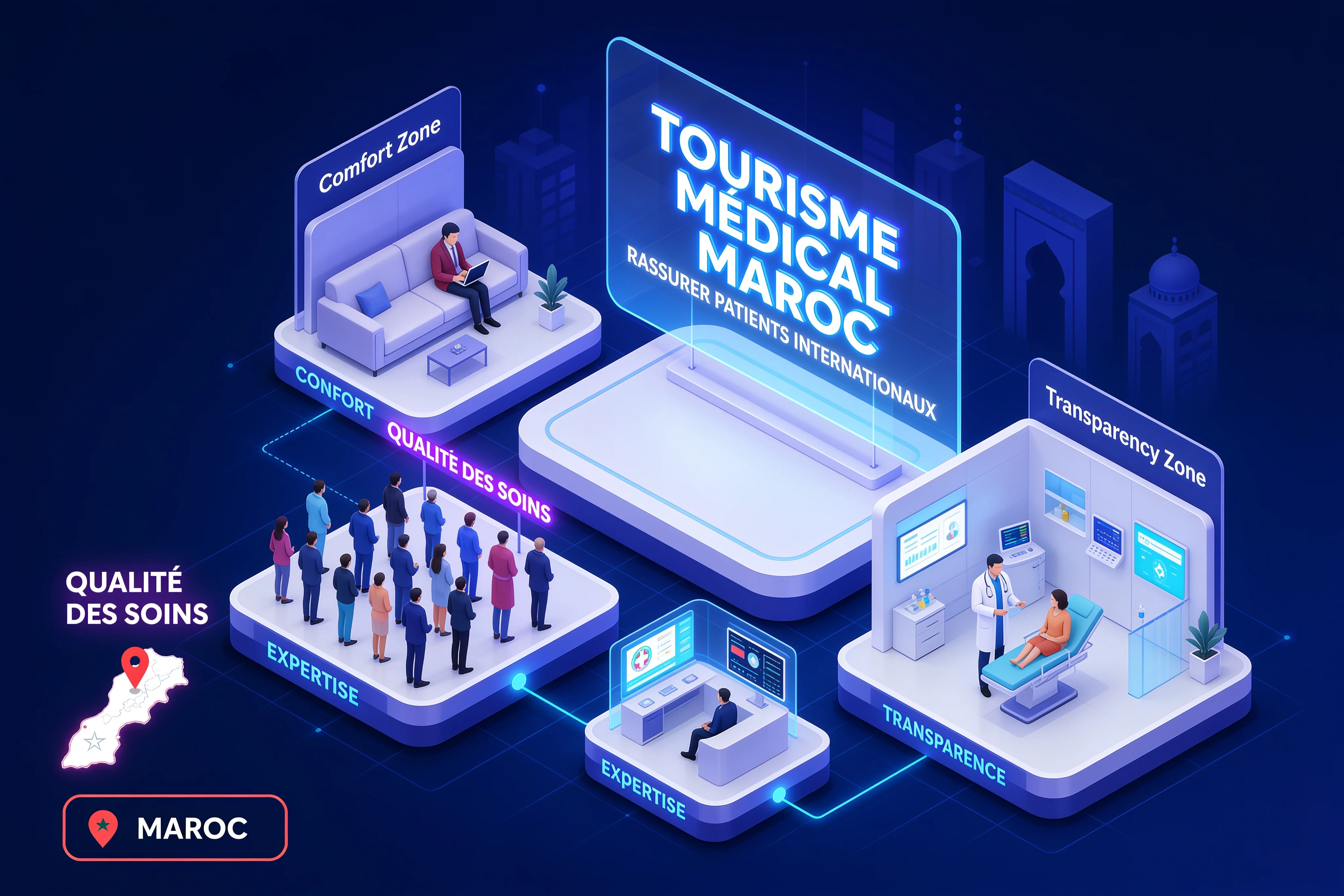
A patient considering surgery abroad makes two decisions at once: to have the procedure, and to entrust their body to a facility they know only through photographs found online. In medical tourism in Morocco, the second decision is often the harder one, because nothing visually separates a properly equipped clinic from an outfit that has simply bought attractive stock imagery.
This is a problem of proof, not of messaging. A serious Moroccan clinic has the technical platforms, compliant operating theatres, comfortable inpatient rooms and trained teams — but it describes them in the same words everyone else uses. A 3D virtual tour shifts the conversation from the declarative to the verifiable: the patient stops reading a promise and starts walking through a place.
Medical tourism in Morocco: a real market, poorly documented
Morocco is one of Africa's long-standing medical tourism destinations, alongside Tunisia and Egypt. Industry estimates have for several years pointed to a volume in the order of several hundred thousand foreign patients treated each year, most arriving from sub-Saharan Africa ahead of European patients — while noting the absence of consolidated official statistics on those flows.
That data gap is not a footnote: it partly explains why the country's positioning lags behind more aggressive competitors. One sector analysis observed that Morocco sat mid-table on an international index of medical destination attractiveness, and that it tends to be perceived first as a leisure destination rather than a healthcare option. At regional level, a more recent reading of the sector notes that medical tourism in Africa has organised itself around a few major hubs, Morocco among them.
For an individual clinic, the practical consequence is simple: the destination's reputation will not carry your case. Your facility, on its own, has to do the convincing.
What an international patient actually worries about
The concerns raised in enquiry emails recur with striking regularity, and they rarely concern surgical technique. They concern the environment: is the room private, is there an en-suite bathroom, is the facility clean, what does the theatre look like, where will my companion stay, and how far is the hotel or the airport.
That displacement is not irrational. A foreign patient has no way of assessing the competence of a surgeon they have never met, inside a health system whose conventions they do not know; so they assess what they can assess. The cleanliness of a corridor, the state of a room or the organisation of a reception desk become proxy indicators for the seriousness of the whole operation. Clinics that grasp this do not try to drag the conversation back to technique: they answer first on the ground where the patient feels equipped to judge.
On top of that sits a heavier fear, fed by widely reported cases: ending up with an unregistered facility or an opportunistic middleman. A feature on the sector in Morocco describes that risk precisely, citing uncertified clinics and unqualified intermediaries recruiting patients through social media, and stressing price transparency and continuity of care as the markers that separate credible operators from the rest.
Visual transparency as a compliance argument
Against that backdrop, showing your premises is no longer an aesthetic choice: it is a way of separating yourself from those who cannot. An irregular operation will never publish a walkable tour of its operating theatre, its sterilisation area and its inpatient ward, because it lacks the means or because the premises would not survive the scrutiny. A compliant clinic has nothing to hide — and demonstrates it in thirty seconds of navigation.
This is a form of proof that is unusually hard to fake. A photograph can be borrowed, cropped or taken years ago in another building; a continuous walkable capture is far harder to fabricate, because the spaces have to connect to one another and the same details have to reappear from different angles. Patients rarely articulate that reasoning explicitly, but they feel it — which is why a tour tends to close doubts that a gallery of images leaves open.
What to show, and what to keep out of frame
The useful route follows the patient's own: entrance and reception, the waiting area, the inpatient room with its bathroom, the treatment corridor, the approach to theatre, and the comfort spaces intended for a companion. The operating theatre itself is shown at rest, clean and lit, with no instruments unpacked and no screens active. No patient, no identifiable clinician, no records and no named labels may appear in shot: capture always takes place with no patients present, and that requirement overrides every commercial consideration.
One common-sense note: stage nothing. A theatre too immaculate to be plausible, or a room dressed like a hotel suite, produces the opposite of the intended effect on an audience that is already wary.
The whole journey, not just the procedure
A medical trip abroad is a logistical operation as much as a clinical one. The patient has to picture an entire week: arrival, pre-operative consultation, the procedure, recovery, follow-up checks, then the journey home. The clinics that convert best are those documenting that full chain rather than the technical platform alone.
In practice, that means including the spaces that matter across several days: the room, obviously, but also the floor lounge, the terrace if there is one, the catering area, and where a companion can sleep. On a recovery stay, these elements sometimes weigh as heavily in the decision as the team's credentials — precisely because the patient cannot assess the latter but can assess the former perfectly well. The same logic applies to recovery-focused facilities, as we describe for wellness centres.
Taking back ownership of the patient relationship
Many Moroccan clinics depend on intermediaries and matchmaking platforms for their international recruitment. The model works, but it casts the facility as an interchangeable supplier: the intermediary owns the relationship, the brand and the margin.
A virtual tour hosted on your own site, in French, English and ideally Arabic, partly reverses that. It becomes the thing a patient shares with their family, the thing they find again when they search your clinic's name, and the thing no intermediary can reproduce for a competitor. It is the same reasoning we apply to aesthetic clinics serving an international clientele.
None of this requires cutting your intermediaries out, which would be commercially reckless for most facilities. It simply means the relationship stops being one-way. A clinic that receives direct enquiries, even a minority of them, holds a reference point in every negotiation about commission rates — and knows what its own patients respond to rather than learning it second-hand.
The specialties where the effect is strongest
Not every specialty gains equally from a virtual tour. The effect peaks when the stay is long, when a companion travels along, and when the decision is made remotely without a prior in-person consultation: aesthetic and reconstructive surgery, bariatric surgery, complex dental implantology, ophthalmology, assisted reproduction, and post-operative care.
Conversely, for short day-case procedures where the patient spends only a few hours on site, the contribution is real but narrower: the room matters less, and the decision turns more on the practitioner and the price. That is not an argument against capturing at all, but for concentrating the session on the spaces actually used rather than scanning the whole building.
Health-related travel is not limited to planned procedures either. A recent report illustrates a different use: chronic patients continuing treatment during a stay in Morocco, with well over a thousand dialysis sessions delivered to foreign patients across centres in Marrakech, Agadir and Meknes. For that audience, knowing what the centre looks like when you will be attending three times a week during a holiday is not a minor detail.
Structuring the journey, from first message to quote
A virtual tour placed at the wrong point in the journey does nothing. In medical tourism, first contact almost always arrives by form, email or WhatsApp, and it is followed by an exchange spread over several days, sometimes several weeks. The most useful moment to send the link is neither the first message nor the last: it is the point where the patient has received their quote and starts discussing it with the people around them.
At that precise moment, the patient is no longer deciding alone. A spouse, a parent or an adult child looks over the file, searches the clinic's name online, and asks the question that stops everything: "are you sure about this place?" A walkable link answers that better than any sales argument, because it lets a sceptical third party form their own view without going through you.
An international coordination team therefore has good reason to build the tour into three fixed places: the email signature, the quotation document itself, and the confirmation message sent once the trip is booked. That last placement is often neglected even though it does useful work on pre-operative anxiety in the days before departure.
What to prepare before the capture session
The dominant constraint is regulatory and ethical: patient confidentiality, respect for restricted-access zones, and coordination with the infection control team. In practice, capturing a theatre or a sterile zone is scheduled with the relevant lead, outside the operating list, with the gowning protocol required of anyone entering the area.
The rest is ordinary preparation: the room reset as it would be for an admission, lights on, blinds open, worktops clear, no active screens, no visible documents. For a mid-sized clinic, capturing the patient-facing spaces usually takes half a day to a full day depending on the number of floors.
What it costs to scan a clinic
For a mid-sized facility — reception, waiting areas, several rooms, one or two theatres and the associated circulation — 3D capture generally runs between 500 and 1,200 euros depending on total floor area, number of storeys and the number of spaces included. Set against the budget spent acquiring international patients through platforms and referral commissions, the investment pays for itself over a very small number of cases. Large multi-service hospitals sit above that range.
Frequently asked questions about clinic virtual tours
Can an operating theatre be shown without breaching hygiene rules? Yes, provided capture is treated like any other activity in a controlled zone: scheduled outside the operating list, with the required gowning, disinfected equipment, and prior sign-off from the facility's infection control lead.
Should the tour be translated into several languages? The information points built into the tour can be offered in multiple languages. For an international clientele, French and English versions are the minimum baseline, with Arabic particularly valuable for patients from the Gulf and North Africa.
Does a virtual tour replace accreditation? No. It makes the reality of the premises visible, which complements certification but never substitutes for it. The two reinforce each other: accreditation reassures on procedures, the tour reassures on environment.
The bottom line
Medical tourism in Morocco suffers less from a quality deficit than from a proof deficit. In a market where patients weigh several countries from a distance and where bad experiences travel fast, the ability to show your premises as they really are becomes a direct competitive advantage — and a natural filter against operators who cannot do the same. The logic is identical to the one we apply to dental practices, at a different scale. Explore our virtual tours for clinics, or tell us about your facility so we can build the tour route that fits your international patients.