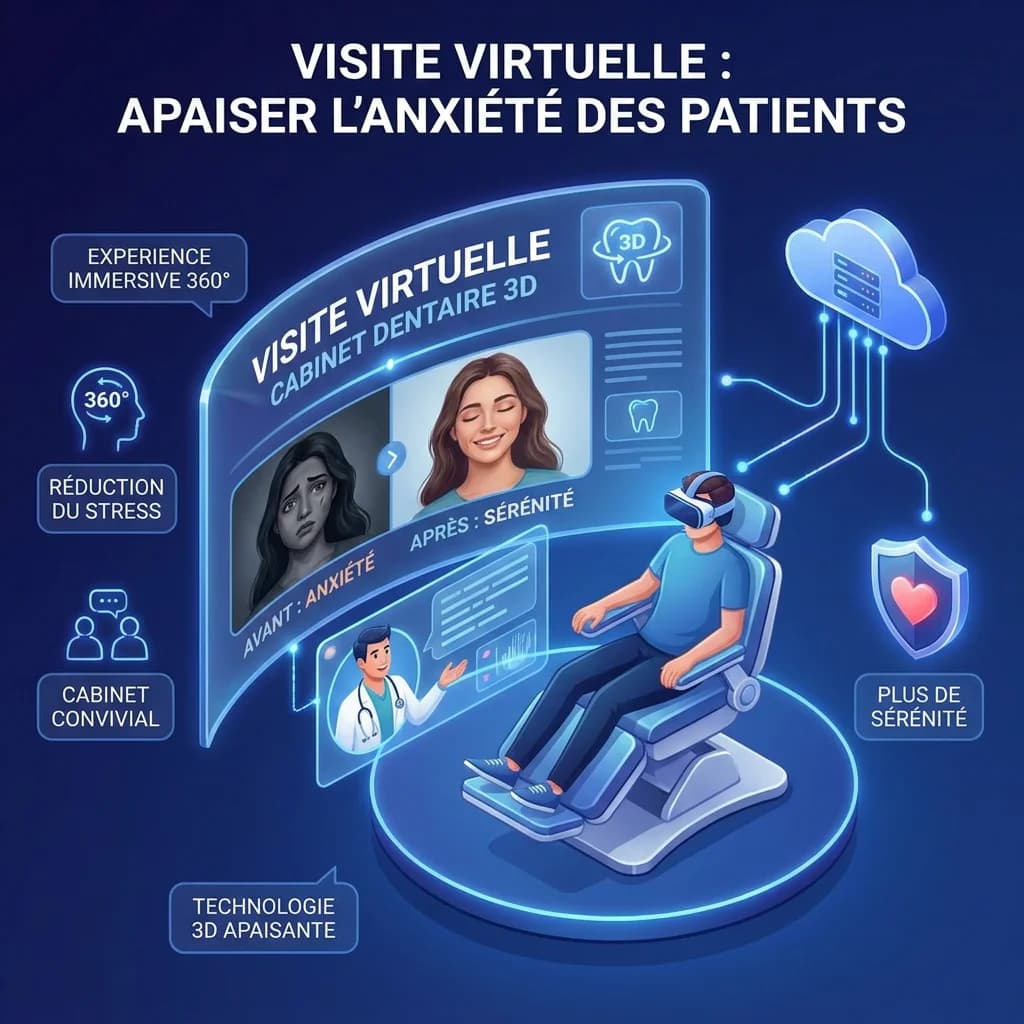
Few healthcare settings are dreaded quite like a dental practice, and few professions say so little about their premises. Most practitioner websites in Morocco offer an address, a phone number and two photos of the building's exterior. For someone who has been putting off an appointment for three years, that is not enough. A dental practice virtual tour answers a question nobody asks out loud but everybody asks internally: what does the place where I am going to lie down actually look like, and will I be safe there?
This is not a matter of marketing polish. Dental anxiety is one of the best-documented reasons people forgo care, and it produces very concrete effects for a practice: appointments cancelled the day before, patients who simply do not turn up, first consultations postponed until something becomes an emergency. Showing the premises in advance does not treat a phobia, but it removes a real obstacle on the way to a first appointment.
Fear of the dentist is common and well documented
The exact figures vary with the definition used, but the direction is consistent. A literature review published in a French-language medical article places the prevalence of dental anxiety between 4 and 20 percent of the general population in industrialised countries, noting that a significant share of adults experience marked dental anxiety and that this fear remains one of the most frequent reasons for not seeing a practitioner at all.
A review devoted to preventing dental anxiety in adults and children adds that a French national survey identified fear of treatment as the second reason people go without dental care, just behind cost, and that it affects men and women alike. The pattern starts early: an international meta-analysis reported in the dental trade press puts dental anxiety among children and adolescents at close to a quarter, with higher levels still among the youngest.
Put differently: for a practice seeing thirty new patients a month, several arrive already tense, and an unknown number never call at all. It is that second group a practice's communication can reach.
That second group is also the one nobody in the practice ever hears from, which is why the problem stays invisible on a dashboard. A no-show shows up in the diary; a person who spent four minutes on your website at eleven at night, felt uneasy and closed the tab does not appear anywhere. Practices tend to optimise the metrics they can see, and this is one of the few that genuinely rewards the effort of making the invisible visible.
What an anxious patient actually fears
The common assumption is that the fear is about pain. That is partly true, but modern dentistry has made real progress on pain management, and the research points mainly at two other factors: the unknown, and loss of control. A study covered by the specialist dental press notes that lying back in the chair is itself a trigger, because the position leaves the patient feeling vulnerable and powerless.
So what a patient dreads is not only the procedure: it is the whole sequence of an experience they do not control. Which door? How many people in the waiting room? Can you hear the drill from the corridor? What does the treatment room look like? Every one of those questions is visual, and every one is answered by a virtual tour without a word being spoken.
What a virtual tour shows, and what it does not
A 3D tour of a dental practice shows no procedure, no patient and no instrument in use. It shows a place, empty and clean, that the visitor moves through freely and at their own pace. That absence of staging is exactly what makes it reassuring: the patient regains control over what they look at and for how long, which is the precise opposite of the situation they fear.
Rebuilding the mental journey, from front door to chair
The most useful sequence follows the patient's real path: the building entrance, reception, the waiting room, the corridor, then the treatment room. That gradual progression matters. Opening straight onto a chair and an operating light achieves the opposite of what you want. Arriving at the chair after passing through a clear reception and a bright waiting room, by contrast, creates the same gentle acclimatisation as a good in-person visit. Information points placed along the route can flag step-free access, where to park or whether there is a lift — practical details that also reduce apprehension.
Children, and the parents who prepare them
With children, preparing for a first consultation makes a considerable difference, and it is the parents who do it. A virtual tour gives them something concrete to work with: they can walk through the practice with the child the evening before, name the rooms, point out the waiting area and the chair, and turn the unknown into something already seen. Paediatric practitioners have long done this with picture books; a virtual tour offers a version that matches your practice rather than a generic one.
A practice that sees a lot of children has good reason to think about what the tour reveals: a reading corner, colour, no instruments visible in shot. These are fit-out choices parents assess in a matter of seconds.
Addressing hygiene without a technical lecture
Patient questions about sterilisation and infection control have become explicit in recent years. Answering them with a paragraph on the website achieves little, because everyone writes the same paragraph. Showing the sterilisation area, the sealed pouches, the autoclave and the clear surfaces produces an immediate, verifiable effect.
It is the same mechanism described in our article on aesthetic clinics and reassurance before a first visit: a written claim invites debate, an image of the real space simply is. One caveat: stage nothing. A sterilisation bay too immaculate to be plausible arouses more suspicion than it settles.
A direct effect on local visibility
Dental practices are almost always chosen locally. The search starts on Google Maps, continues through reviews, and ends on the practitioner's website or with a phone call. Publishing a 360 tour on the business listing enriches that path at the exact moment a patient is weighing two or three practices in the same neighbourhood, and adds a content type most competitors do not have.
The side effect, often underestimated, is dwell time: a visitor exploring a virtual tour stays markedly longer than one swiping through four photos. In a local market where three practices compete for the same few streets, that difference in attention converts directly into phone calls.
There is a second, subtler benefit. Reviews for dental practices tend to cluster around two themes: the practitioner's manner and the state of the premises. The first is out of your hands on any given day. The second is entirely within your control, and a tour lets prospective patients verify it for themselves before they form an expectation. Practices that keep their spaces genuinely well maintained rarely get credit for it in photographs; a walkable tour is the format where that care finally reads.
A practical lever against no-shows
The missed appointment is one of the quietest costs a dental practice carries: a lost slot cannot be recovered, and it tends to recur with the same patient profiles — precisely the most anxious ones. The mechanism is almost always identical. The patient books in a moment of resolve, apprehension climbs back as the date approaches, and cancelling becomes the path of least resistance.
Placing the tour link in the confirmation email or text message acts on exactly that moment. A patient who gets a reminder two days out can revisit the premises, find the waiting room they have already seen, check where to park. It will not turn a severe phobia into calm, but it does cut the share of withdrawals caused simply by the place remaining abstract. For a practice losing three slots a week, the financial stake is not trivial.
What a virtual tour cannot do
The limits deserve stating plainly, otherwise the tool gets misused. A virtual tour does not replace a consultation, does not reduce the discomfort of a procedure, and is not enough to manage a diagnosed phobia: in those situations, support belongs with the practitioner and, where appropriate, with specific approaches discussed in consultation. Nor does it replace the quality of the phone welcome, which is often still the first real contact.
What it does, it does well: it removes spatial uncertainty, it gives the patient exploration time entirely under their control, and it makes visible a standard of care in the premises that no sentence on a website can establish. It is a trust-building tool, not a clinical one, and presenting it that way avoids misunderstandings with patients and staff alike.
What to prepare before the capture session
The main constraint in a working practice is patient confidentiality. Capture therefore always happens outside consultation hours, with the premises empty and no patients or records visible. Any named document, lit screen or sample label has to come off the worktops, and no computer should be displaying practice-management software.
On the practical side, a few simple steps transform the result: clear the worktops, tidy the cables, switch on every light, open the blinds for natural light, and reset the treatment room completely. A session covering a three- to five-room practice usually takes two to three hours.
It is also worth deciding in advance which rooms stay out of the tour. Staff areas, the office where records are kept and any storage room add nothing for a patient and complicate the confidentiality check. A tighter route through four well-presented spaces reads better than a complete circuit through nine, and it keeps the file lighter on a mobile connection — which is how most patients will open it.
What it costs to scan a dental practice
For a standard practice with a reception, a waiting room, one or two treatment rooms and a sterilisation area, 3D capture generally runs between 150 and 350 euros depending on floor area and the number of rooms. Set against the cost of acquiring a new patient through online advertising — and above all against the lifetime value of a patient who stays with the practice for years — the investment pays for itself over a very small number of extra first appointments. Group practices and multi-chair dental centres fall outside that range, since capture time rises with the number of rooms.
Frequently asked questions about dental practice virtual tours
Does the practice have to close for the capture? No, but you need a window with no patients: the end of a day, a quiet morning or a Saturday all work. The premises must be empty for confidentiality reasons, not technical ones.
Could a virtual tour frighten a phobic patient further? Experience points the other way, provided the tour respects the natural progression of the route and shows no procedure or instrument in use. A highly anxious patient keeps control either way: they can close the tour at any moment, which is not true in the chair.
Can the tour be built into online booking? Yes. The most effective placement is just before the confirmation step, at the precise point where a hesitant patient might still back out.
The bottom line
A dental practice is not sold, it is chosen — and it is chosen on trust signals more than on a list of procedures. Showing the premises as they are, in the order the patient will encounter them, removes part of the unknown that feeds anxiety and drives postponement. It is the same logic we apply to wellness centres and to practices treating international patients. Explore our virtual tours for clinics and practices, or tell us about your practice so we can design the tour route best suited to your patients.