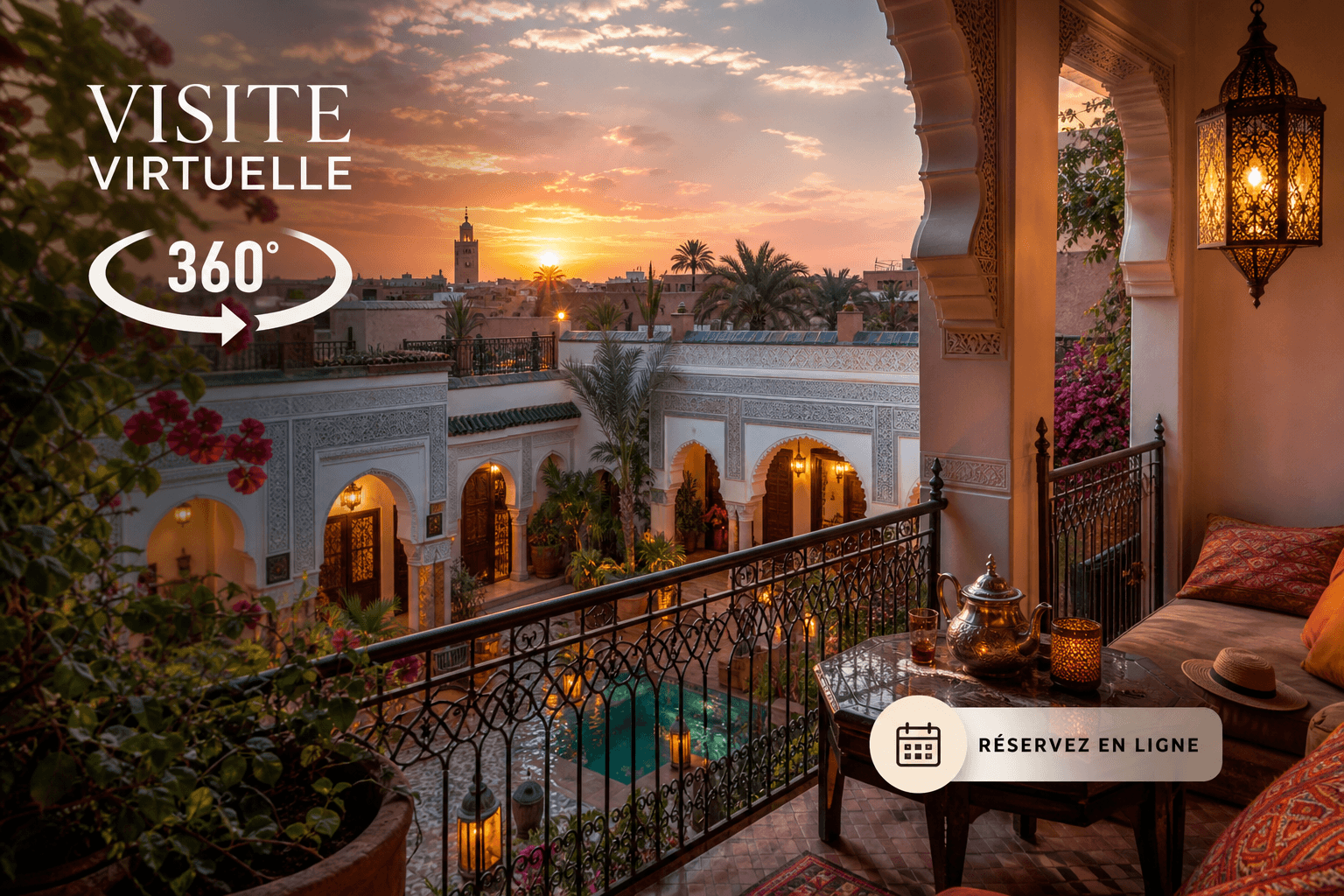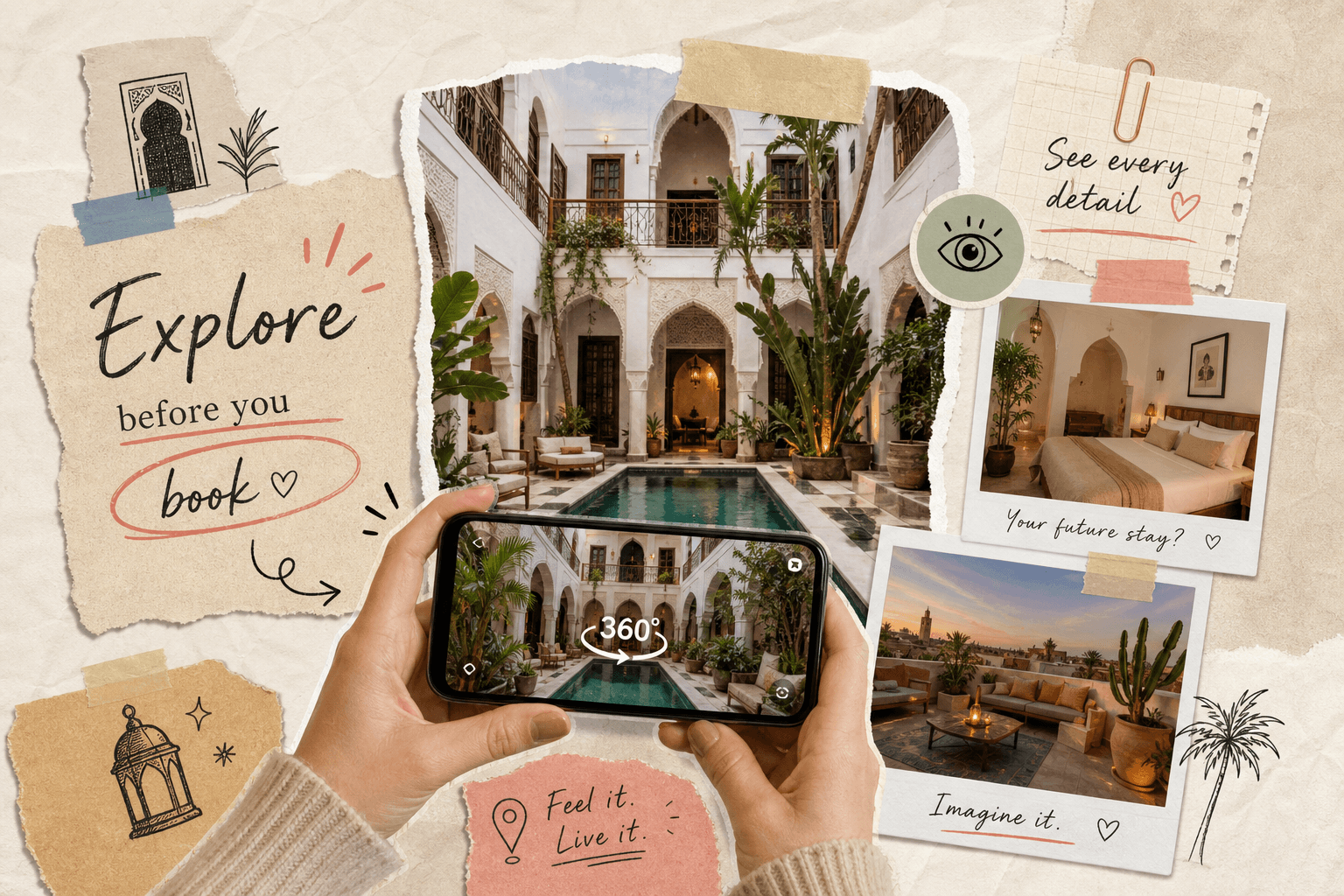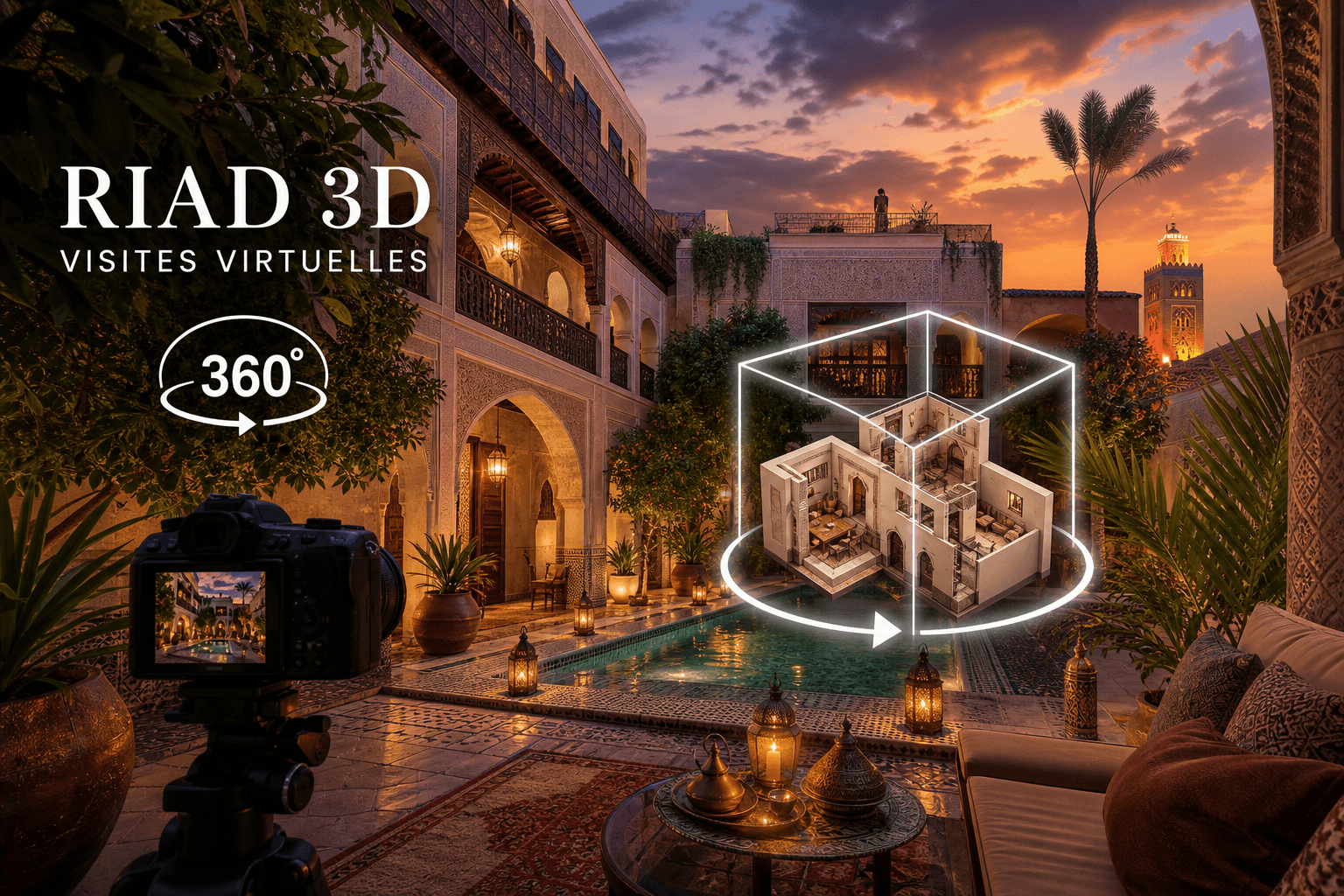
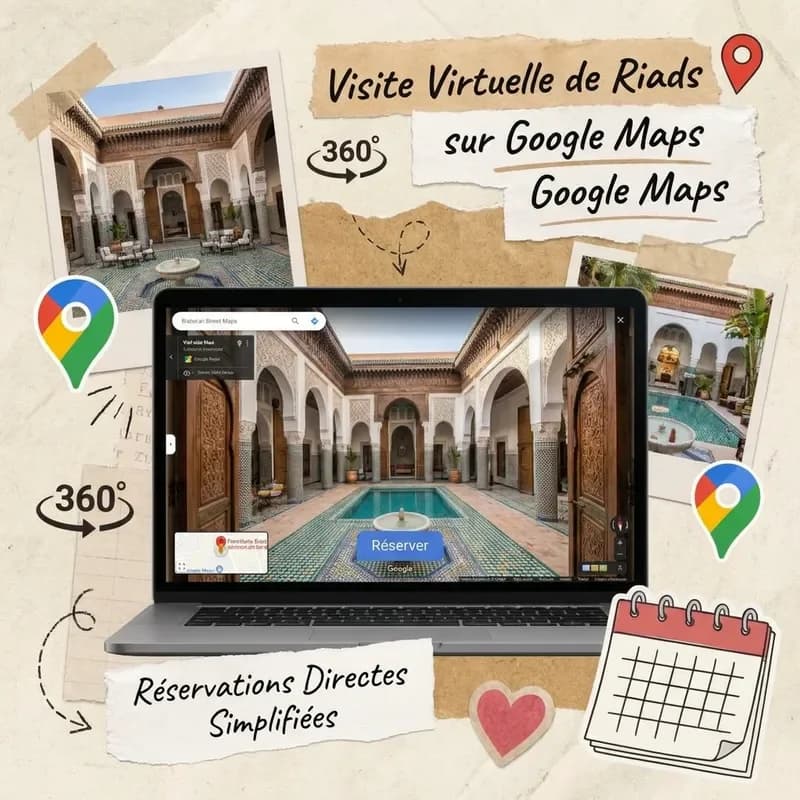
A traveller planning a stay in Marrakech rarely opens your website first. They type "riad medina Marrakech" into Google, look at the map, open three business listings, compare ratings, scroll the photos, and decide within a couple of minutes which ones deserve a further click. A riad virtual tour on Google Maps lands at exactly that moment: while your property is still one candidate among three, before the traveller has even reached Booking or your own reservation engine.
That is a different job from a virtual tour hosted only on your website. On your site, the tour convinces someone who has already found you. On Google Maps, it helps you get found, then chosen. For a riad in the medina, where direct competition runs to hundreds of addresses within a fifteen-minute walk, that distinction carries real weight.
Why the Google listing became the first point of contact
The international traveller's booking journey has shifted. Inspiration happens on Instagram, comparison on Google, validation in the reviews, and booking on whichever platform feels most trustworthy at that precise moment. The business listing sits at the centre of that sequence, and it gets consulted far more often than a riad's homepage.
Google states the role explicitly: its page for businesses notes that photos and virtual tours help people decide to visit a business, and that owners can publish imagery themselves or work with a professional. A guide devoted to Google tours reports for its part that listings enriched with a virtual tour attract markedly more engagement than those limited to conventional photos.
What Google displays once a tour is published
In practice, a 360 tour attached to your listing surfaces in several places: the knowledge panel shown beside search results, the photos tab of the listing, and directly on Google Maps, where an icon signals that the place can be explored from the inside. The visitor moves from browsing photos to walking through space, without leaving Google and without installing anything.
That last detail is worth pausing on. Most of your prospective guests are browsing on a phone, on hotel wifi or roaming data, often while doing something else. Anything that asks them to download an app, create an account or wait through a loading screen loses a meaningful share of them. A tour that opens inside an interface they are already using removes every one of those points of friction, which is precisely why the Google route converts differently from a link buried in a booking confirmation.
360 photos, Street View tours and hosted tours are three different things
The confusion is common and costs owners time. A standalone 360 photo is a single panorama, publishable in minutes from the Google Maps app; useful, but limited, because you cannot move from room to room. An indoor Street View tour is a set of panoramas linked together and positioned on the map, letting someone travel from the patio to the roof terrace. A hosted 3D tour, Matterport-style, offers the richest experience — dollhouse view, 2D plan, measurements, information points — but it lives on your website, not inside Google.
These are complements, not alternatives: the most effective approach for a riad is to publish a 360 version on the Google listing to capture attention, then point visitors to the full hosted tour on your own site, where your commission-free booking engine is waiting.
The real stake: what every intermediated booking costs
This is where it matters. A Moroccan agency specialising in hospitality marketing notes that many Marrakech properties depend heavily on booking platforms, with commissions commonly falling in a 15 to 25 percent band per night. Across a full season, the difference between a riad capturing 15 percent of its bookings directly and one capturing 40 percent is not measured in brand awareness; it is measured in net margin.
The Google tour's role in that shift is indirect but real: it acts upstream of the platform. A traveller who discovers your riad on Google Maps, explores the patio, climbs to the terrace and then clicks through to your website arrives with you directly. The same traveller who discovers your riad on Booking will book there, because that is where their account, their loyalty points and their history already live.
The particular case of a riad in the medina
Riads face a problem the hotels of the new town never encounter: the address is often hard to locate, the entrance is a discreet door down a narrow derb, and the façade gives away nothing of what lies behind. Many travellers know this, but it feeds a persistent unease before booking, then genuine stress on arrival day with suitcases in hand.
A tour published on Google handles both moments at once. It shows that behind an anonymous door there is a patio, a fountain, a terrace; and if the capture includes a few exterior panoramas — the entrance to the derb, the small square nearby, the closest visual landmark — it becomes an arrival tool as well. Few riads exploit this, even though it removes a good share of the panicked ten o'clock phone calls.
There is a commercial argument buried in that practical one. A traveller comparing two medina riads at similar rates is, in effect, weighing two unknowns. The one that shows its entrance, its courtyard and the route from the nearest recognisable square has converted an unknown into a known quantity. The other is still asking for trust it has not yet earned. On a first booking with a property nobody in the traveller's circle has stayed at, that asymmetry frequently decides the outcome.
How to publish a 360 tour on your listing
There are two routes. The first is self-service: you produce equirectangular panoramas and publish them through your business profile manager or the Google Maps app, respecting the minimum resolution requirements and placing the location pin precisely, as set out in a step-by-step publishing guide. The second is to work with a Google-certified provider, which guarantees the capture rules are followed and the imagery is hosted on Google's own servers, a point covered in an article on Street View tours for businesses.
Either way, one precaution comes before the capture: your listing must be verified, complete and current. Publishing a tour on a listing with wrong opening hours or a badly chosen category is like repainting a front door without fixing the lock.
Riad virtual tour: what to show, and in what order
A riad tells its story through the patio. That is the natural entry point for the tour, the view with the strongest effect and the one that instantly separates your property from a standard hotel room. A traveller who sees a bedroom first asks what the nightly rate is; a traveller who sees a courtyard first asks when they can come. Then come the salon, one or two rooms representative of your rate categories, the terrace, and finally the spaces that decide longer stays: the breakfast corner, the plunge pool if there is one, the hammam.
When you capture matters almost as much as the route. In a riad, light drops into the patio through an opening overhead and moves quickly: shooting at midday flattens the volumes, shooting too late leaves the ground-floor rooms in unflattering gloom. A mid-morning session, when light reaches the patio without falling vertically, almost always produces the best result. Postponing by half a day beats scanning a riad under heavy cloud.
The temptation to hide the narrow staircases typical of riad architecture is strong. It is a mistake. A traveller who discovers steep steps on arrival with a 23-kilo suitcase writes a review about it; one who saw them online chose with full knowledge. Transparency about real constraints is the best filter against poor ratings, as we explain in our article on showing everything before the booking.
Coordinating the tour with the rest of your online presence
An isolated virtual tour achieves little. It achieves a great deal when it appears everywhere a traveller hesitates: on the Google listing, on your homepage, in the description of each room category, in replies to enquiries received by email or WhatsApp, and in the material you send to inbound travel agencies.
On booking platforms, embedding an external link is generally restricted. The usual workaround is to export several high-resolution stills from the tour — the patio in morning light, the terrace at the end of the day — and use them as lead photos, while keeping the walkable experience for your direct channels. That asymmetry is deliberate: the platform gets a strong shop window, your own site gets the experience nobody else can offer. Our selection of riads already scanned in Morocco illustrates several of these setups.
Measuring the real effect on bookings
Publishing a tour and measuring nothing means relying on an impression. Three indicators settle the question. The first sits in your business listing statistics: listing views, clicks through to the website, direction requests. The second sits in your site analytics: average session length for visits arriving from Google Maps, and bounce rate on the booking page. The third is the only one that ultimately matters: the share of your room-nights sold directly, month after month.
One methodological note. Record all three figures for the two months before the tour goes live, then for the three months after, allowing for seasonality. Comparing a November to an April proves nothing in Marrakech. Comparing November to November, on the other hand, isolates the effect of the change reasonably well.
One further habit is worth building: ask your direct guests how they found you, and record the answer in your booking system. Filled in consistently for three months, that single field often tells you more than any statistics dashboard, because it captures what analytics cannot see — a recommendation from a past guest, a discovery on the map, a link forwarded by an agency.
What it costs to scan a riad
For a riad of typical size — patio, salon, five to eight rooms, terrace — 3D capture generally runs between 200 and 450 euros depending on the number of rooms, the number of levels and which ancillary spaces are included. Measured against the commission paid on a handful of nights, the investment is recovered very quickly: a few extra direct bookings in a season cover it. Larger guesthouses, or riads spread across several connected buildings, sit above that range.
Frequently asked questions about virtual tours and Google Maps
Does a published tour improve local search ranking? It does not act directly on ranking, but it enriches the listing and increases time spent on it, two signals that carry weight in Google's local ecosystem. The most measurable effect, though, remains the click-through rate to your own website.
Can a published tour be removed or replaced? Yes. Imagery published on your listing can be replaced after a renovation or a change of décor, which is recommended as soon as the premises no longer match what the traveller sees.
Does the riad have to close during capture? No. The session is usually scheduled mid-morning, between check-out and check-in, and rooms are scanned as they are turned over. No closure is needed.
The bottom line
For a riad, the Google listing is not a secondary channel: it is often the first place a traveller forms an opinion. Publishing a 360 tour there, then pointing visitors to a full tour hosted on your site, means acting upstream of the booking platform rather than after it. It is the logical extension of the approach we describe for reassuring a traveller booking in Marrakech. Explore our virtual tours built for riads, or tell us about your property so we can design the tour route that sells it best.