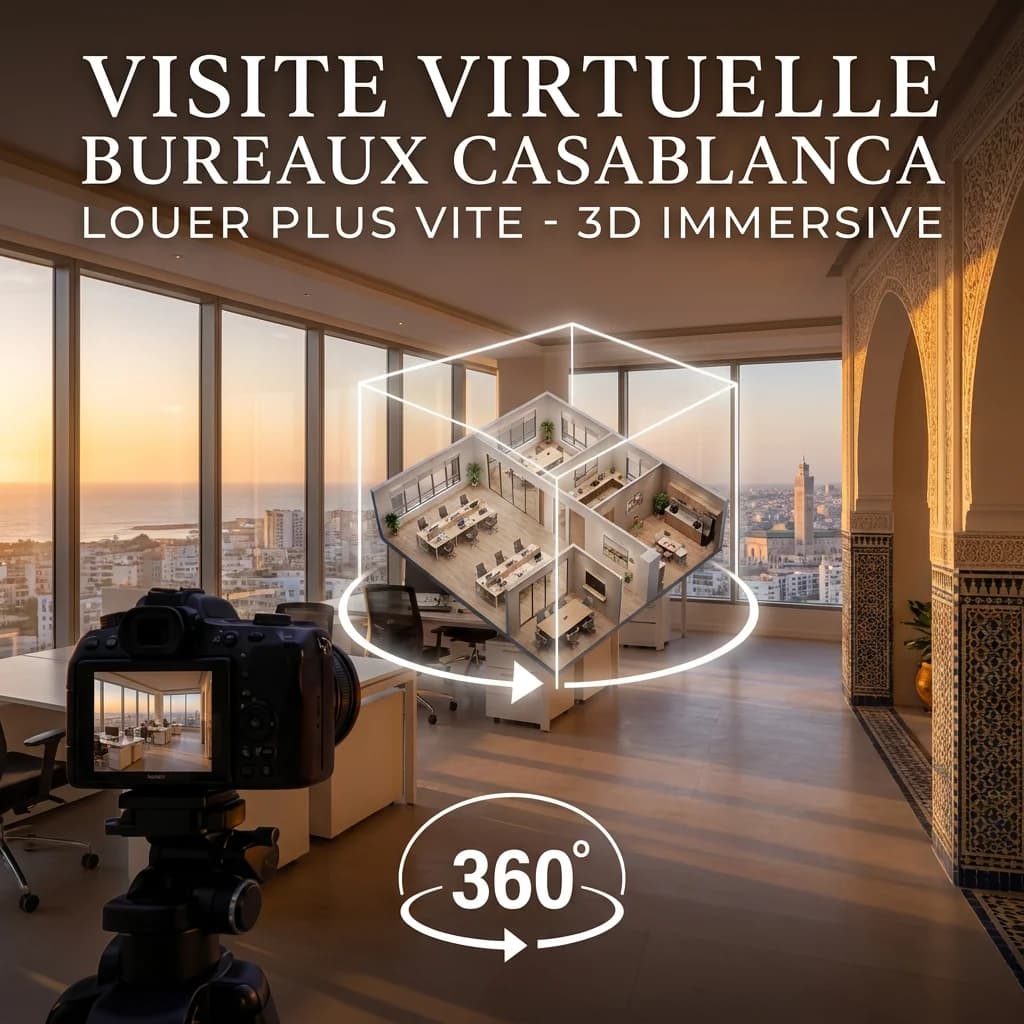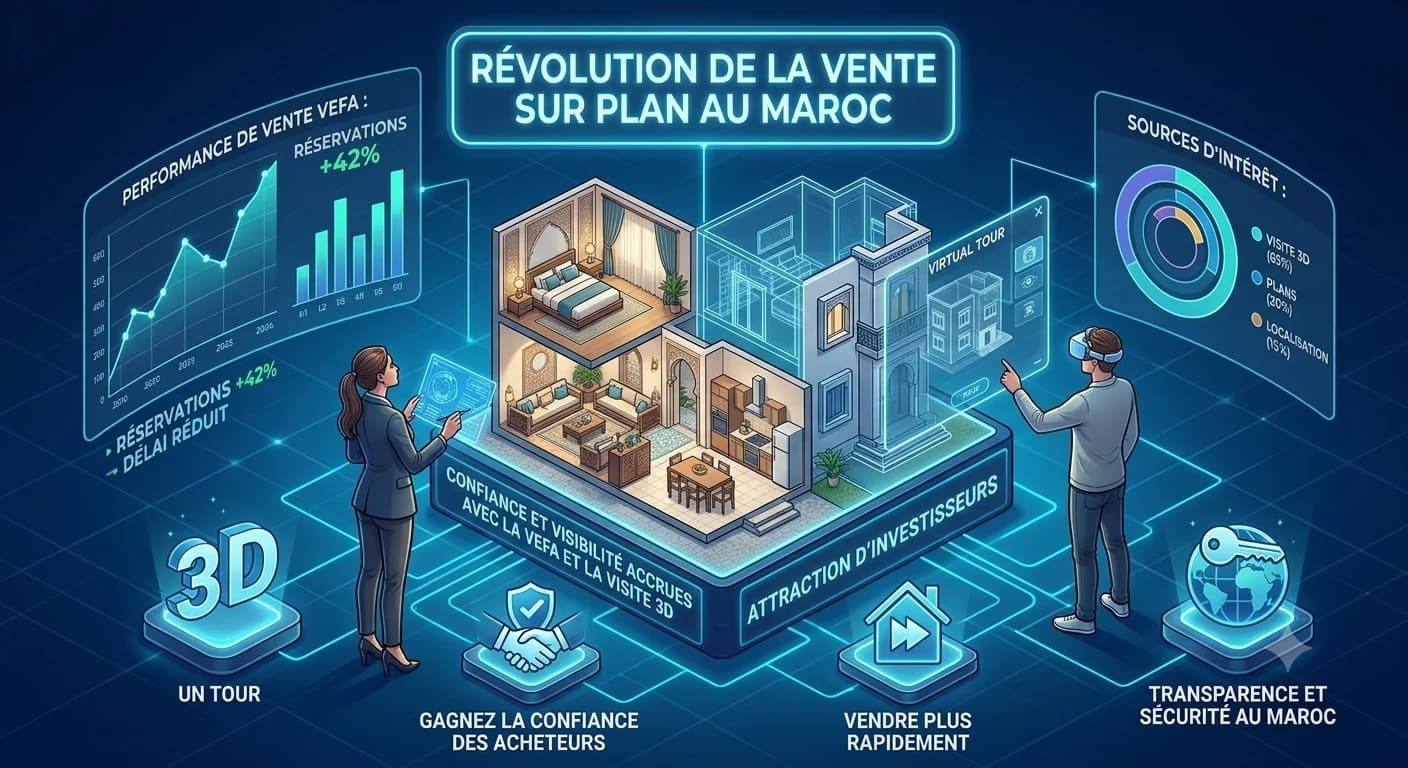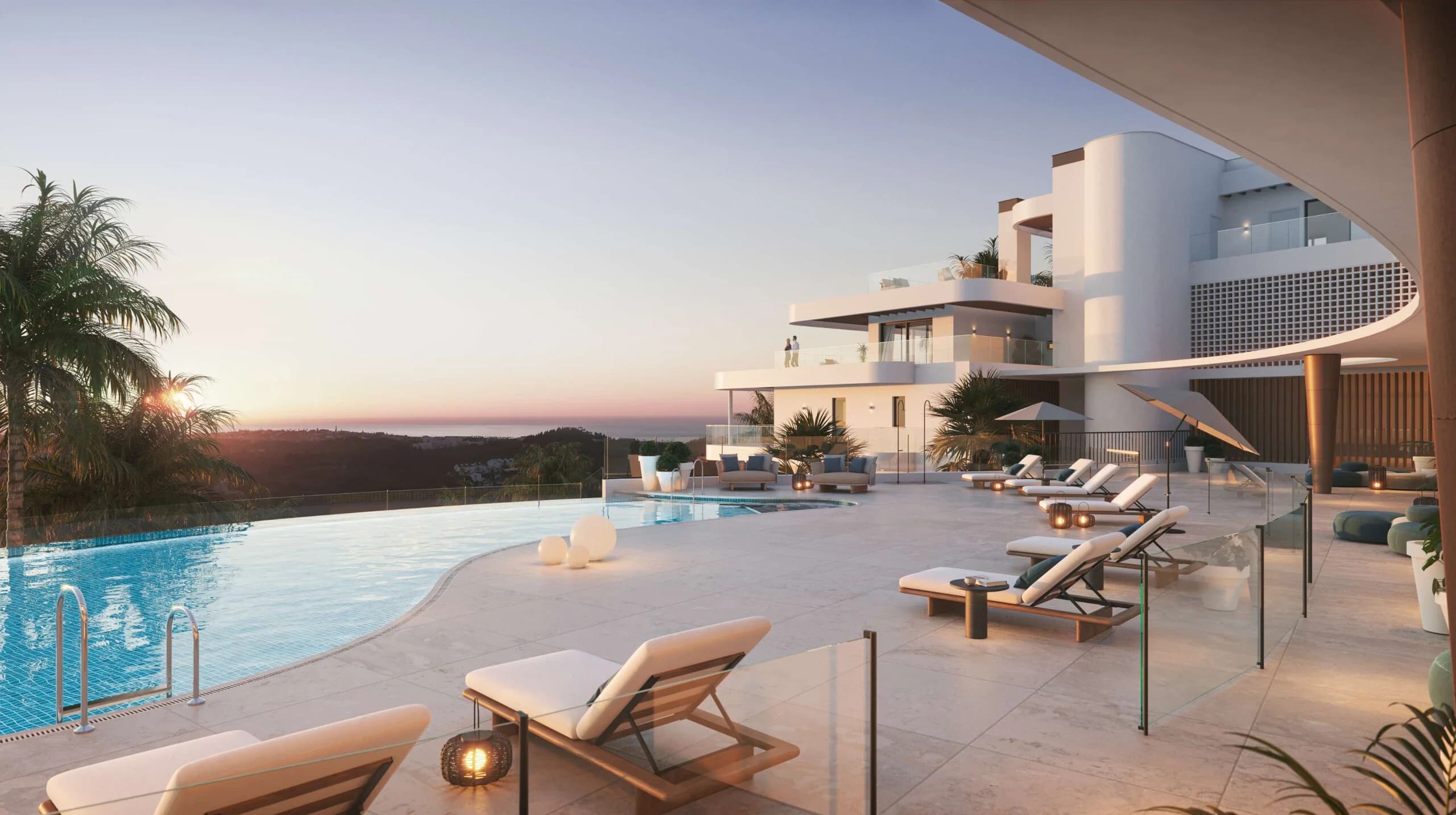
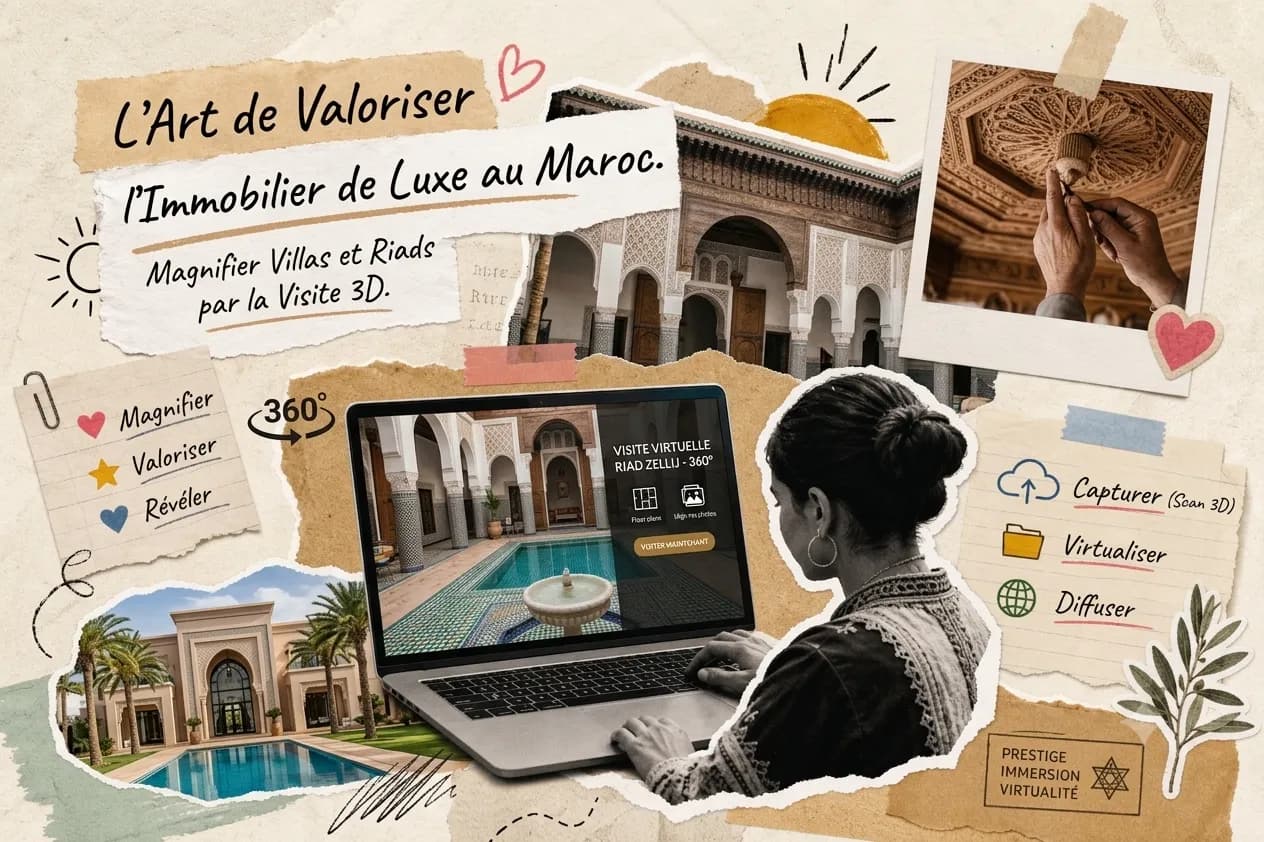
An 8-million-dirham villa in Anfa or a restored riad in the Marrakech medina doesn't sell like a 45-square-metre studio. The typical buyer — often an investor, a diaspora professional, or a foreign purchaser — takes weeks to decide, compares few options but in great depth, and expects a presentation that matches the asking price. Yet too many high-end properties are still shown with the same ten generic photos used for a standard apartment, when a well-produced luxury real estate Morocco 3D tour completely changes how a property is perceived.
That's a missed opportunity: at this level, the visual presentation doesn't just inform — it actively shapes how the property's value is perceived.
Why high-end properties deserve different treatment
In luxury real estate, the buying decision is rarely impulsive. Buyers want to understand how spaces flow into each other, how the patio is oriented relative to the sun, the ceiling height of a traditional Moroccan salon, or the view from a rooftop terrace. An immersive 3D tour, with an interactive floor plan and clickable points of interest on architectural or decorative details, lets you tell the property's story instead of simply listing its rooms.
For a developer marketing several similar villas within one residential project, this level of presentation also signals seriousness to buyers used to international standards — especially when part of the clientele lives abroad and buys without ever viewing the property in person before signing. Still, it pays to stay realistic: field feedback from the upscale Marrakech villa market notes that professional photography remains the primary visibility driver, and that a 3D tour works mainly as a complementary filter for foreign buyers rather than a wholesale replacement for classic visuals.
The particular challenge of the riad
A riad presents a specific challenge: its introverted architecture, built around a central patio, doesn't translate well to standard photography, which captures one room at a time and loses the whole sense of vertical movement between floors and rooftop. A 3D virtual tour designed for this kind of property, by contrast, recreates the real experience of moving through it: down to the patio, up to the terrace, rediscovering each level the way an on-site visitor would.
A remote sales tool for foreign buyers
A significant share of riad and upscale villa buyers in Morocco live abroad and plan their trips months in advance. Being able to explore a property in detail before booking a flight changes everything: the physical visit becomes a confirmation step rather than a discovery step, cutting down the number of trips needed before a final decision. It's the same principle we cover for remote renting for the diaspora, applied here to a much higher price point.
Showcasing traditional architecture
Zellige tilework, carved plaster, cedar wood, a patio planted with orange trees: what gives a riad or a Moroccan-style villa its value often comes down to craftsmanship details more than floor area. A successful virtual tour in this segment favours capture points that highlight these details, with the ability to zoom in on decorative elements, rather than a simple succession of rooms shown at standard eye level. That's a meaningfully different approach from a virtual tour for a modern apartment, where the goal is mainly to show proportions and functionality.
A tool for intermediaries: concierge services and family offices
In this segment, the final buyer isn't always the first person to view a property. Luxury concierge services, property hunters and family offices often shortlist several properties on a client's behalf before proposing a trip. A 3D virtual tour lets them present a qualified first shortlist remotely, quickly rule out properties that don't fit the brief, and only bring the final client to view the two or three options most likely to succeed.
Staging best practices before filming
In the luxury segment, pre-capture staging matters more than usual: matching linens, fully decluttered countertops, ambient lighting switched on alongside natural light, and sometimes temporary decorative touches (fresh flowers, candles, a set table) to bring reception spaces to life. These details, easy to miss on a quick walk-through, stand out particularly well in a 3D tour where visitors take their time lingering in each room.
A concrete example: a development of twin villas in Bouskoura
On a development of ten identically designed twin villas, it's tempting to produce just one "generic" virtual tour for the whole project. In practice, that approach weakens the sales pitch: every buyer wants to picture THEIR future home, not a generic average. The more effective approach is to produce a full tour of the show home, then lighter captures — a handful of key viewpoints rather than a complete tour — for each already-built unit, particularly when orientation or the view differs from one plot to the next.
How much does a 3D tour cost for a high-end property
For a villa or upscale riad, expect a cost of roughly €400 to €900 depending on floor area, number of levels and architectural complexity — a marginal investment relative to the sale price, but one that can tip the decision for a buyer torn between two properties that look equivalent on paper.
Complementing the 3D tour with aerial views
For a villa with a pool, landscaped garden, or open views, adding drone aerial footage considerably strengthens the impact of the virtual tour. These shots show how the property sits within its surroundings, its proximity to the sea or the Atlas mountains, and the true scale of a plot in a way interior tours alone can't convey. This is a particularly useful addition for riads on the edge of a medina or villas in the Marrakech region, where the relationship between the built structure and the outdoors is often central to the sales pitch.
Frequently asked questions about luxury real estate virtual tours
Does a 3D tour work for a property still under construction? Yes, through a reconstruction based on architectural plans and realistic 3D renders, a solution frequently used for villas sold off-plan before completion.
Can access to a high-end property's virtual tour be restricted? Yes, the tour can be published with private-link access rather than public indexing, an option often chosen for prestige properties where the seller's discretion matters.
Should the virtual tour be redone after a partial renovation? That's recommended as soon as significant spaces change in appearance, so the tour accurately reflects the property's current state and avoids disappointing the buyer on arrival.
The bottom line
In the luxury segment, every detail of the presentation matters: materials, light, flow, atmosphere. A well-produced 3D virtual tour doesn't just show a property — it reveals its character, alongside careful professional photography rather than instead of it. For properties aimed at a broader market or at rental, our articles on selling faster in Morocco and on renting to the diaspora round out this approach. Get in touch to discuss the best way to showcase your next villa or riad.