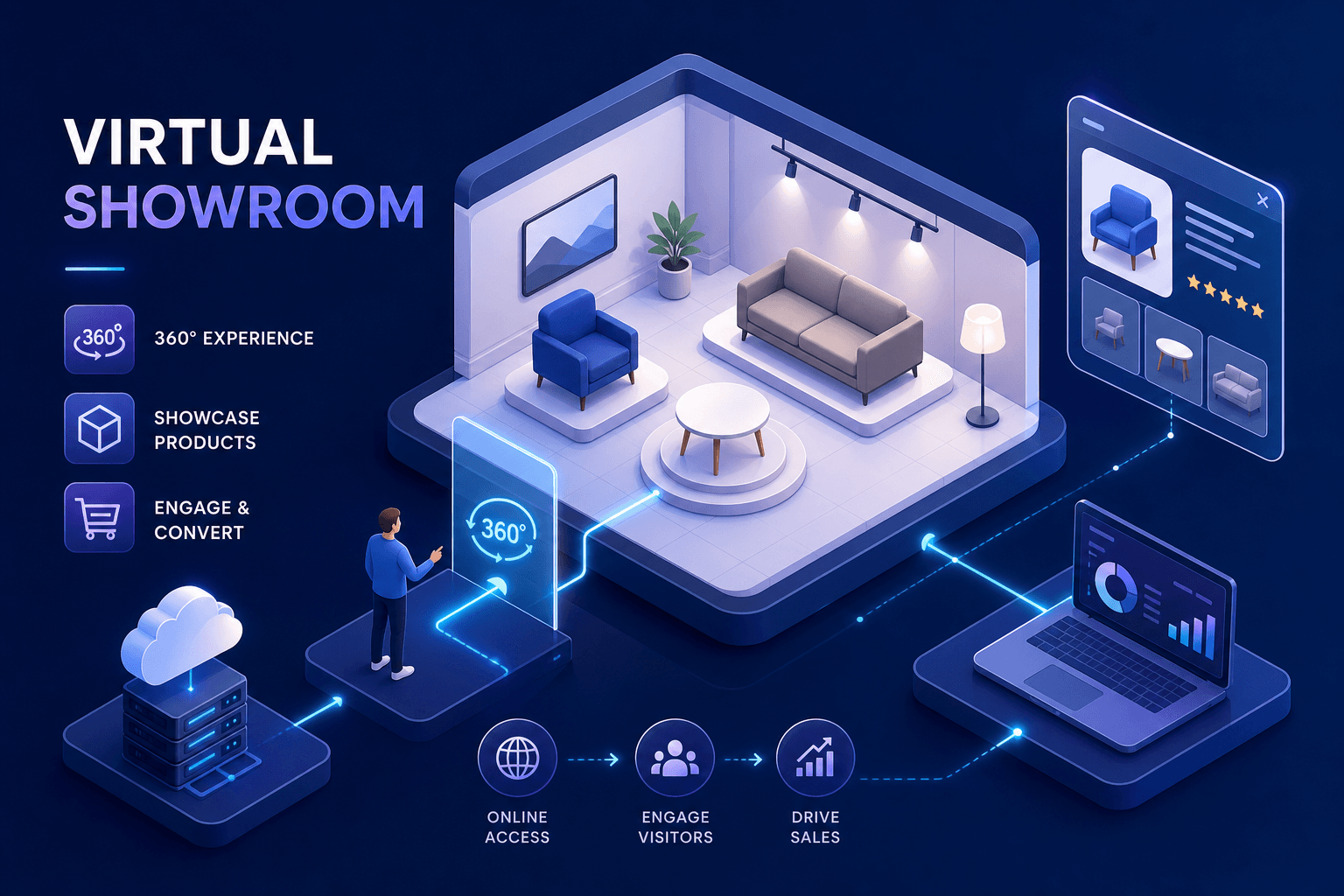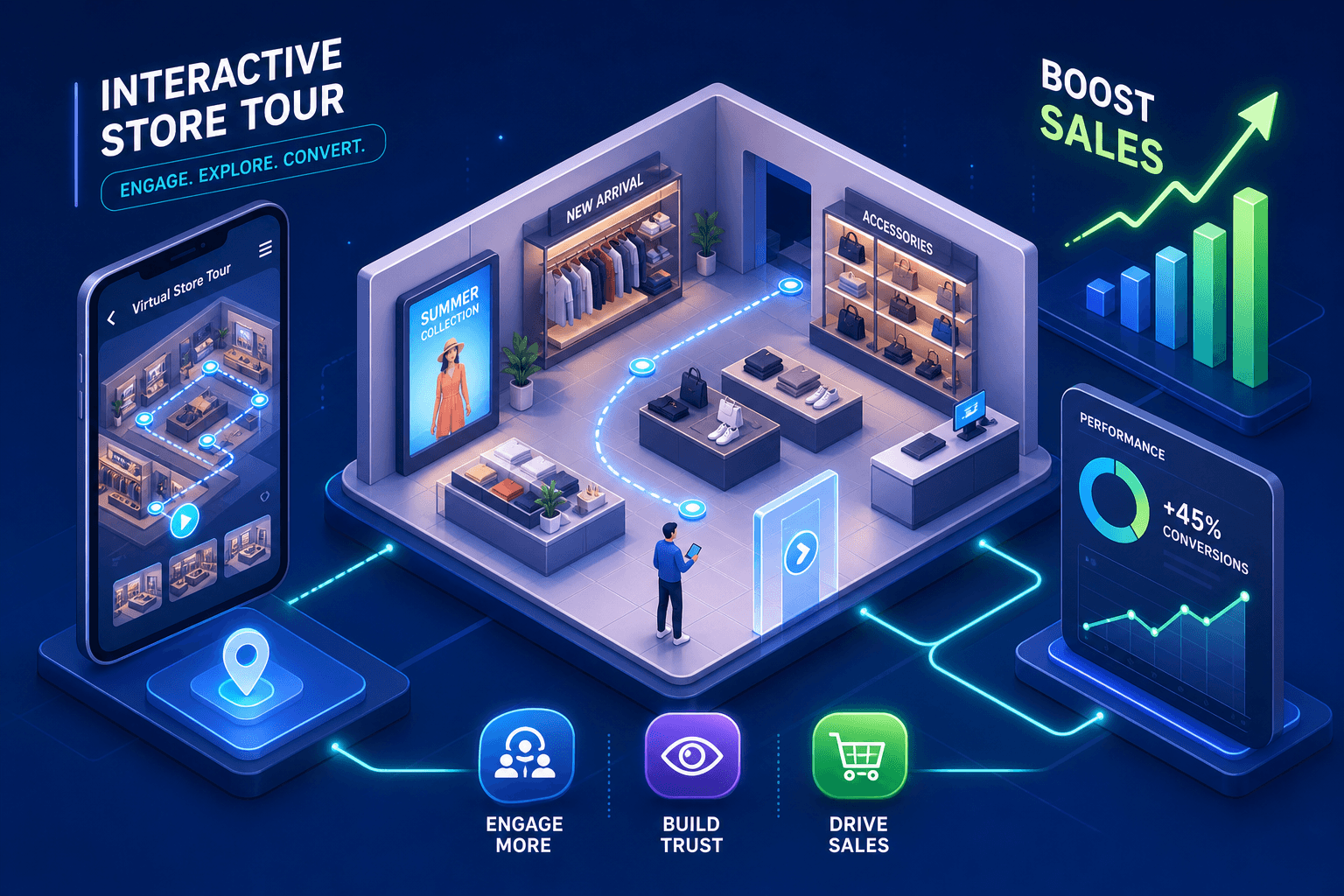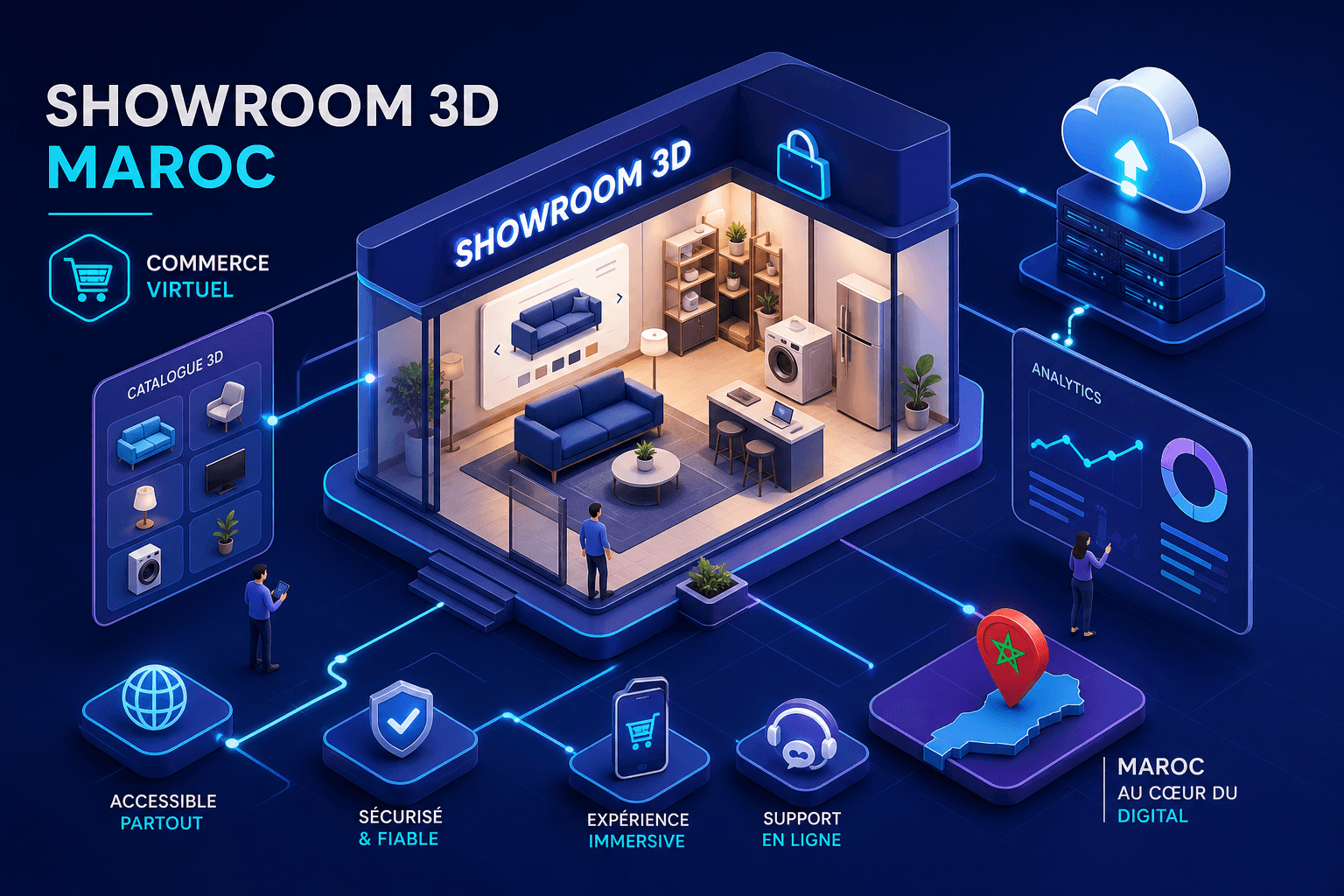
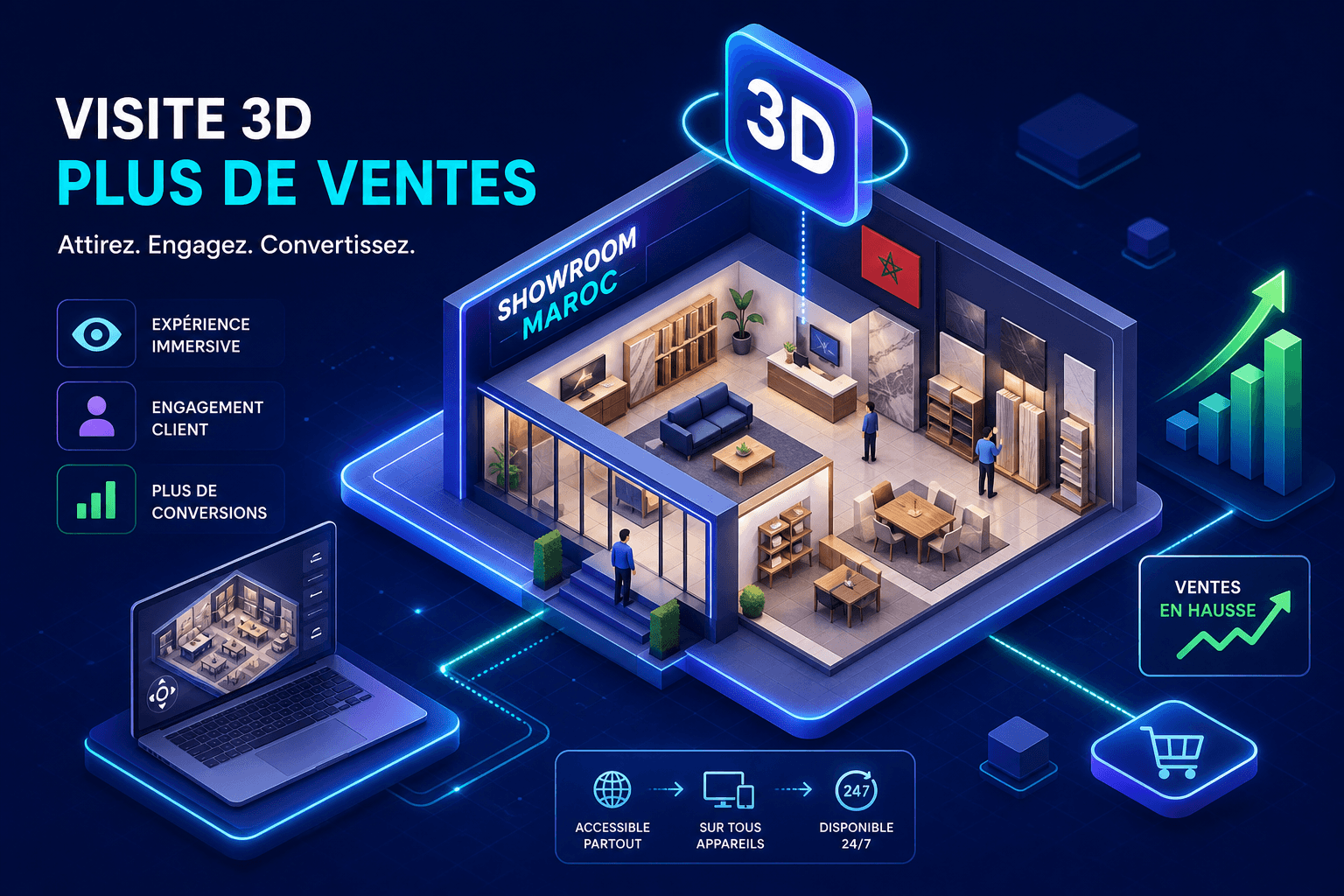
Picture a client in Casablanca looking for a high-end fitted kitchen. They land on your site, see a few photos, cannot get a clear sense of the space, and close the tab. Thirty seconds later, they are exploring a competitor's virtual showroom from their couch, clicking on the model they like, checking available finishes, and sending a quote request. This scenario plays out every day. Sixty percent of buyers research online before setting foot in a showroom, and a significant share of those who do not find an immersive experience move on to a competitor who offers one. How can a Moroccan showroom sell more with a 3D tour? The answer starts with understanding what you are losing every week without one.
At Immersio, we have worked with Moroccan showrooms for years and the finding is consistent: those that offer an interactive 3D tour sell more, faster, with fewer wasted visits. Results are measurable within the first few weeks — some clients see their first qualified inbound leads within the month following launch. This article covers everything you need to turn your physical space into a remote sales tool.
What the numbers actually say about 3D tours and sales
3D virtual tours are not a passing trend. Matterport benchmarks and several sector studies converge on the same conclusions: conversion rates increase by 30 to 50% after integrating an immersive tour. Sales close roughly 31% faster. Time spent on a site with a 3D tour is five to ten times that of a standard site. These figures deserve a nuanced reading: results vary by sector, showroom size, and distribution quality.
Another metric that speaks directly to sales teams: product returns drop by 20 to 40% in e-commerce and phygital showroom contexts, because clients arrive with a precise mental picture of what they ordered. Virtual tours for sales in Morocco make particular sense here: out-of-city buyers and Moroccans living abroad represent a growing share of distance purchase decisions, especially for high-ticket products like furniture or interior decor. Seventy percent of consumers say they feel more confident in their decision after a 3D tour, and 65% prefer exploring a space in three dimensions over standard photos. This level of confidence directly reduces friction to purchase and shortens sales cycles.
Three concrete strategies to sell more with a 3D tour
Distribute the tour everywhere your buyers are looking
A 3D tour only has value if it is visible. Embedding it on your website via an iFrame is the first step, but it is not enough. Share the link directly via WhatsApp Business with prospects, post navigation clips on Instagram and Facebook, and include the link in your email campaigns. Each channel creates a new entry point to the immersive experience — and therefore to the purchase decision. A client who explores your virtual showroom from an Instagram story arrives already engaged before ever speaking to an advisor, turning the first contact into a tailored conversation rather than a generic presentation.
Use the 3D tour to qualify prospects before the physical visit
The 3D tour works as an intelligent filter. A prospect who has already explored your space online arrives at the showroom with a clear purchase intent: they know exactly what they want to see and touch, and they come with specific questions. Field feedback from comparable showrooms points to a 40% reduction in unproductive visits after adopting a virtual tour for sales. Concretely, sending the tour link before an appointment replaces an exploratory first visit and frees up valuable sales time for your team.
Activate the tour as a salesperson available 24/7
Your physical showroom closes at 7pm. Your virtual showroom never does. A client can explore your products at 11pm from Dubai, click on a product tag of an interactive 3D mockup, check a sofa's dimensions, and leave their contact details via an embedded form. Unlike a PDF catalog or static photos, the 3D tour simulates a permanent sales presence — at no additional cost after the initial creation. It is a silent sales force working for you while your team rests.
The features that actually make a difference in a showroom tour
Interactive product tags: from click to purchase intent
Hotspots and product tags are what turn a 360° store tour into an active sales tool. In a showroom context, these are clickable points positioned on each piece of furniture or product on display, showing the spec sheet, price, available colors, and a call to action toward the contact form or quote request. Take a concrete example: a client clicks on a leather sofa in the tour, checks the dimensions and available finishes, then sends a request directly from the interface — without ever leaving the experience. This friction-free buying journey is simply not something standard photos can offer.
Tour analytics to drive your sales strategy
A well-configured 3D tour generates valuable data: time spent by zone, most visited areas, click rates on product tags. Tools like CAPTUR3D or Matterport's Mattertraffic platform go even further with heatmaps and user journey analysis. These metrics let you know which products attract the most attention online, adjust the physical layout of your showroom, and prioritize follow-ups with the most engaged prospects.
Embedded appointment forms and CTAs to capture every lead
A short form embedded directly in the tour — "Request a 3D visit" or "Get a quote" — can capture more qualified leads than those generated by a standard website, because the prospect has already interacted with your products before submitting their details. Placement is critical: position the CTA just after a product hotspot, in sticky mode on mobile, or as a contextual pop-up after a defined exploration time. A/B tests in commercial virtual reality contexts regularly show significant gains for CTAs placed directly after a product interaction, compared to those positioned at the bottom of the page.
What budget to plan and what return to expect for a Moroccan showroom
The costs of creating a 3D tour in Morocco vary by the size of your space. For a small showroom under 200 sqm, the budget runs between 1,500 and 5,000 DH. For a medium space between 200 and 1,000 sqm, expect between 5,000 and 20,000 DH. For a large showroom over 1,000 sqm, rates sit between 20,000 and 80,000 DH depending on complexity. Annual maintenance costs remain generally low: hosting is included in most Moroccan offers, limiting recurring costs to 0–5,000 DH per year depending on the provider. Note that advanced CMS customizations may require occasional technical support.
The ROI calculation method is straightforward. Identify your average basket, estimate the number of additional leads generated per month through the tour (based on the +30 to 50% conversion benchmarks), and compare against the one-off creation cost. Based on data from comparable contexts, return on investment is generally reached in 3 to 6 months depending on the sector and distribution quality — provided leads are properly handled by your sales team.
Why Immersio is the right partner for your showroom in Morocco
To illustrate what this approach looks like in practice, here is how Immersio, 3D Virtual Tours in Morocco structures each deployment. Every tour is created with Matterport technology, the global standard for immersive 3D scanning: free navigation, dollhouse view, interactive hotspots. Everything is delivered within 48 hours of the scan session, with an embeddable link ready to integrate on your site or share across all your channels. Integration is done via a simple iFrame with no development required in the vast majority of cases — for highly customized CMS setups, the team supports integration on request.
The product tag feature is integrated from creation, without going through a web developer. Every product displayed in your showroom can have its own clickable information point, configured directly in the tour. That is what makes the difference between a passive visual tour and an active sales tool capable of generating qualified leads outside your opening hours.
Immersio operates across Morocco — Marrakech, Casablanca, Fez, Rabat, Agadir, and beyond. The team understands the specific constraints of Moroccan commercial spaces: complex natural lighting, material textures, open architectures. Post-production includes AI-assisted exposure and rendering corrections for a faithful result that showcases your products as much as your space.
Your first steps to measure results from day one
Before publishing your tour, define three priority baseline indicators: the number of inbound leads via the embedded form, average tour visit time, and the conversion rate from online tour to a physical appointment. Without these initial measurements, it is impossible to evaluate the real impact. Matterport analytics provides this data natively, and third-party tools like CAPTUR3D allow more refined tracking with heatmaps and country-level views.
After the first four weeks, analyze the most explored zones to adjust your product tags, test two different positions for your main CTA, and make sure to share the tour link across all your channels simultaneously. A 3D tour improves over time if you treat it as a living tool, not a fixed photo. The data it generates gives you a precise view of what your clients actually look at — and that changes how you present your products, online and in store.
Conclusion: every week without a 3D tour is a missed opportunity
Back to the Casablanca client from the opening. What lost them was not your offer — it was the absence of an immersive experience at the moment they needed it. Understanding how a Moroccan showroom can sell more with a 3D tour is precisely how you avoid that scenario. A 3D tour is not a gimmick: it is a measurable, profitable remote sales tool, with documented results to back it up. The only condition is activating it correctly — right distribution, well-configured product tags, metrics tracked from day one.
For showrooms that want to make this move without losing time, Immersio delivers a complete 3D tour in 48 hours with all sales features built in. Depending on your average basket, a handful of additional sales is generally enough to cover the initial investment. The real question is not whether a virtual sales tour in Morocco can help you convert more — it is how many prospects you are letting slip away every week without one. 3D Tour: Showrooms & Retail — measure it for yourself.