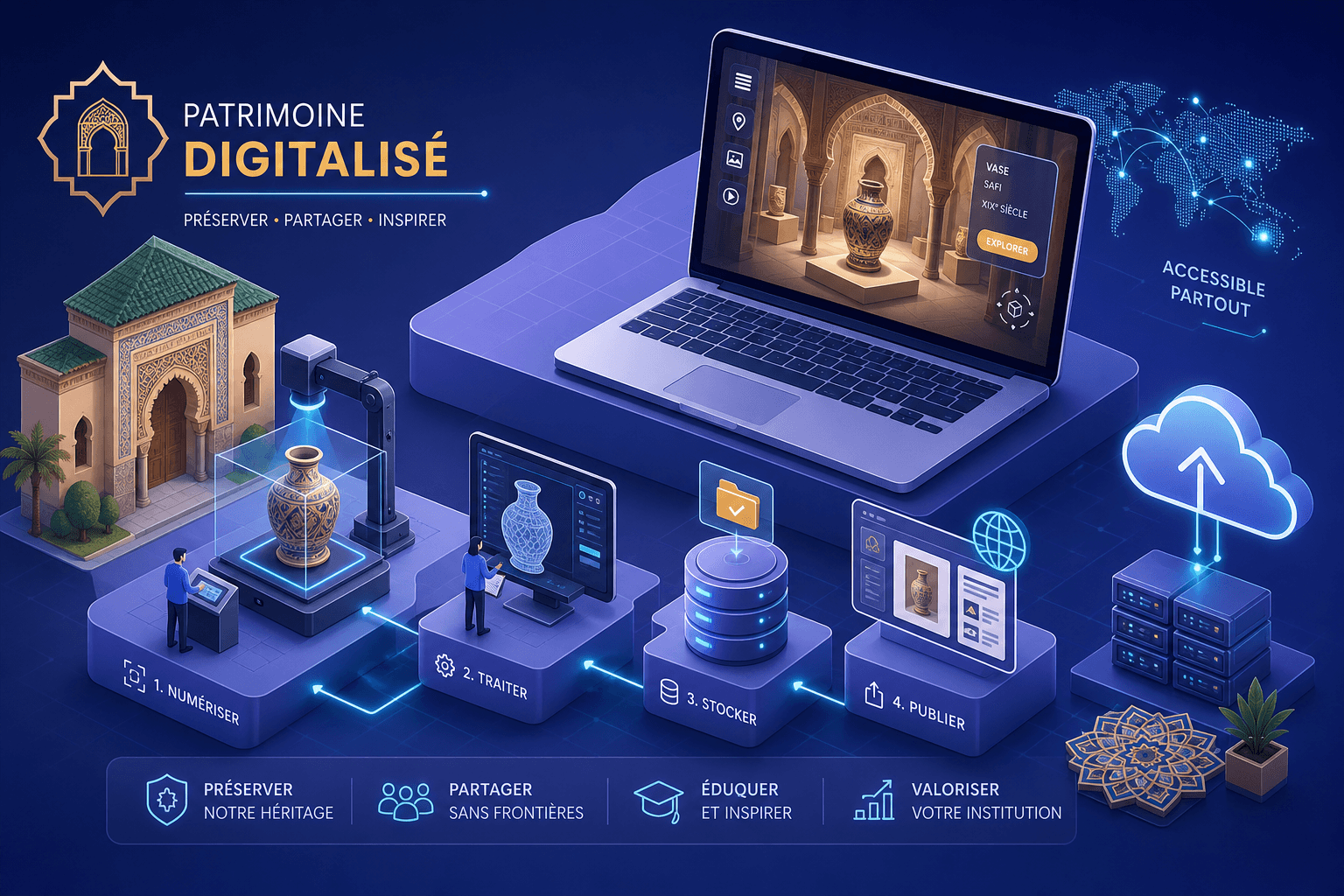
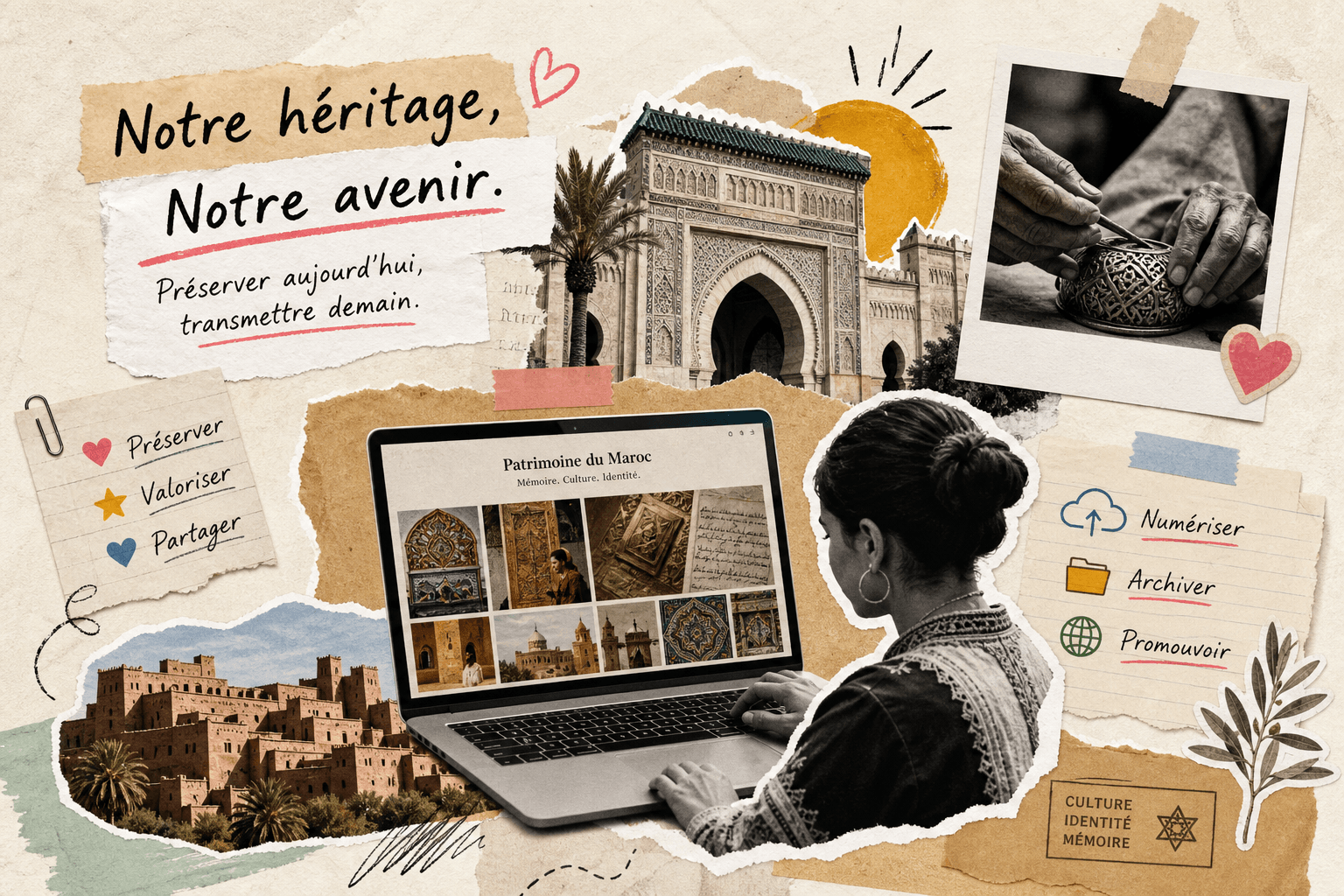
Morocco is home to nine UNESCO World Heritage sites, hundreds of thousands of ancient manuscripts, medinas that defy architectural comprehension, and kasbahs sculpted by centuries of civilization. Yet much of this heritage remains invisible to the world: degraded by time, inaccessible to the general public, and often not rigorously documented. This reality illustrates the urgency of building a digital heritage in Morocco worthy of this cultural wealth. This is not an anecdotal problem. It is an irreversible loss in progress.
Cultural digitization is no longer a luxury reserved for major European nations. It has become a survival condition for fragile heritage. In Morocco, several public and private actors have begun building the foundations of an ambitious digital conservation ecosystem. Companies like Immersio translate this national ambition into immersive experiences accessible from anywhere in the world. This article gives an honest assessment of what exists, identifies real blind spots, and proposes a concrete roadmap for those who want to act.
Digital heritage in Morocco: the major digitization projects
The history of Moroccan heritage digital conservation officially begins in 2009, with the launch of the Moroccan Digital Library (BNM) by the National Library of the Kingdom of Morocco (BNRM). Equipped with i2S scanners specifically designed for fragile documents — parchments, tissue paper — the BNRM set itself a considerable objective: digitize 80,000 manuscripts representing 200,000 titles, from the 9th century to the present day. Tangible result: 4.6 million pages digitized by 2016, accessible via the Kitab platform (kitab.bnrm.ma), which centralizes national publications since 1968.
The most recent turning point came in April 2025, at GITEX Africa in Marrakech, with the signing of an ambitious interministerial agreement. Announced objectives: 700,000 books and art objects, 100,000 ancient manuscripts, integration of the Amazigh language, and the establishment of a digital legal deposit. This project is part of the Morocco Digital 2030 strategy, supported by a global investment of 11 billion dirhams for national digital transformation.
On the museum side, the Fondation Nationale des Musées (FNM) has engaged a multi-phase digitization strategy: website redesign with AI integration, a mobile app with "smart cartels" (interactive panels in augmented reality, a first for Morocco), and immersive virtual tours. Driven by a partnership with the Orange Foundation and Moroccan startup Virtual Vision, this initiative saw notable acceleration: during the pandemic, 72.7% of Moroccan museums offered virtual experiences as part of the "Museum at Home" initiative.
From medinas to museums: when immersive tours change the game
Several Moroccan sites are already accessible online in digital form. Fort Borj Lekbir has an immersive platform consultable from anywhere in the world. Hassan II University in Casablanca, in partnership with SDL Casablanca Patrimoine, developed a virtual museum of the city. The Ministry of Youth, Culture, and Communication announced a 3D virtual access program for Moroccan historic monuments, currently in the deployment phase.
360° visit or truly immersive experience?
There is a fundamental difference between a standard 360° tour and a truly immersive experience. Some spatial digitization technologies, such as Matterport, produce a complete dollhouse view of the space, full three-dimensional free navigation, and interactive hotspots enriched with contextual information about works or architecture. The visitor can measure the real proportions of an Andalusian salon, walk through a zellige gallery, or explore the inner courtyard of a riad from their phone in Paris or Seoul. Real spatial depth, the automatic floor plan, and direct website integration clearly distinguish this approach from simple photographic panoramas.
This is precisely what Immersio's 3D Tour for Museums & Cultural Spaces offers — a Moroccan specialist in producing 3D tours for museums, galleries, historical sites, and cultural spaces across the country. With short delivery times and high-quality post-production, Immersio makes this technology accessible to institutions that have neither the resources nor the technical expertise to deploy it alone. A museum in Fez or an archaeological site like Volubilis becomes accessible from Tokyo or São Paulo — no visa, no plane ticket. For international cultural tourism, this represents a captive audience to reach before a physical trip is even considered.
Digital sovereignty and funding: the blind spots of Moroccan digital heritage
Law 05-20 on cybersecurity requires that sensitive data be hosted exclusively on Moroccan territory. For cultural institutions wishing to use international cloud platforms to archive their digitized collections, this creates a real legal tension. The Moroccan sovereign cloud project exists but is not yet fully funded. The concrete risk: collections representing national identity hosted on foreign infrastructure, with all the dependency and sustainability questions this implies.
The funding question is equally critical. Several national mechanisms present documented gaps when it comes to cultural heritage: Morocco Digital 2030 mobilizes massive budgets but without a dedicated line for heritage institutions; MOWAKABA funds SME digitization, not museums or libraries; the national AI strategy remains disconnected from heritage issues. The direct recommendation: future calls for projects from the Public Administration Modernization Fund (FOMAP) must explicitly integrate cultural heritage digitization as an eligible priority. Without this policy decision, initiatives will remain fragmented and dependent on one-off partnerships.
Technical standards: the foundations of a lasting cultural archive
A digital conservation project without solid technical standards is an archive with a limited lifespan. The international reference standards cover two main families. For metadata, Dublin Core provides basic information (title, creator, date, subject) for any digitized object; IIIF (International Image Interoperability Framework) allows interoperable access to images with zoom and annotations; METS encapsulates metadata and files with full traceability.
File formats and long-term archiving
For file formats, uncompressed TIFF or JPEG2000 are the standard for image archiving, while PDF/A suits text documents. The OAIS model (ISO 14721) remains the absolute reference for long-term archiving systems. These practices are recommended by UNESCO and adopted by BNRM partner institutions like the Bibliothèque nationale de France; their systematic application in the Moroccan context remains uneven across institutions.
The BNRM broadly aligns with these practices, notably through its partnerships with the BNF and UNESCO recommendations. Digitized and accessible collections are documented on the BNRM site, illustrating the scale of work already done (digitized BNRM collections). But the absence of a formal national framework creates significant disparities between institutions. Independent museums and galleries often operate without connection to major international databases like Europeana, limiting the international visibility of digitized heritage.
Roadmap: designing a heritage digitization project in Morocco
Before choosing any technology, an institution must clarify governance. Who holds the digital rights over the collections? Who validates content published online? Who chooses and manages the hosting infrastructure? These questions, addressed too late, block entire projects. Involving the relevant ministries (Culture, Digital Transition), local communities, and technical experts from the start is not a formality — it is a success condition. Hosting infrastructure must be chosen in compliance with Law 05-20.
Format choices then depend on the primary objective. For a long-term conservation project, the TIFF + METS + Dublin Core combination is the minimum foundation. For an international promotion and public access project, immersive virtual tours with IIIF integration and an embeddable link on the institutional site are the most effective tool. These two approaches do not exclude each other — they complement naturally.
Finally, no project should start without defining its impact metrics from day one:
- Number of virtual visits per month and average engagement duration
- Geographic origin of digital visitors
- Conversion rate between virtual discovery and subsequent physical visit
- Growth of international institutional partnerships generated by digital visibility
These data points guide future funding decisions and justify partnerships with institutions like Europeana, UNESCO, or foreign universities.
Moroccan cultural heritage on the world stage
Digitization does not only serve conservation. It propels Moroccan heritage into the homes of visitors on every continent. A cultural tourist who virtually explores the medina of Fez or the Roman ruins of Volubilis from home is already a future traveler. They can also become an ambassador, a financial supporter, or an influencer within their network. Digital allows reaching this global audience directly, at a fraction of the cost of a traditional international promotion campaign.
Morocco has real assets to take African leadership in this area: advanced digital infrastructure relative to the continental context, an undeniable UNESCO heritage wealth, and an ecosystem of tech startups capable of executing high-quality projects. The 2025 BNRM agreement, the ambitions of Morocco Digital 2030, and field operators like Immersio together lay the conditions for cultural influence befitting what Morocco has to offer the world.
The digitization of Moroccan digital heritage is no longer a question of will — it is a question of concrete choices: which tools, which standards, which funding, and which actors to implement them. The foundations are set. The construction has only just begun.