How many visitors does your institution lose every year simply because they cannot travel to Marrakech, Fez, or Casablanca? For a museum in Morocco, creating a virtual museum is today the most direct answer to that question. A researcher in Berlin or an art history student in Tokyo — these audiences exist, they seek quality cultural content online, and the vast majority will never walk through your physical doors. The reality is hard to avoid: for a large share of the world's audiences, an institution without a digital presence is an invisible one.
The good news is that the technology to fix this is accessible in Morocco right now. Providers like Immersio allow Moroccan museums and heritage institutions to create virtual tour experiences at the standard of the world's greatest institutions, using Matterport technology. In this article, we explore why digitization has become unavoidable for any virtual museum in Morocco, what the country has already built, and how your institution can make this move concretely.
Why cultural institutions can no longer ignore digital
The 2020 pandemic acted as a brutal wake-up call. What was a "someday" project became an operational urgency within weeks. Museums that had invested in online experiences maintained a connection with their audiences; according to several post-COVID sector reports, their online engagement rate was incomparably higher than that of institutions without a digital presence, which disappeared from the radar for months. Since then, visitor behavior has durably changed: post-pandemic attendance data from many European museums shows that a growing share of the public researches and explores online before deciding to make the trip.
The geographic reach argument is even more decisive for a Moroccan institution. A physical museum in Fez naturally reaches local visitors and a few passing tourists. A Moroccan digital museum reaches thousands of people simultaneously, 24 hours a day, with no calendar or capacity constraints. In September 2025, UNESCO itself took this step by launching its own virtual museum at MONDIACULT 2025 in Barcelona — a global platform using 3D and virtual reality to document stolen cultural objects. You can consult the UNESCO virtual museum launch and coverage in The Art Newspaper. If the world's most influential cultural organization is investing in this format, it is not a signal to ignore — it is what reference institutions are doing, right now.
What major museums proved by opening their doors online
The Louvre, the Rijksmuseum in Amsterdam, the Smithsonian Institution — these institutions did not launch virtual tours as a technological whim. They responded to real demand and the results were immediate. During pandemic closures, the Louvre recorded an average of 330,000 virtual visits per week in the first weeks, with 100% non-French-speaking visitors. This figure illustrates a simple phenomenon: digital does not replace the physical visit — it opens a door to audiences who would never have made the trip.
The Rijksmuseum went even further with an ultra-high-resolution digitization of Rembrandt's Night Watch, enabling pixel-by-pixel exploration unavailable even in the physical gallery. Google Arts & Culture now aggregates over 2,000 cultural institutions worldwide, with over 1,800 immersive Street View tours available for free.
These initiatives transformed museums into permanent global cultural destinations. The structural benefits are real: partnerships with foreign universities, increased visibility in the international specialist press, and new revenue streams through paid-access virtual exhibitions for some institutions. These results are not reserved for major European institutions — they are accessible to any museum ready to take the step.
Why a virtual museum in Morocco is an opportunity to seize now
The national momentum is real. In April 2026, the Fondation Nationale des Musées (FNM) and the Fondation Orange Maroc formalized a museum digitization partnership, led by Moroccan startup Virtual Vision. This project rolls out in several phases: redesign of the FNM website with AI integration, creation of dedicated pages per museum, development of a mobile app with interactive "smart cartels," and virtual tours of permanent and temporary exhibitions. The pilot example, the Mohammed VI Museum of Modern and Contemporary Art, is a concrete first milestone.
Other projects complete the picture. The Virtual Maritime Museum of Morocco (museemaritime.ma), operational since late 2025, is the first fully online museum in the country, dedicated to Moroccan maritime history with digitized archives, photos, and artifacts. In Casablanca, the Living Lab led by SDL Casablanca Patrimoine and Hassan II University aims to reconstruct in 3D disappeared sites including the old medina and the Habous district. In 2026, Minister Mehdi Bensaid announced virtual 3D access to historic monuments for Moroccans and foreign tourists.
The momentum is there, but a significant gap still exists between what is announced and what is delivered at international standard. That gap is precisely the opportunity for institutions ready to act now rather than wait for the market to force them.
The technology that changes everything: Matterport vs 360° photography
Not all online tour formats are equal, and the difference is immediately perceptible to the visitor. A standard 360° tour assembles panoramic photos between which the user "jumps" from one fixed point to another. It is better than nothing, but it conveys neither spatial depth nor the real sensation of walking through a gallery. Matterport technology works differently: a camera equipped with infrared and LiDAR sensors simultaneously captures both the image and the geometry of the space, automatically generating a complete three-dimensional model.
For a museum, the advantages are concrete and measurable. The dollhouse view allows an online visitor to fly over all the galleries in an aerial view to understand the layout of the spaces before entering virtually. Interactive hotspots serve as clickable digital labels, embedding texts, sounds, videos, or artwork descriptions directly in the 3D environment. The automatically generated floor plan offers centimeter-level precision useful for both cultural mediation and digital heritage documentation. This is the difference between a tour that gives the visitor a genuine sense of presence, and a series of stitched-together photos.
These features — free navigation, dollhouse view, editorial hotspots, and interactive floor plan — are produced automatically by Matterport technology and delivered as an embeddable link, ready to integrate directly on your institution's website. Immersio deploys this technology for Moroccan cultural spaces, supporting each project from the editorial preparation phase through to final delivery.
Steps to create a virtual museum in Morocco: the concrete process
Editorial preparation
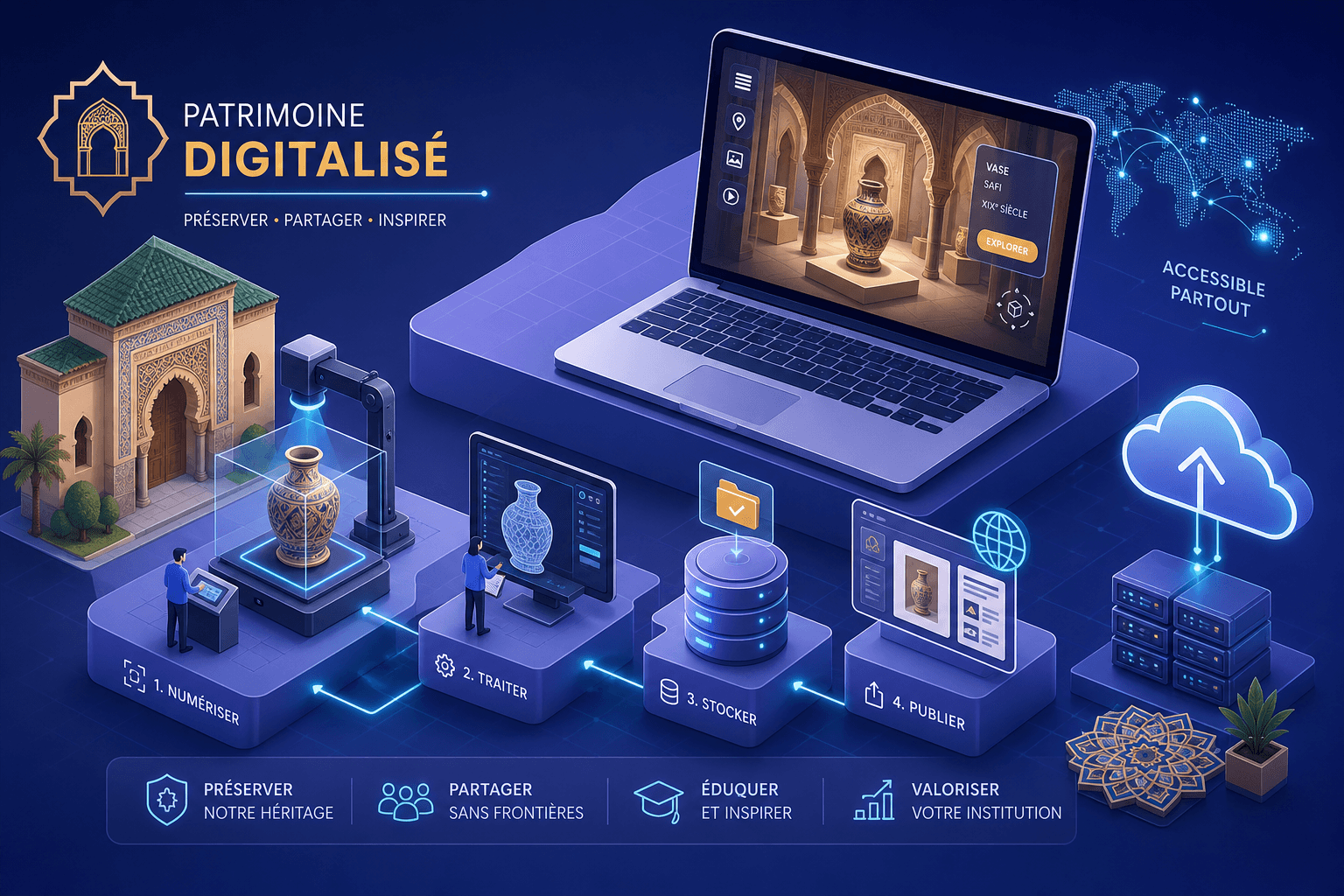
The process is simpler than most institutions imagine. It starts with an audit of the spaces to capture: which galleries, in what logical visit order, which hotspots to plan for the most significant works or objects. This preparation phase, conducted in collaboration with the provider, can last from a few hours to a day depending on the museum's size and complexity. It determines the narrative quality of the final result, because a technically perfect scan without prior editorial thinking produces a cold and unengaging tour.
On-site capture
The on-site scan session generally takes a few hours for a standard-sized space — the exact duration varies by floor area and room configuration. The Matterport camera is positioned at regular intervals in each gallery, simultaneously capturing both image and spatial depth. No permanent installation is required, and the museum can reopen the following day without constraint.
Post-production and delivery
The post-production phase refines the render, integrates editorial hotspots, and prepares the final link. Timelines vary by content volume and requested integration complexity — generally allow a few business days for a complete project. The result is delivered as an embeddable link compatible with most websites and social networks. For distribution on specialist cultural platforms like Google Arts & Culture, additional steps may be needed depending on each platform's specific requirements.
The real benefits once your museum is online
The most obvious impact is geographic: your institution becomes accessible to a cultural journalist in New York preparing an article on Moroccan digital heritage, to a school group in South Korea, to a master's student in Islamic history at the University of Berlin — at 3am on a Sunday. This permanent presence generates structural opportunities that physical existence alone cannot provide: partnerships with foreign universities, integration into international educational programs, visibility in specialist publications that do not travel for their reporting.
Heritage benefits are often underestimated in this debate. A Matterport scan constitutes a precision documentary archive of your space as it exists today — invaluable in the event of a fire, renovation, or future restoration work. Hotspots enriched with descriptions and audio-visual content turn the virtual exhibition into a concrete educational tool for Moroccan and foreign schools. Some international institutions have also developed paid-access temporary virtual exhibitions — a supplementary revenue stream worth exploring at the Moroccan scale, depending on each institution's audience and model. Digitization is not a cost: it is a cultural infrastructure that works for your institution around the clock.
The question is no longer "if" but "when"
Virtual museums are no longer a futuristic option reserved for large institutions with exceptional budgets. They have become a baseline infrastructure for any Moroccan digital museum that wants to exist beyond its physical walls. Morocco has clearly begun this turn: public-private partnerships are active, ministerial announcements have followed, and the first operational projects demonstrate that political will exists. But the window to position ahead of this movement remains open for institutions that act now.
Ready to create your virtual museum in Morocco? Immersio supports Moroccan cultural institutions at every stage of their digitization — from the initial editorial audit to the delivery of an international-standard virtual tour experience. Tell us about your space: together we will build a digitization plan tailored to your reality. Discover our 3D tour services for museums and cultural spaces.