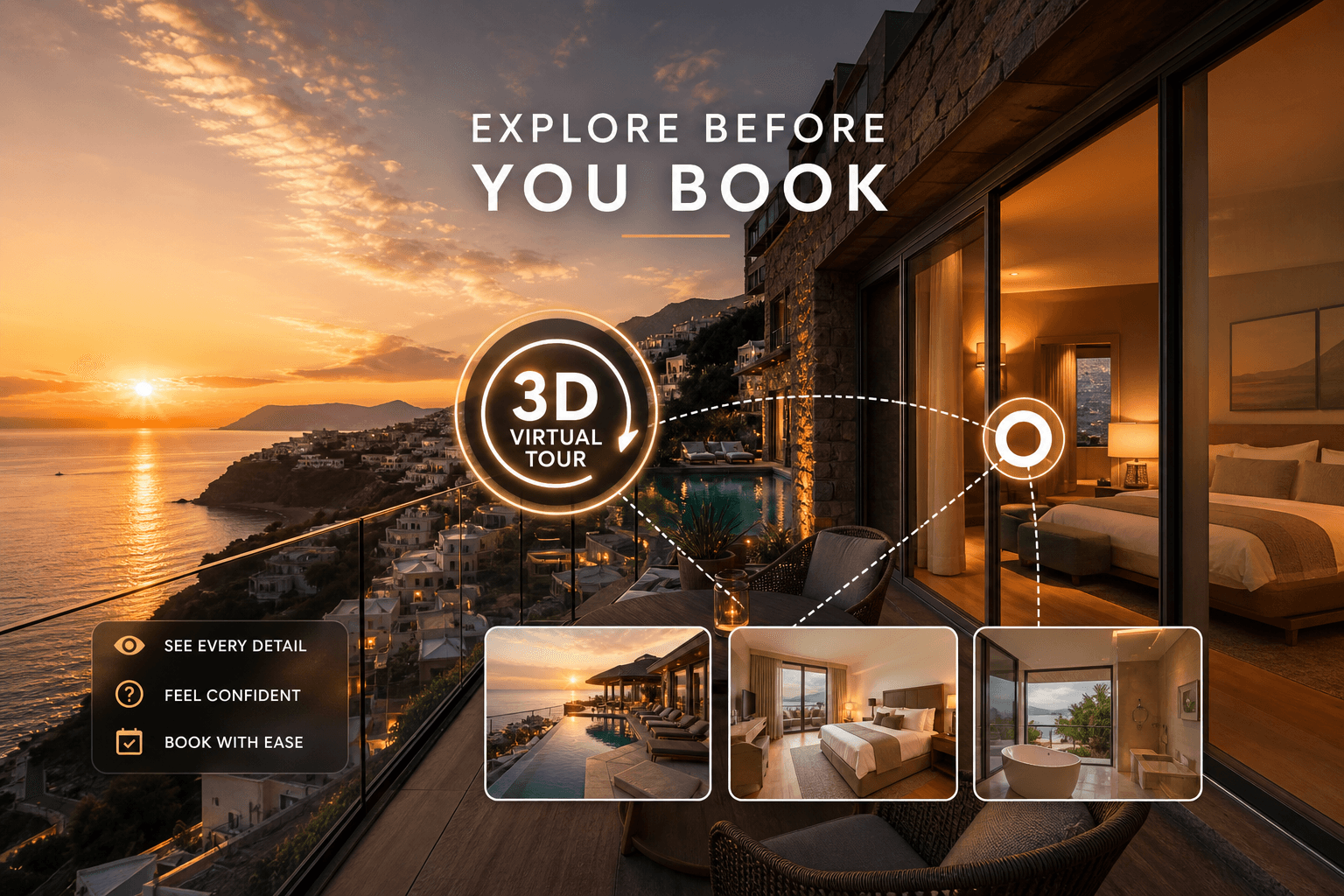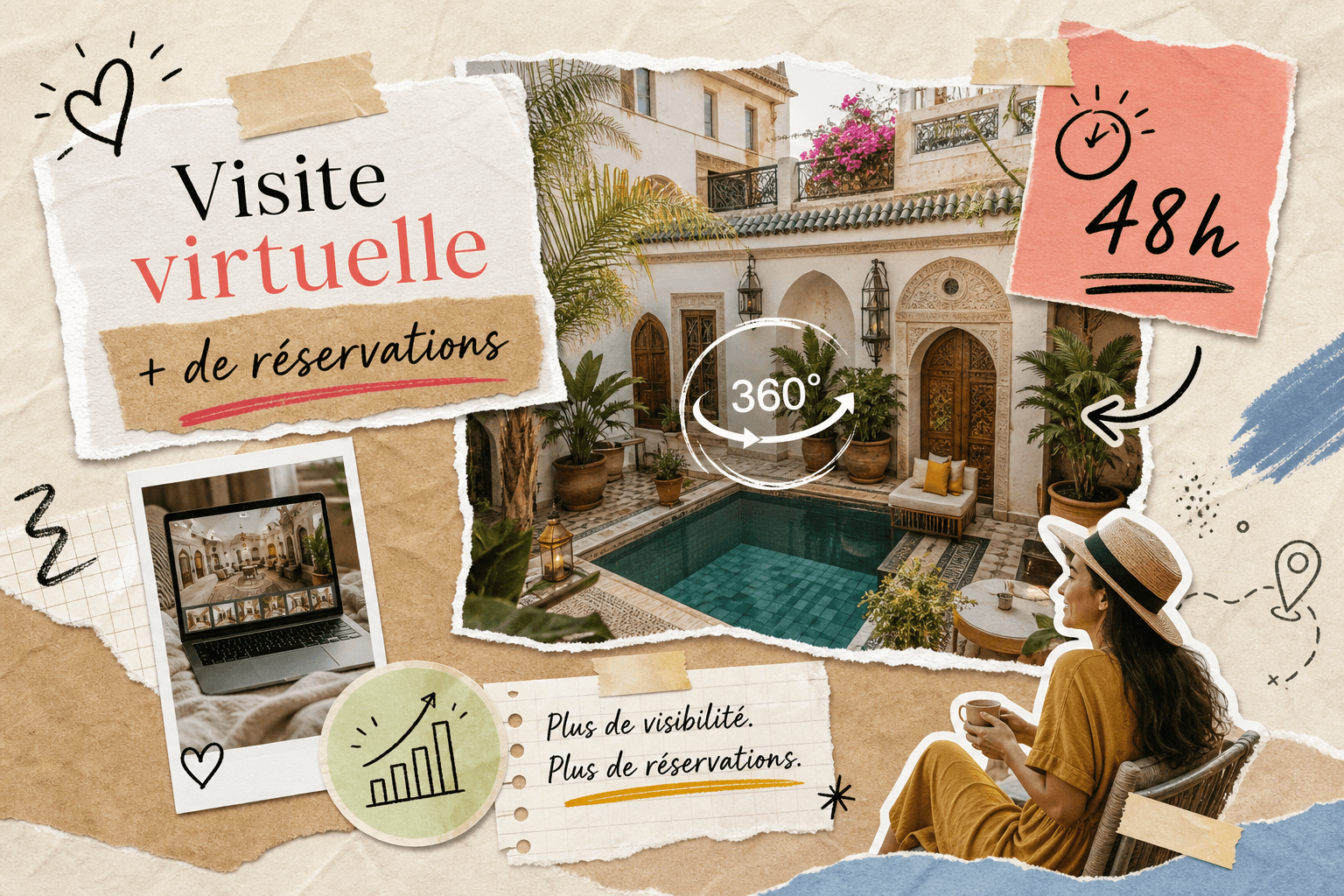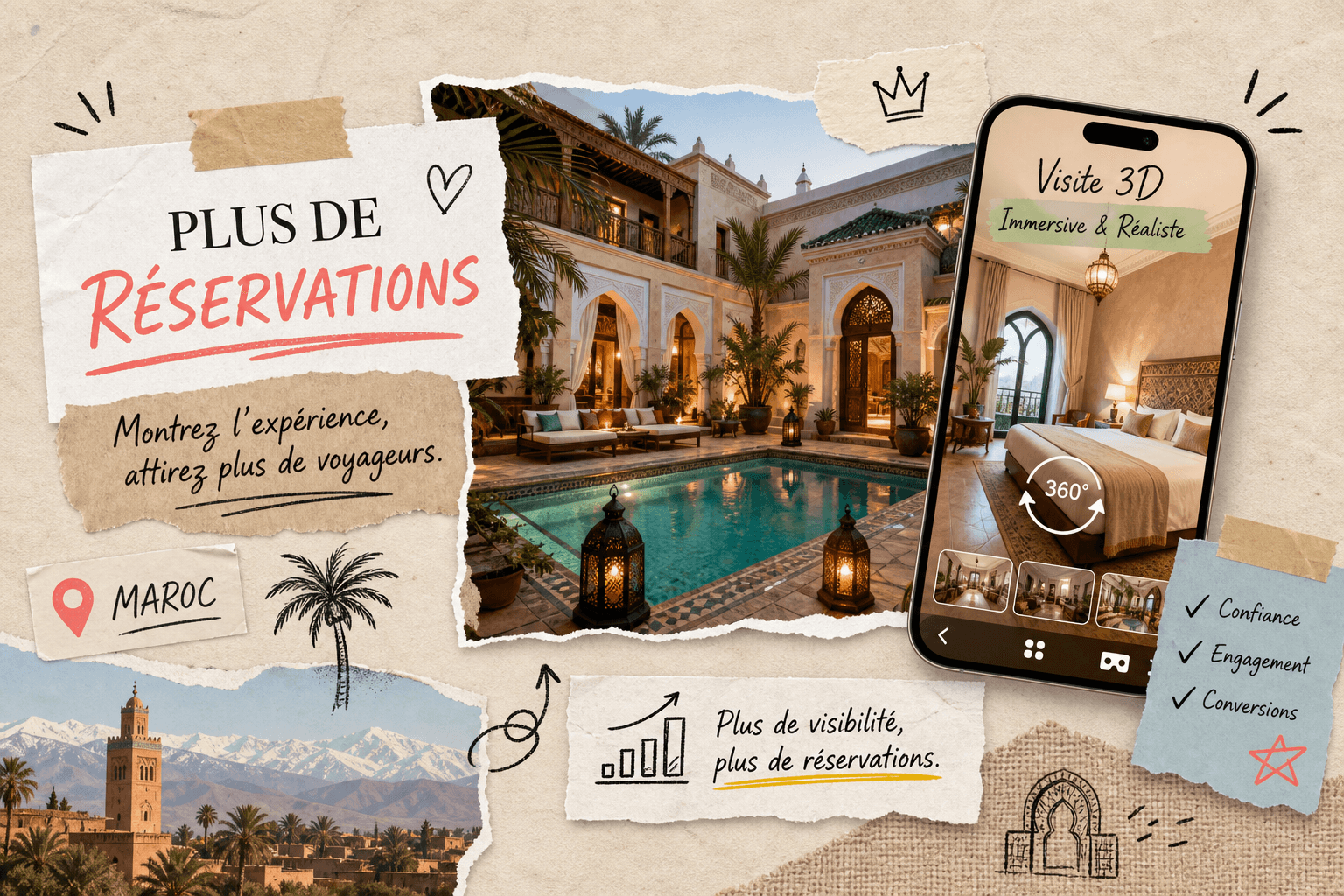
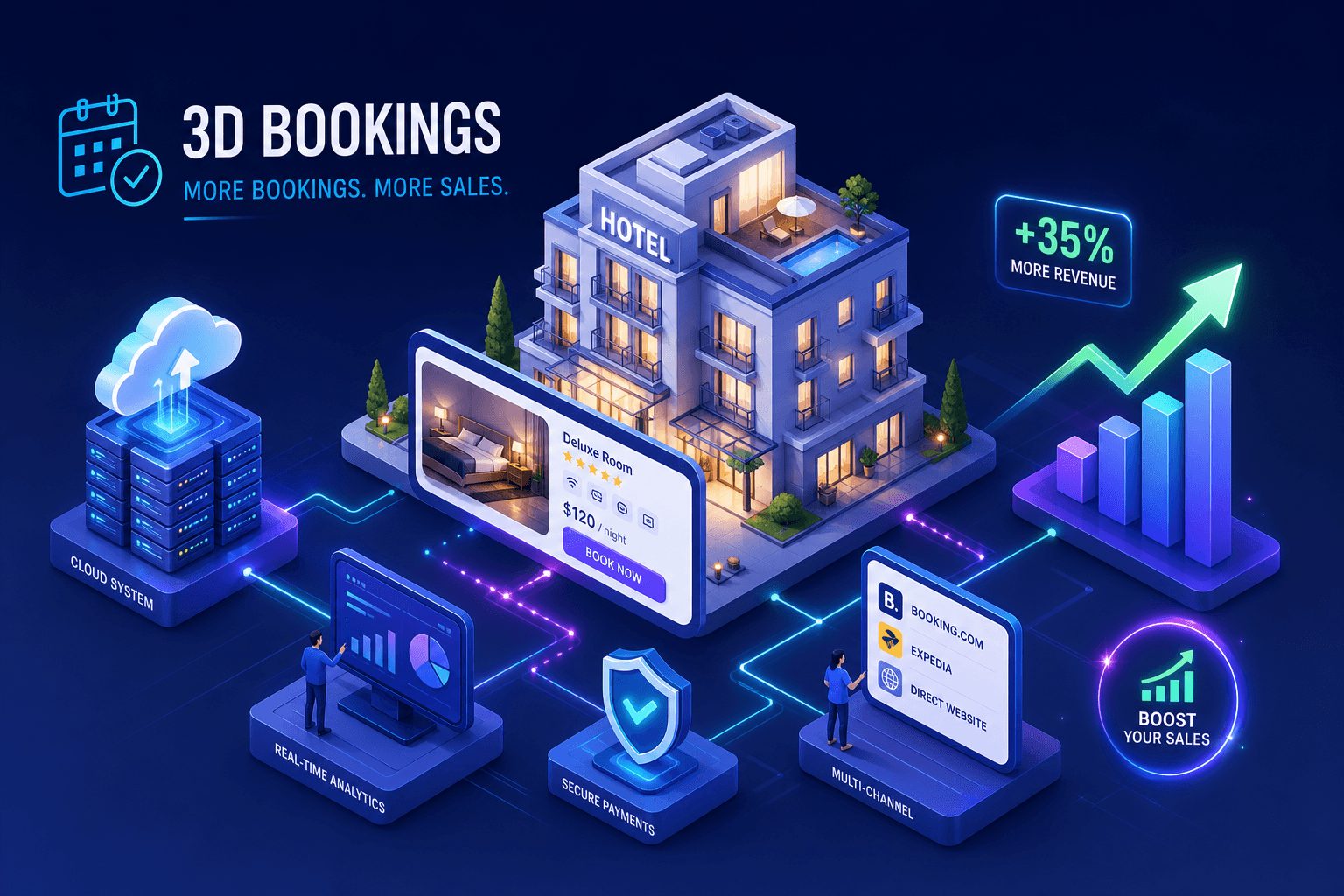
In 2026, a traveler hesitating between two hotels almost always chooses the one they have already explored online. This is not a hunch — it is backed by data. Hotel 3D bookings, meaning bookings generated through an interactive immersive tour, increase on average by 48% compared to properties that still rely solely on static photos. The difference is considerable and shows directly on net revenue.
The idea is not to replace your photos. It is to give future clients something photos cannot offer: the feeling of already being in your corridors, your lobby, your room with a rooftop view. This article explains how 3D virtual tours work, why they convert, and how to integrate them concretely on your site, your Google listing, and your booking platforms.
How hotel 3D bookings increase your revenue
The 2026 sector data all points in the same direction: hospitality properties that integrate a 360° virtual tour on their site record an average of 48% more bookings compared to those that do not. In some configurations, the gain reaches 52%, according to data published by Visiting Media across a panel of several hundred properties of varying sizes and categories.
Google My Business listings tell the same story. A listing enriched with a 360° virtual tour generates 35% more clicks toward the direct booking platform. Users spend twice as long on the listing, and properties using this format are perceived as more credible by 18-to-34-year-old travelers — a segment that now accounts for the majority of online bookings.
Fewer cancellations: an often-underestimated benefit
The impact on cancellations is probably the least-discussed benefit, yet one of the most valuable. Hotels using 360° virtual tours see an average of 28% fewer cancellations — the rate dropping from 18% to 13%. The mechanism is simple. A client who has already freely navigated your spaces, room by room, arrives with expectations aligned with reality. No bad surprises, no disappointment. This result directly impacts net revenue, not just gross booking volume.
Why the modern traveler books with their eyes
The main barrier to direct booking is not price. It is doubt. Photos can be retouched, descriptions can stay vague, angles carefully chosen to hide what is unflattering. A traveler who cannot feel the space before committing will compare indefinitely, or end up going through an OTA where they feel less exposed to risk. The 3D tour removes this doubt by offering free navigation, at any hour, from any device.
This mechanism is well established in consumer behavior research: when a future client explores your reception, your suite, your terrace as if they were there, they build familiarity with your property. That familiarity generates confidence, and confidence shortens the decision cycle. Time spent on a page integrating an immersive tour is multiplied by 5 to 10 compared to a standard photo page, with a direct and measurable SEO impact on Google ranking.
Which technical solution to choose for your profile
Three platforms dominate the market in 2026, with very different positioning. Understanding their distinctions will prevent you from investing in the wrong tool.
- Matterport: the reference for upscale hotels and palaces. Signature dollhouse view, interactive hotspots, automatically generated floor plans, photorealistic quality at 134 megapixels. Equipment investment and pricing structure are enterprise-oriented.
- Kuula: affordable, ideal for small properties already equipped with 360° gear. No real 3D depth, but smooth mobile navigation and a short learning curve.
- Panoee: the only platform with an unlimited, watermark-free free plan. Seven hotspot types, offline export possible. A good entry point for testing before investing in a more complete solution.
Why most hotels use a specialized provider
Choosing and operating a professional-grade 3D solution requires equipment, post-production, and technical integration that virtually no hotel team has the time or resources to manage in-house. The result of a scan carried out without mastery of light, angles, and image processing is often disappointing compared to existing photos. Technology alone is not enough: capture expertise is what makes the difference between a functional tour and a genuine sales tool.
This is the problem Immersio solves upfront: you get a complete Matterport tour, carefully post-produced and ready to integrate, without touching the technical side. The hotelier focuses on their business while the technology works for them, and hotel 3D bookings start converting. Discover our dedicated offerings for properties at 3D Tour: Hotels & Residences.
What Immersio delivers concretely in 48 hours
The process is designed to be friction-free. The Immersio team travels on-site with Matterport technology, scans all spaces — rooms, lobby, event spaces, terraces, gardens — and delivers 48 hours later an embeddable link directly integrable on the property's site and booking platforms. Each scan automatically generates free navigation, a dollhouse view, and interactive hotspots. National coverage: Marrakech, Fez, Casablanca, Rabat, Agadir.
What distinguishes Immersio from a generic provider is knowledge of Moroccan architectural specificities. A riad, a patio, a medina have their own natural light logic: strong contrasts, interior spaces open to the sky, a depth that flat photos do not convey. Knowing where to position scan points, how to handle light transitions, how to guide the eye toward what makes the space unique — this is what turns a technical tour into an authentic sales tool.
Integrating your 3D tour without sacrificing mobile performance
A poorly integrated 3D tour can slow down your page and hurt your SEO. In practice, correct integration comes down to three technical rules. The iFrame integration should use the loading="lazy" attribute to load the tour only when the user scrolls down to it. This keeps the LCP (Largest Contentful Paint) under 2.5 seconds, the threshold Google requires for a good mobile score.
Integration for hotel 3D bookings on Google Maps and other channels
For your distribution strategy, the priority order is clear:
- Your Google My Business listing: the 360° tour appears directly in Google Maps and generates 35% more clicks toward your direct booking site — an immediate gain on your most profitable channel.
- The room page or homepage of your official site, via iFrame with a CTA or pop-up to avoid auto-loading.
- Shareable links in your email campaigns and on social media, to extend exposure time to your space.
Add descriptive alt text tags on fallback images and a LodgingBusiness Schema markup including the tour URL. These elements help Google understand the interactive content and correctly index it in rich results.
Estimating return on investment before you start
The cost of a professional 3D tour for a hotel of 20 to 100 rooms ranges from €2,500 to €8,000 ex-VAT in Europe, with a realistic breakdown: photography between €1,000 and €3,000, post-production between €800 and €3,000, hosting and integration between €500 and €2,000. In Morocco, rates are structurally more accessible for an equivalent quality level, which mechanically improves the investment-to-return ratio. Requesting a personalized quote remains the only way to get a precise estimate based on the size and complexity of your property.
The profitability calculation is straightforward. A 30-room hotel at €120/night that currently generates 40 direct bookings per month produces €4,800/month via its direct channel. A 30% increase represents 12 additional bookings — €1,440 in additional monthly revenue. At this rate, a professional 3D tour pays for itself in 2 to 4 months. This is not a marketing expense with uncertain returns — it is a sales tool with measurable payback, and hotel 3D bookings are the best illustration.
FAQ: hotel 3D bookings, your most common questions
How does a 3D tour increase hotel bookings?
By removing the main barrier to direct booking: doubt. A traveler who freely explores your spaces before booking arrives with expectations aligned to reality, which reduces hesitation, shortens the decision cycle, and decreases cancellations.
How long does it take to produce a hotel 3D tour?
With Immersio, the on-site scan takes one day and the complete tour is delivered within 48 hours — ready to integrate on your site and booking platforms.
Does a 3D tour work for small hotels and riads?
Yes. Immersive formats are particularly effective for independent properties whose unique spaces — patios, terraces, Moroccan architecture — are difficult to convey in photos. That is precisely where a 3D tour creates the most commercial value.
What is the impact on Google ranking?
A properly integrated 3D tour improves time on page, reduces bounce rate, and strengthens the Google My Business listing — three signals that directly influence local ranking. The LodgingBusiness Schema markup also allows you to appear in rich results.
The real question is no longer "if" but "when"
Technology does not change what travelers are looking for: they want to feel confident before clicking "book." What evolves, year on year, is their tolerance for uncertainty. It decreases. 3D tours are no longer a competitive advantage reserved for major international chains — they are becoming the standard expected by travelers accustomed to exploring before buying.
If you manage a hotel, riad, or palace in Morocco, the data has already answered the question of usefulness. One question remains to settle: the launch date. To start generating hotel 3D bookings and measure the impact from the moment it goes live, contact the Immersio team — the tour is delivered in 48 hours, and your direct booking channel starts benefiting immediately.