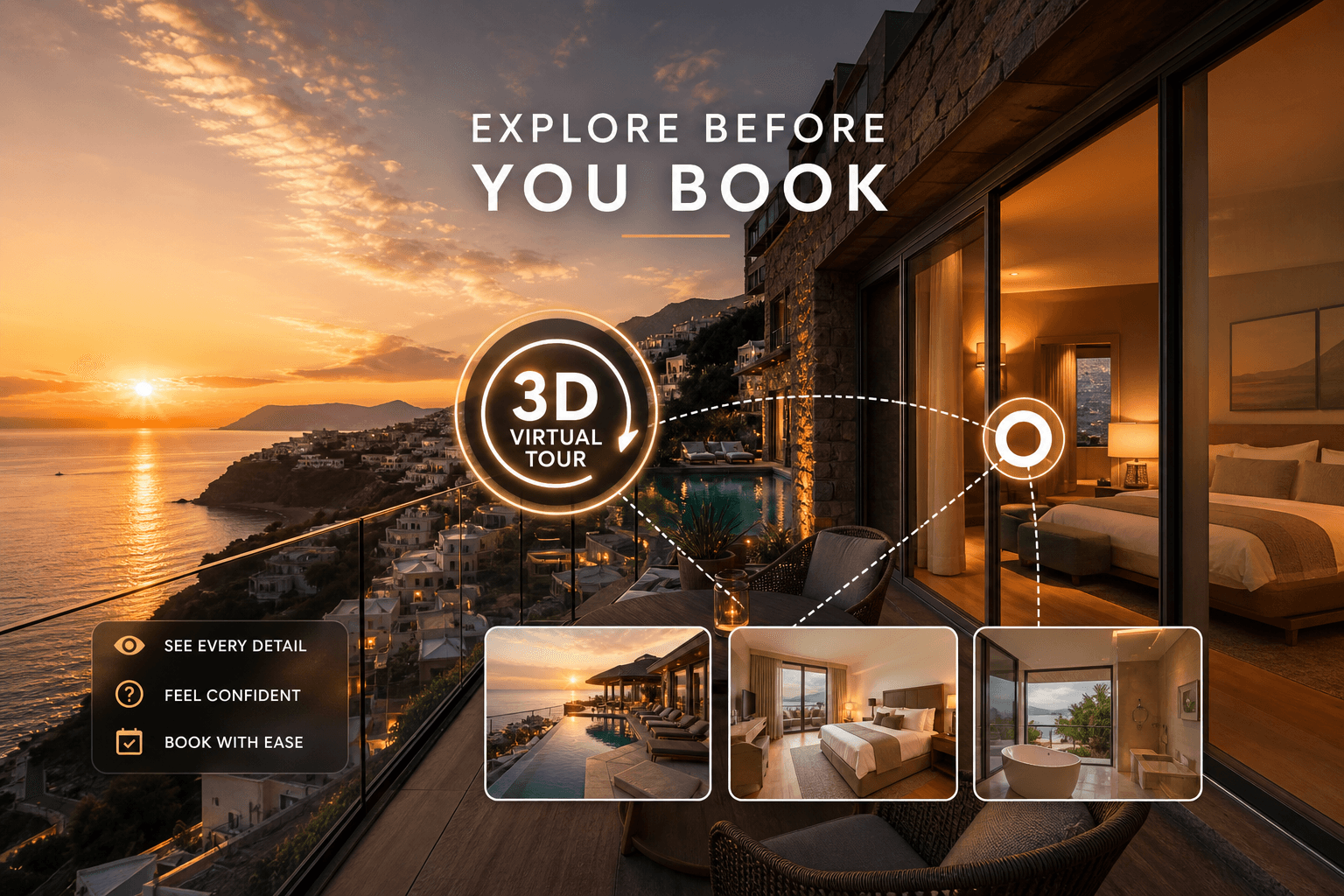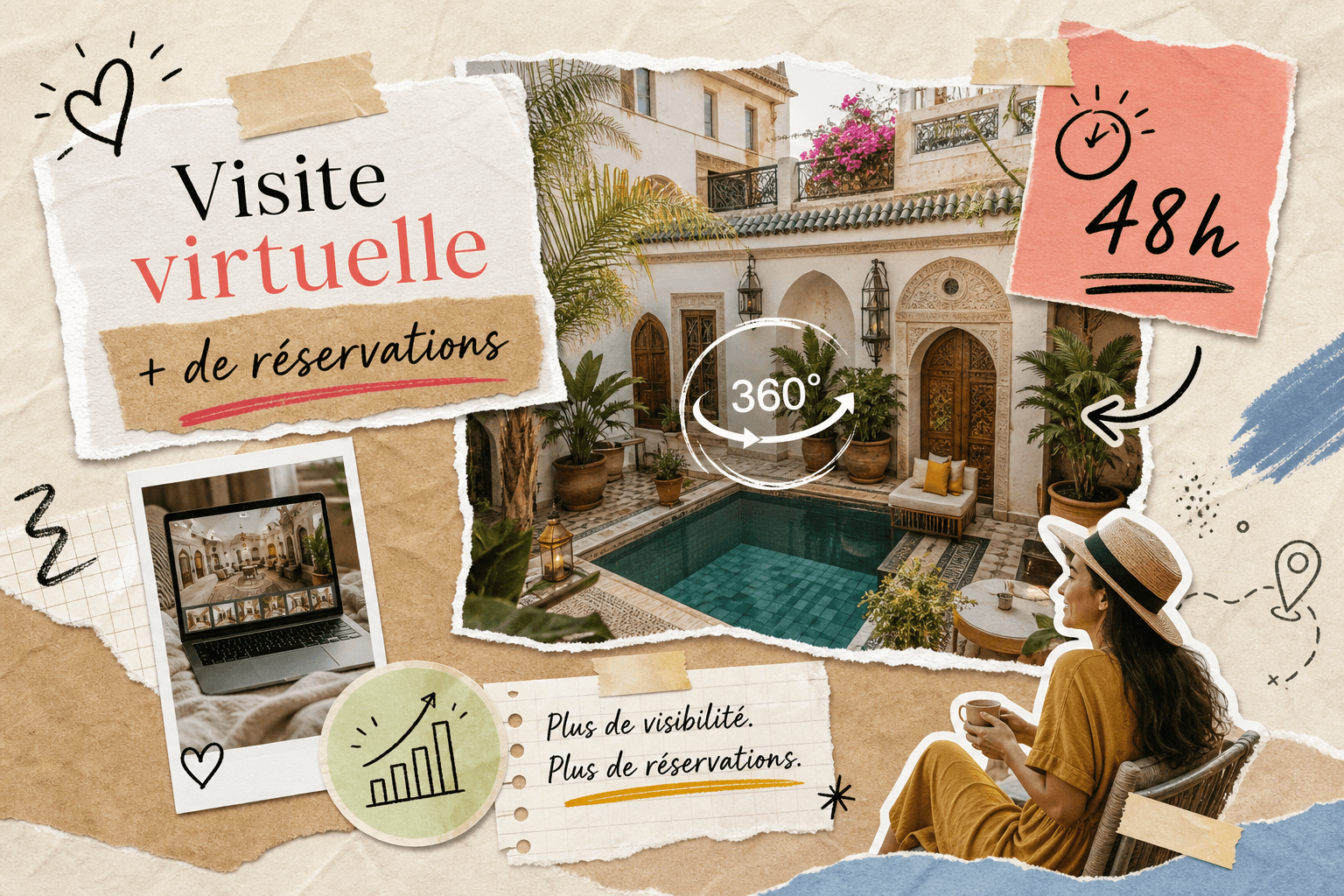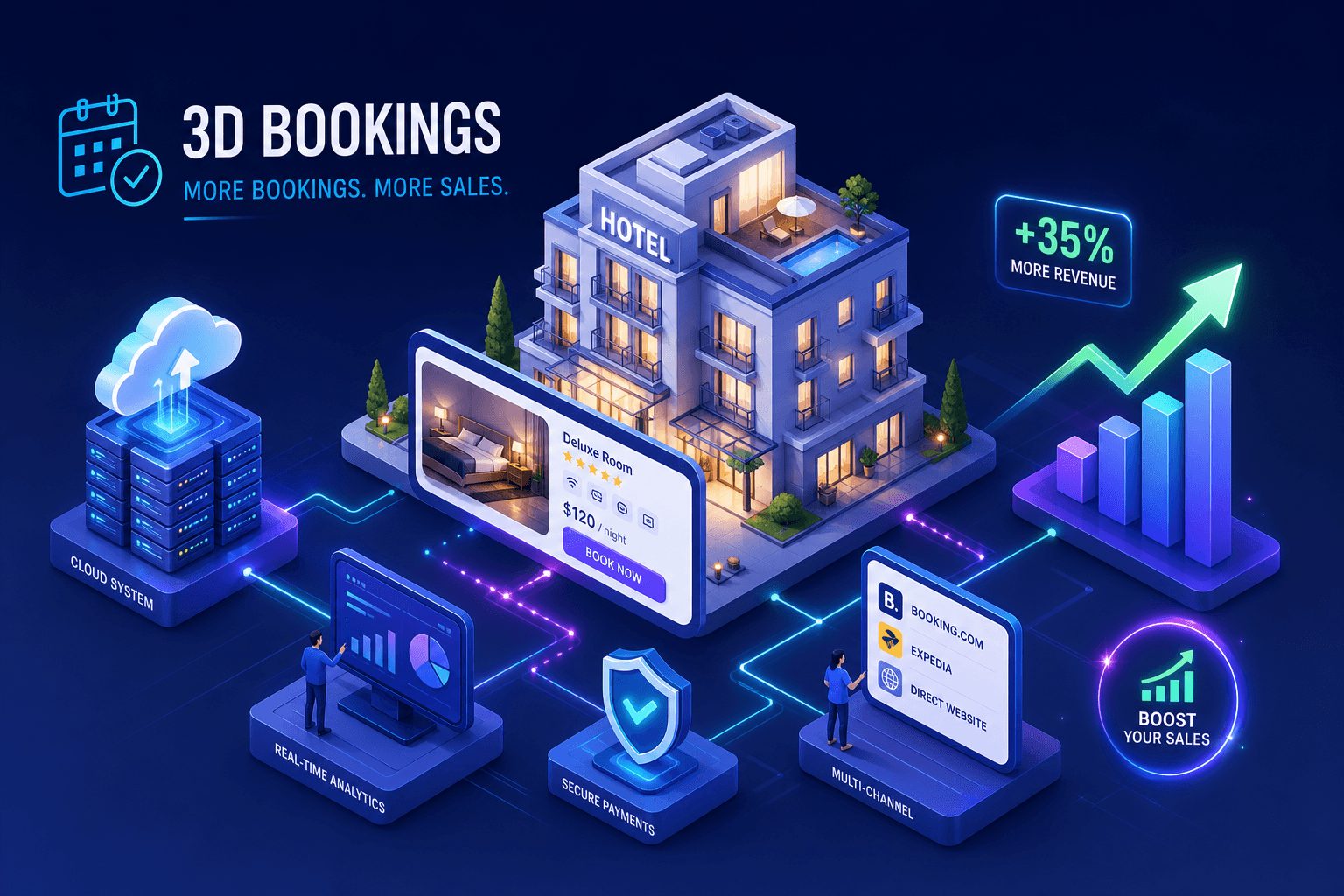
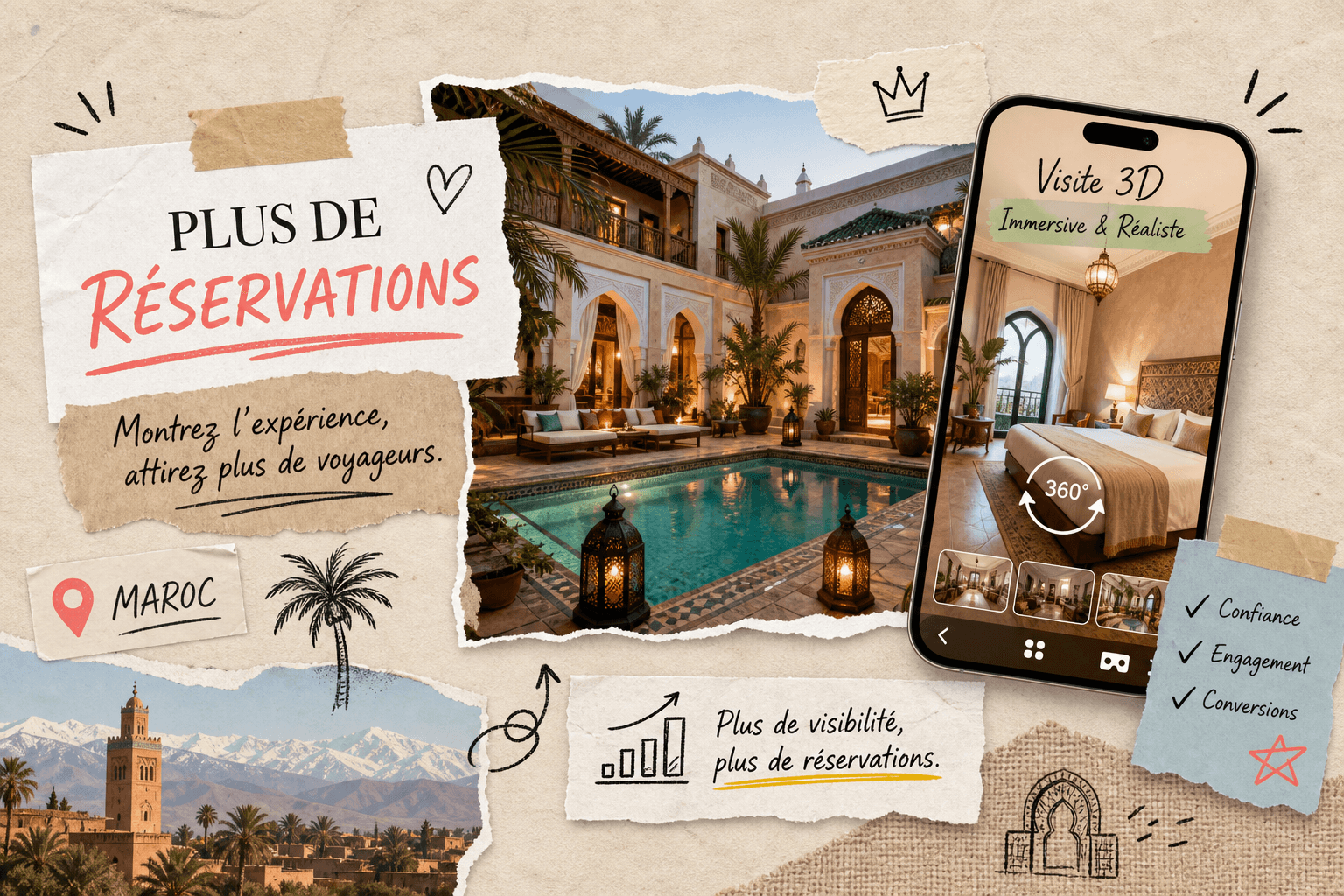
A European traveler is browsing ten hotels in Marrakech from their couch. They cannot touch the zellige, smell the jasmine in the patio, or assess the real size of the rooms. If your static photos do not give them visual certainty, they book elsewhere. The question is no longer whether immersive tours work — that is established. The real question is how to increase hotel bookings with a 3D tour in Morocco by deploying this tool correctly, from production to performance tracking, so your 3D tour becomes a genuine commercial engine.
What the data reveals about 3D tours and hotel bookings
Measurable booking increases on the direct channel
Before investing in a tool, you want to know whether it delivers results. Industry benchmarks on virtual tours in hospitality suggest that properties that have integrated this type of content on their direct site see booking increases ranging from 30% to 130%, depending on the client segment and the quality of the integration. The median observed is around 67 to 85%, which represents a commercial impact that any hotel digital marketing professional should take seriously.
Fewer cancellations, more trust
The other often-underestimated benefit involves cancellations. When a client has virtually "walked the corridors," there are no bad surprises on arrival. Sector case studies document a 20 to 28% reduction in cancellations after implementing an immersive tour. For riads and medina hotels — often poorly conveyed by standard photography — this effect is particularly significant: the three-dimensional architecture of a patio or a zellige terrace creates expectations that only a volumetric tour can properly calibrate.
An SEO signal that photos cannot reproduce
On the SEO side, visitors exploring a 3D tour stay 5 to 10 times longer on your page, according to several sector analyses of hotel properties. This session duration signal tells Google's algorithms that the page delivers a quality experience, simultaneously improving your organic ranking and your direct booking conversions. It is a double advantage that static photos simply cannot reproduce.
Why Moroccan hotels have more to gain than others
Architecture built for volumetric capture
The Moroccan context creates a particular equation. Architecturally rich spaces, a predominantly international clientele, and a highly competitive online booking market make it an ideal setting for 3D tours. A riad is a three-dimensional environment by nature. Its proportions, ceiling height, the way light crosses the central patio, the organization around the courtyard — all of this is lost in a flat photo. The dollhouse view of a Matterport tour, on the other hand, provides an immediate understanding of the building's volume, even for a client who has never encountered this type of architecture.
An international clientele deciding from a distance
French, British, and American markets are among the key sources of premium bookings in Moroccan hotels. These travelers make significant decisions from a distance, sometimes months in advance, based solely on what they see online. A 3D virtual tour bridges the gap between the online discovery and the on-site reality, giving the client a level of visual confidence that no other format can match — which is reflected in the direct booking conversion rates observed after integration.
Producing an effective 3D tour: making the right choice from the start
Technology choice: 360° or volumetric scan?
The quality of the tour determines its commercial impact. A blurry, poorly paced, or feature-poor tour will not convert. First, understand the difference between two often-confused technologies. A 360° tour is built from stitched panoramic photos: the result is decent, but navigation remains rigid and proportions sometimes lack precision. A Matterport scan generates a true 3D model with real measurements, free and fluid navigation, an automatic dollhouse view, and an integrated floor plan. For a Moroccan hotel targeting an upscale clientele, the perceived quality difference is significant.
Hotspots, CTAs, and non-negotiable elements
For a 3D tour to truly convert within a hotel digital marketing strategy, four elements are essential:
Free navigation, allowing the visitor to choose their own path through the space.
Interactive hotspots — clickable pins that reveal key information: room size, available amenities, direct link to the booking page.
The dollhouse view, giving an instant overall read of the hotel's structure.
The embeddable link, allowing integration on your site in minutes with no technical skill required.
Post-production and delivery timelines
This is exactly what Immersio's 3D Tour for Hotels & Residences offers in the Moroccan market: a professional Matterport scan carried out on-site at your property, AI-assisted post-production, and delivery of all formats in under 48 hours. A turnaround this short can be decisive for hotels that need to position themselves before a high season or an upcoming marketing campaign.
Integrating the tour on your site so it actually works
Positioning and CTAs: the basics
Having a 3D tour without integrating it correctly is like displaying your best room in a poorly lit corridor. Placement and integration technique determine whether your tour converts or gets ignored. The basic rule: the tour must appear in the top 50% of the room page, without the visitor having to search for it. Pair it with a visible CTA ("Visit this suite in 3D") with a contrasting button. Do not leave the tool at the bottom of the page.
Mobile optimization and technical performance
On mobile, touch controls must be smooth: simple swipe, intuitive zoom, hotspots large enough to tap with a thumb. Research on hotel booking behavior shows that over 70% of searches now happen on smartphones. If the experience is painful on mobile, you lose the majority of your audience before they have even explored a room. Use lazy loading for the Matterport iFrame so the tour does not weigh on the initial page load time, and aim for a PageSpeed score between 85 and 90 on mobile, targeting strong Core Web Vitals rather than a single synthetic score.
Interactive hotspots can go even further: embed a direct link to your booking form. A user exploring your luxury suite can click "Book this room" without leaving the visual experience. This friction-free journey significantly reduces drop-off between discovery and confirmation.
Distributing your 3D tour across the right channels
Google Business Profile and local SEO
Your 3D tour is not just website content. It is a multi-channel digital marketing asset you can deploy everywhere your future clients are looking for you. Start with Google Business Profile: integrating your tour directly into your Google listing amplifies your visibility in local searches. Travelers can explore your hotel from search results before ever clicking on your site. Case analyses document CTR increases on organic results of up to 30% for listings enriched with a virtual tour.
Social media, OTAs, and email
On social media, a 360° video preview shared on Instagram or Facebook generates more interactions than a standard photo, according to several studies on immersive content engagement. The full tour link can be placed in the bio or in stories with a clear CTA. LinkedIn is particularly relevant if you are targeting corporate event organizers or wedding planners who make significant decisions from a distance.
On the OTA side, check your primary platform's compatibility with 3D tour links. Some already allow you to enrich listings with this type of content. And in your newsletters or follow-up emails, a "Revisit our hotel in 3D" link creates a differentiating touchpoint that may be enough to tip a hesitant purchase decision.
Measuring ROI and adjusting your strategy over time
Setting a baseline before launch
A 3D tour should be treated as a managed investment, not a one-off purchase. Before launch, establish a clear baseline in Google Analytics: average time on the room page, bounce rate, conversion rate between site visits and bookings. These figures are your reference point. Without them, you cannot measure the tour's real impact.
KPIs, targets, and return on investment calculation
After launch, compare the same metrics using a before/after approach or an A/B test. The priority indicators to watch are session duration (target: over 3 minutes), direct booking conversion rate (target: 15 to 25% increase based on industry benchmarks), and the volume of direct bookings over the period. To calculate ROI, the formula is simple: additional revenue generated minus the cost of the 3D tour, divided by that same cost, multiplied by 100. In many Moroccan hotel scenarios, the return on investment can turn positive within the first quarter — sometimes sooner, depending on traffic volume and average booking value, though results vary by property.
If session duration stays low after launch, first check the tour's positioning on the page, then the quality of the tour itself. If conversions improve but cancellations also increase, rework the informational hotspots to better align guest expectations with reality. Optimization is a continuous process, not a one-time configuration.
Act now
Knowing how to increase hotel bookings with a 3D tour in Morocco is not just about producing beautiful visual content. It is a complete chain: choosing the right technology, integrating it on your site and channels thoughtfully, then tracking KPIs to measure real impact. Moroccan hotels that take this structured approach see significant increases in direct bookings, often visible within the first weeks of deploying the content.
If you want to move fast, Immersio delivers complete Matterport tours in 48 hours, purpose-built for hotels, riads, and palaces in Morocco. The team visits on-site and carries out the professional scan, then hands you all formats ready to use: free navigation, dollhouse view, interactive hotspots, embeddable link. To see concrete examples, visit Our Work — 3D Tours in Morocco. The tour is ready. Put it to work.