A riad reveals itself from the inside. Behind a discreet doorway, everything happens in the courtyard — the vertical breathing of the patio, the water catching the light, the shadows sculpting the zellige. A facade says nothing about the experience. A standard photo barely says more.
A significant share of your travelers, buyers, or investors decide from a distance. If your riad does not exist in 3D, or if it is presented without depth or material truth, it risks being overlooked among more readable listings. Bookings and qualified visits tend to go to spaces that can be walked through in a few clicks, with clear and engaging 3D visualization.
The good news: you do not need a six-month digital project to get there. Understanding how to present a Moroccan riad in 3D starts with choosing the right method, and local specialists like Immersio know how to capture zenith light, traditional textures, and the human scale of a riad with rare precision. By the end of this guide, you will know how to choose the right method for your project, write a solid brief, demand the right deliverables, and avoid costly mistakes.
How to present a Moroccan riad in 3D: the three methods
Architectural 3D rendering: the photorealistic image
An architectural render is a fixed image calculated from a 3D model. You start from plans or a survey, build the 3D model of the riad, apply PBR textures for the zellige, tadelakt, and wood, simulate the lighting, then export in high resolution. The result is a view controlled to the pixel, perfect for telling a story of intent.
This format serves brochures, investor decks, and off-plan sales. It is ideal if your project is under renovation and you need to show the expected result. You control the light, furniture, and atmosphere, even if it means stylizing reality. Standard outputs are 4K JPEGs or TIFFs, scene by scene: patio, suites, lounge, terrace.
Video and flythrough animation
A 3D video puts a virtual camera in motion through your riad for 60 to 120 seconds. It animates the light, the vegetation, the basin water, and layers in a soundtrack. It is a powerful format for social media, YouTube, and commercial presentations, condensing the experience into a fluid and memorable narrative.
The trade-off is technical. It requires a longer production timeline, heavy GPU renders, and video post-production. This format remains an excellent teaser, but it does not replace the free navigation of a virtual tour when the goal is to reassure and convert.
Interactive virtual tour via digital scan
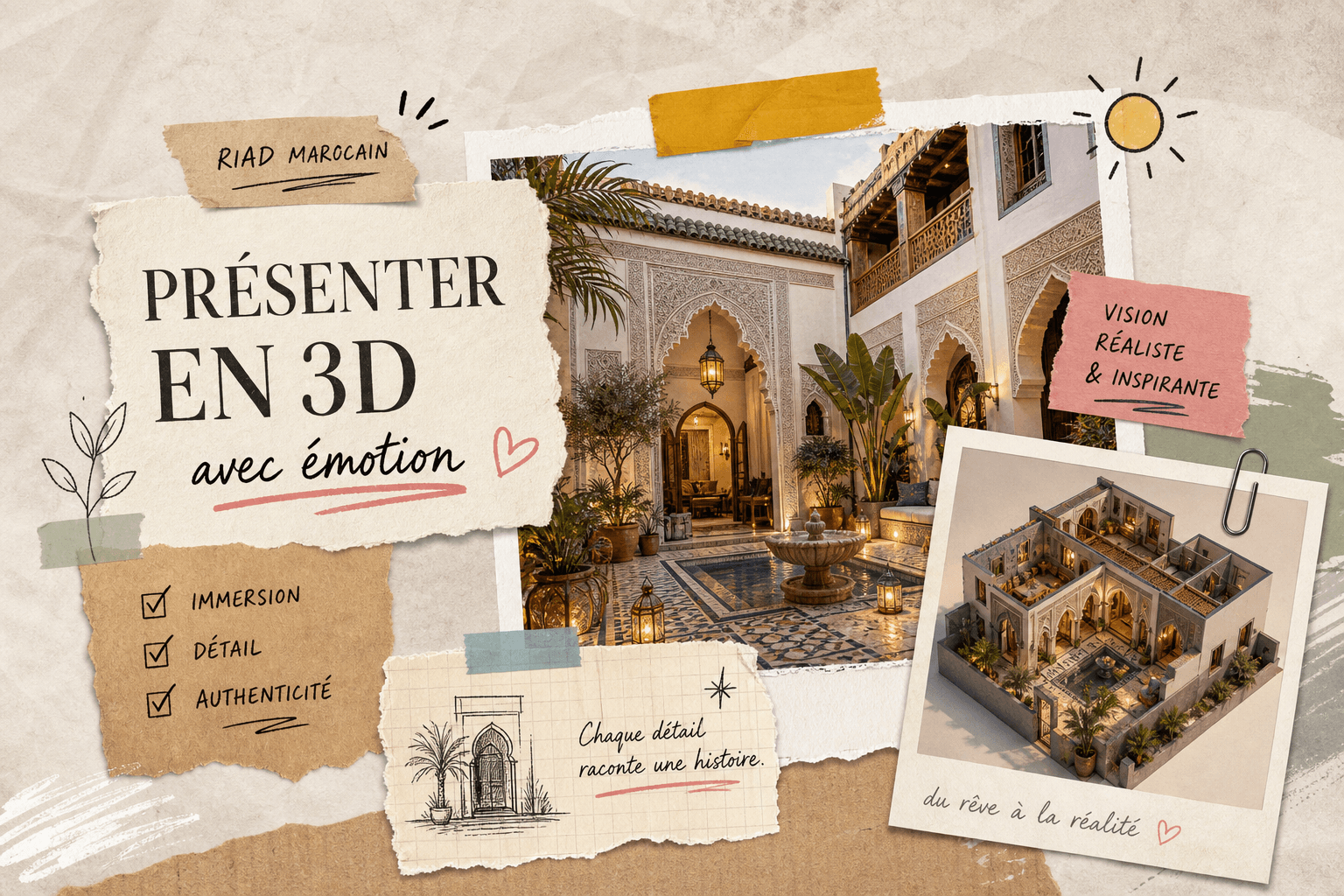
A 3D scan captures the real space with a dedicated camera, such as Matterport technology. The platform automatically generates a navigable tour, a dollhouse view of the riad, and a floor plan. You get a faithful digital twin, directly embeddable on your site, accessible on mobile and desktop.
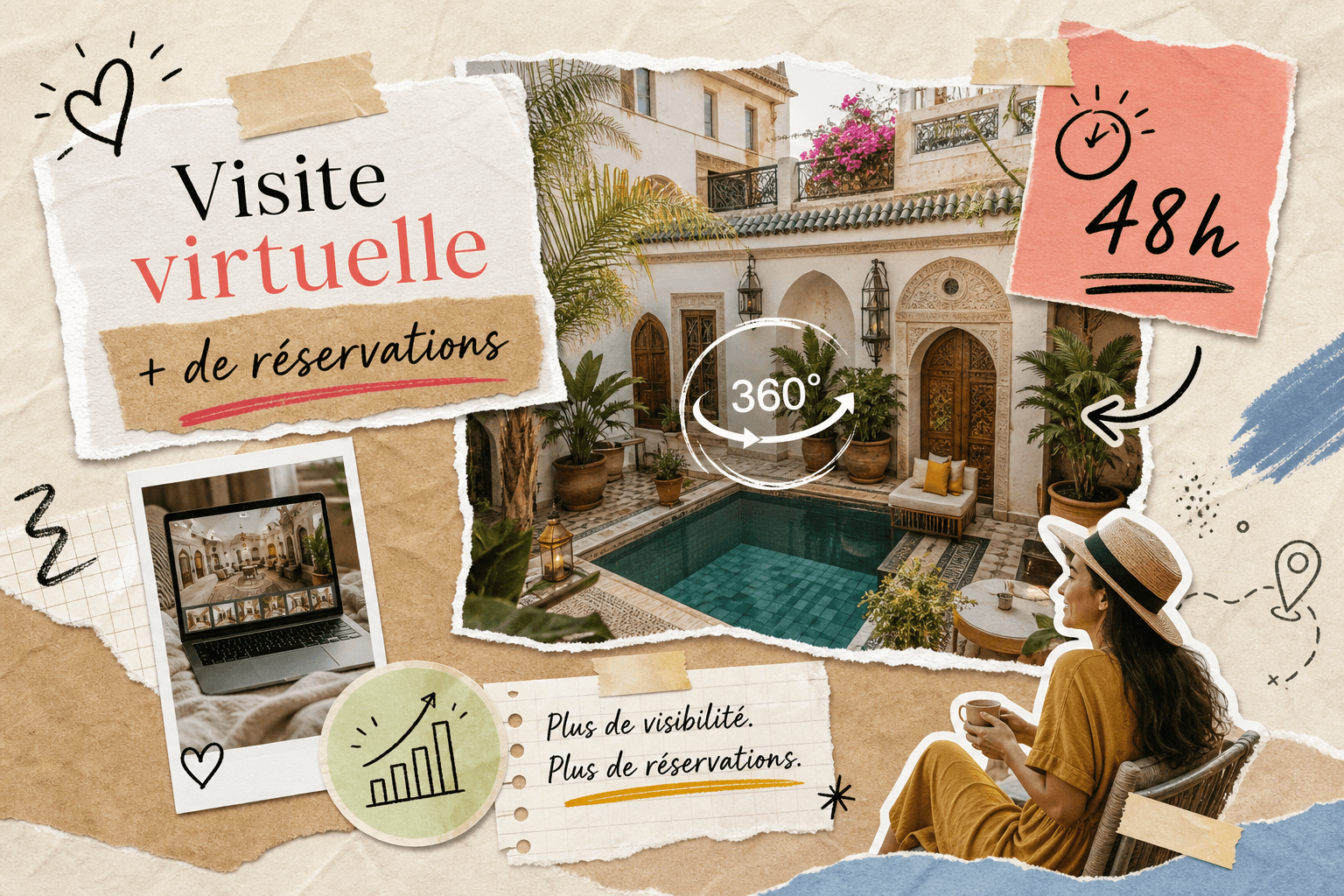
For a riad, this is a decisive advantage. The natural light is recorded as it bathes the patio, the traditional Moroccan textures in 3D are authentic because they come from the real space, and manual modeling is largely avoided — though post-processing and optimization work is often still needed depending on the complexity of the venue. At Immersio, the tour is generally delivered in 48 to 72 hours, with free navigation, informational hotspots, and simple link sharing.
What makes modeling a riad particularly demanding
Enclosed architecture and zenith light
A riad is organized around an open-sky patio. Light enters from above, varies strongly with the time of day, and bounces off plasterwork, water, and colonnades. It comes from the sky, not from large glass panels — which changes everything for the architectural render.
Reproducing it accurately in 3D requires mastery of HDRI, global illumination, and cast shadows. Common errors are renders that are too uniform, flattening the volume and erasing the drama of the courtyard. When indirect light is credible, the riad recovers its atmosphere.
Traditional materials: zellige, tadelakt, carved wood
Each material has its challenges. Zellige reflects differently depending on the angle, its patterns are repetitive but never identical, and its grout captures moisture. Tadelakt has a soapy sheen, micro-imperfections, and natural tones from ochre to off-white. Carved cedar wood plays on the depth of its grooves and a subtle patina.
A convincing 3D render of a Moroccan riad depends on careful, varied PBR textures. Libraries like Poliigon or Quixel Megascans help, but generic assets quickly show their limits against Moroccan craftsmanship. The best 3D visualizations combine quality resources with custom retouching to preserve the handcrafted character.
Software and pipelines by objective
For high-quality images and videos
For magazine-level still images, a proven pipeline combines a SketchUp structure with a V-Ray or Enscape render. V-Ray offers photorealistic precision; Enscape accelerates the revision cycle while remaining convincing. Goal: total control and high-end architectural render.
For 4K films, start in SketchUp or Blender, then switch to Twinmotion or Lumion. These engines handle patio vegetation, basin water, and lighting atmospheres efficiently. Expect several weeks of work and a qualified 3D team to nail the modeling, animation, and final color grading.
The scan-to-web pipeline for online presentation
The scan-to-web pipeline is radically shorter. A team scans your riad on-site, the platform processes the point cloud and assembles the immersive tour with dollhouse view and floor plan. With no complex web development, an embeddable link is ready for your site — though post-production, optimization, and occasional retouching are part of the process.
You gain the realism of real light, the truth of the materials, and free navigation that answers visitors' questions without a sales pitch. The timeline difference is significant: 48 to 72 hours for a professional scan versus 3 to 6 weeks for a full traditional 3D pipeline (depending on volume and post-production level). This is the natural solution if your space already exists.
What deliverables to demand based on your use case
For hotel marketing and direct bookings
Make the interactive virtual tour your primary format. Free navigation, hotspots explaining services, dollhouse view to locate suites and terraces: this is the format that removes doubt and drives conversion. Supplement with 5 to 8 photorealistic images optimized for Booking, Google, and your site.
Add a short 30-to-60-second video for social campaigns and retargeting. An effective combination for a riad pairs the immersive 360° tour on the site, image carousels for OTAs, and a teaser video that encourages clicking through to the tour — a set that can noticeably improve engagement and reduce booking abandonment.
For seasonal rental and real estate sales
The virtual tour reduces unnecessary physical visits and reassures distant clients. The interactive floor plan generated by the scan is valuable for picturing the space, taking measurements, and understanding volumes. For a sales dossier, agents also appreciate 4K image exports of key rooms.
Deliverables to demand from your provider:
Embeddable virtual tour link
Dollhouse view of the full riad
Annotated floor plan
5 to 10 4K images of key rooms
1-to-2-minute presentation video, budget permitting
Budget and timelines: what to plan for
Indicative rates by format
For a traditional 3D render, expect 4,000 to 5,000 DHS per photorealistic image. A complete pack — images, video, and 360° tour — often falls between 40,000 and 150,000 DHS depending on the riad's size, level of detail, and number of revisions. Timelines range from 3 to 6 weeks, with creative back-and-forth to plan for.
A digital scan-based solution, by contrast, typically delivers the interactive tour, dollhouse view, and floor plan in 48 to 72 hours, at a fraction of the cost of a full architectural render. You save time, gain real-world accuracy, and improve marketing ROI potential — especially if your priority is online conversion.
What drives the final price
Several factors influence the quote. The total floor area and number of rooms to cover, the complexity of materials to reproduce, the volume of revisions, and the mix of deliverables chosen each weigh on the budget. Always ask for an itemized breakdown, line by line, with final formats listed.
Riad size and number of rooms to cover
Level of material detail: custom zellige or generic assets
Number of revisions included in the contract
Delivery formats: images, video, interactive tour, VR files
A precise quote beats a "starting from" price every time. It is your best guarantee of quality and timeline.
Local expertise: the factor that changes everything for authentic rendering
What a generalist cannot reproduce
A generic 3D studio often produces clean but cold renders. Light too uniform, pixel-perfect zellige but soulless, proportions that betray the human scale of the patio — the magic vanishes. Authenticity comes from an intimate understanding of the space — the way the morning sun crosses the courtyard and how a candle reflects in the tadelakt.
This grammar cannot be bought from an asset store. It comes from fieldwork in Morocco, alongside artisans and real riads. Whether you need 3D modeling of a riad from plans or a virtual tour of an existing riad, the difference shows in the light and the materials.
Immersio: from on-site scan to fast immersive tour delivery
Immersio: 3D Tour for Riads & Guest Houses is a Moroccan provider specialized in capturing and immersively presenting riads, hotels, and palaces. Our team scans on-site with a Matterport camera, then our AI-assisted post-production delivers an interactive tour, a dollhouse view, and a floor plan — generally in 48 to 72 hours depending on volume and retouching level. The link is ready to embed on any website, with no additional development.
The strength of this approach lies in fidelity. The zenith light is yours, the zellige and tadelakt textures are yours, the atmosphere of the place is intact — no approximate reconstruction. Our role is to turn your riad into a precise, engaging conversion tool. Browse our work — 3D Tours in Morocco.
Conclusion
The decision framework is clear. If you are selling off-plan or presenting a renovation, architectural rendering remains fully relevant to control every detail. If your riad exists and you want to show it to distant clients right now, a virtual tour by scan is the fastest and most accurate solution.
Ultimately, how to present a Moroccan riad in 3D depends on your objective, your timeline, and whether the space exists yet. Whatever method you choose, the challenge remains the same: do justice to a rare place, with the light, materials, and volumes it deserves. Choose the formats suited to your use case, demand clear deliverables, and surround yourself with a team that knows riads from the inside.
Ready to take the next step? Contact Immersio for a demo or a personalized quote. We operate across Morocco and deliver your immersive tour, floor plan, and dollhouse view as fast as possible — ready to embed on your site.