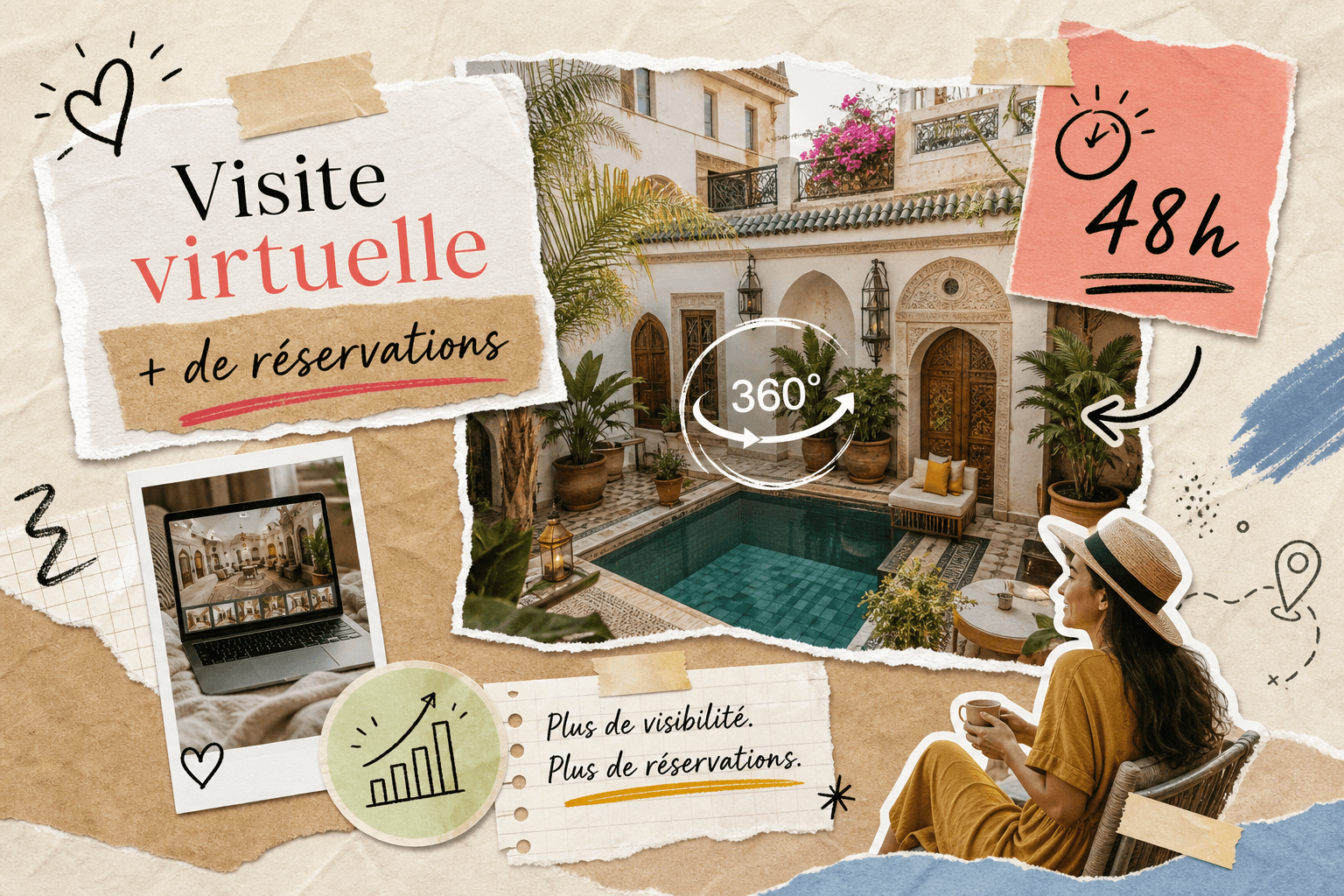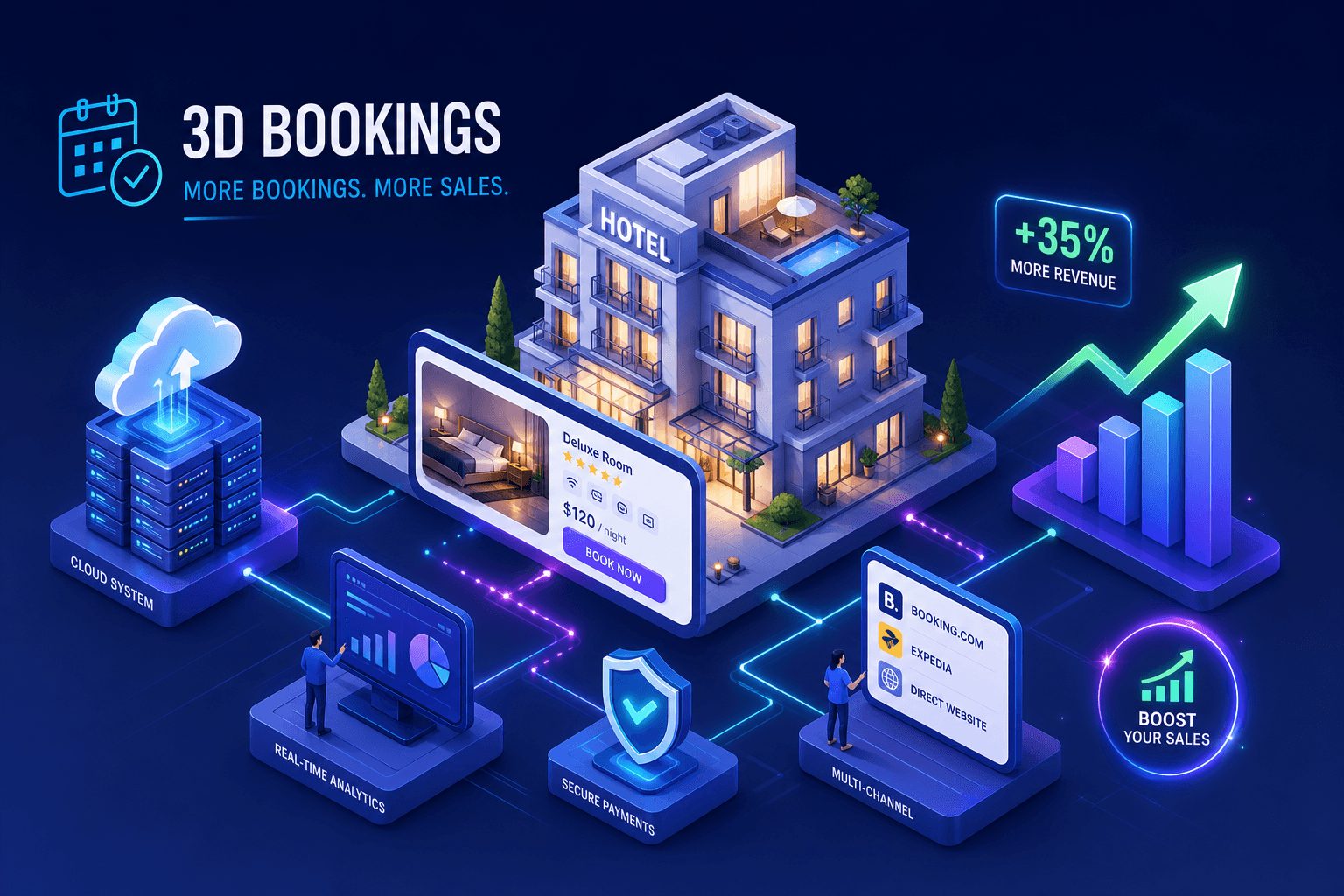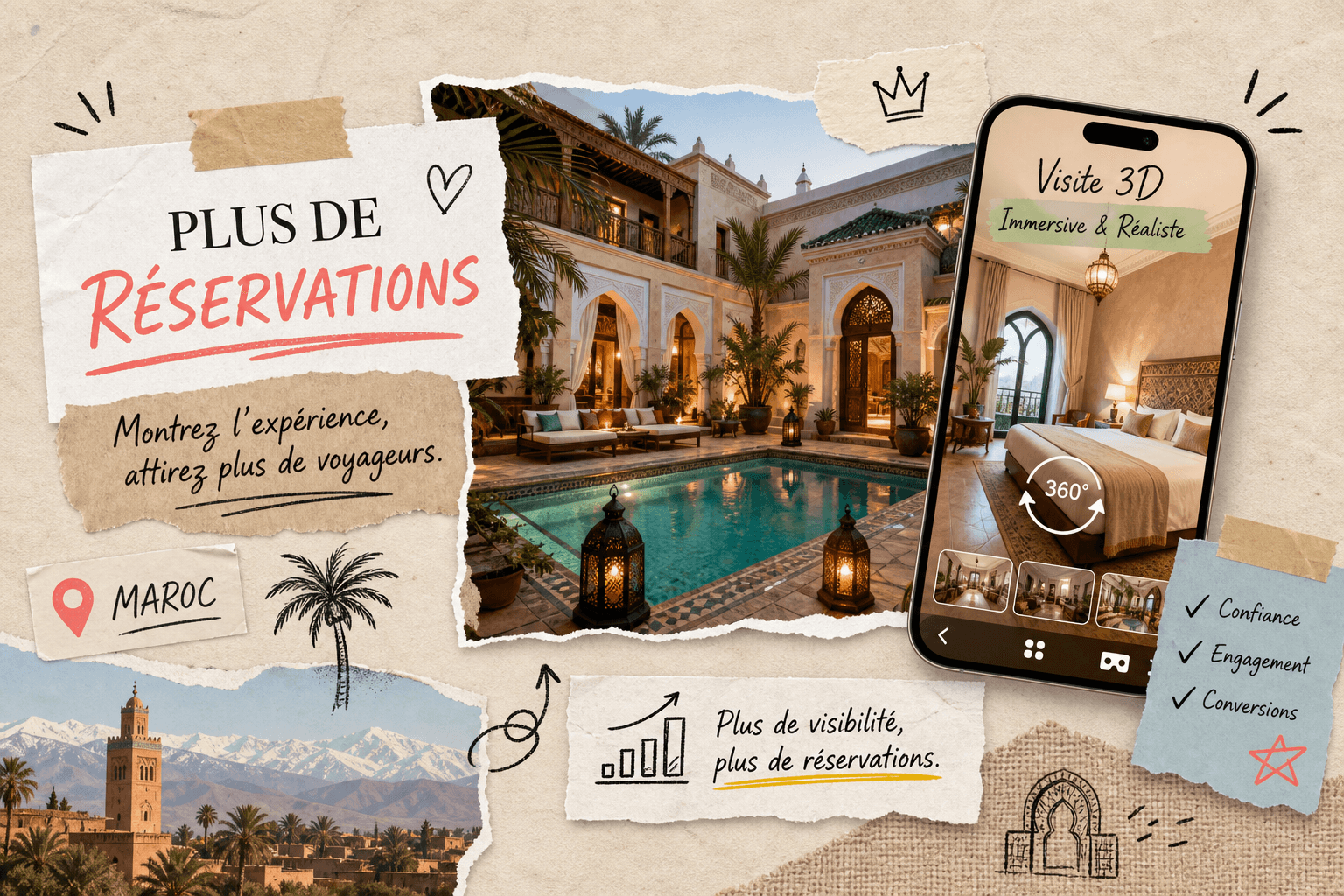
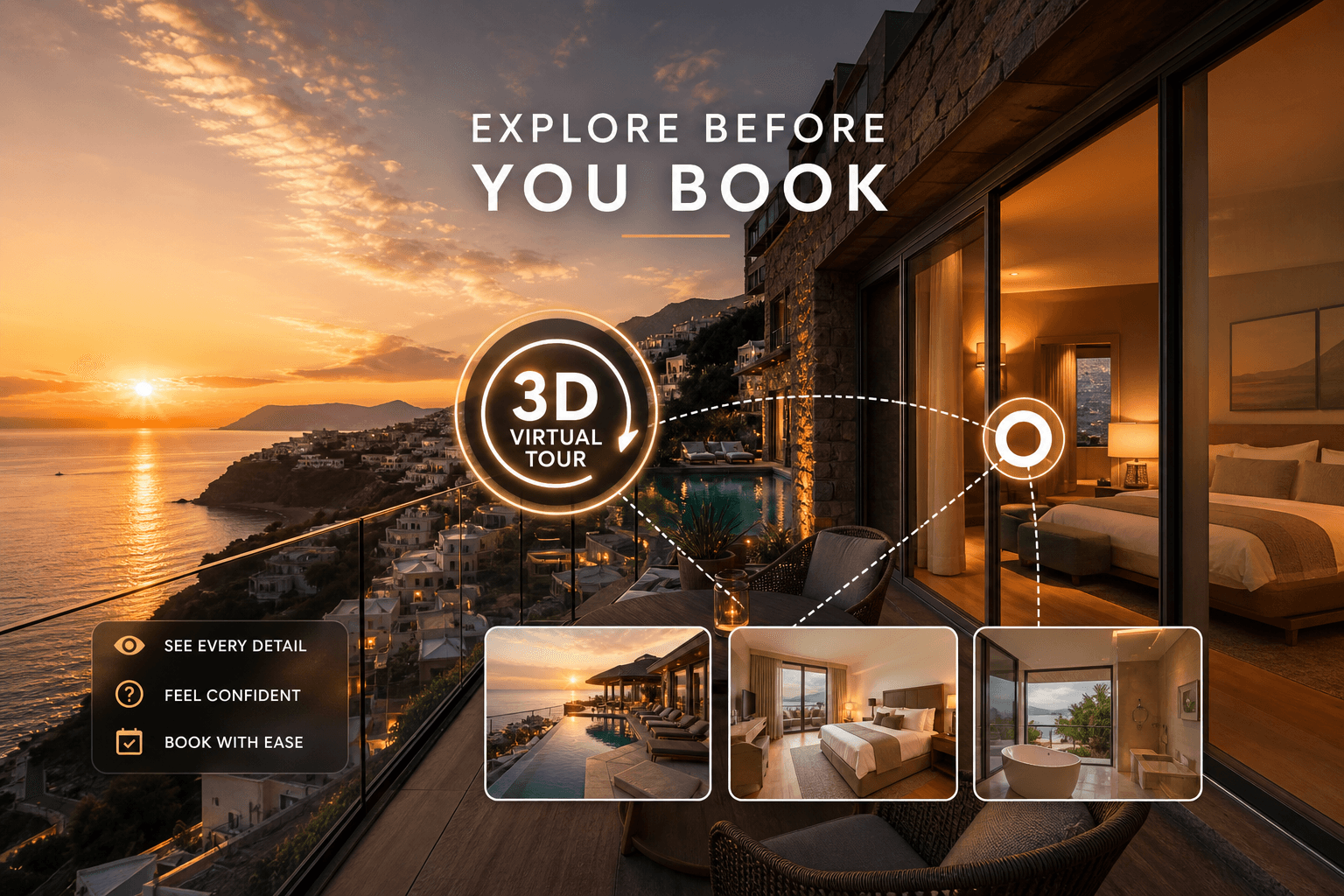
How many travelers visit your site, examine your photos, compare your rates — then close the tab without booking? This behavior — hotel booking hesitation — is one of the most costly challenges in digital hospitality. It is not always about price or competition. It is often about trust, and trust is built when doubt disappears. A 3D virtual tour to reduce hotel booking hesitation is precisely the answer: it gives the client what no photo gallery can offer — the ability to walk through your space before committing.
Photo galleries no longer convince. Travelers have been surprised too often on arrival: a room smaller than expected, a dark corridor instead of a bright entrance, a "sea view" overlooking a parking lot. Immersio supports Moroccan hotels through this shift to immersive, with technical and architectural expertise tailored to local specificities.
This article explains why your clients hesitate, how a 3D virtual tour eliminates these barriers, and how to build a concrete setup so your immersive tour becomes a genuine sales tool.
What actually goes through a client's mind before clicking "Book"
The hesitating traveler is not doubting your hotel. They are doubting what they cannot see. This nuance changes everything about how to address the problem. According to behavioral psychology research applied to e-commerce, loss aversion plays a central role in the purchase decision: the client would rather not book than risk a disappointment. Fear of a bad surprise ranks among the most decisive conversion barriers, alongside price and concerns about hidden fees.
Photographic distortion as the first culprit
Professional hotel photos are generally taken with a wide-angle lens, creating an illusion of space that is hard to challenge. The problem is that your clients know this. An 18 sqm room looks spacious in an image and tiny on arrival. Client experience feedback and user tests documented by several booking platforms show that this collective awareness of photographic distortion turns your most beautiful images into sources of mistrust. The more stunning the photo, the stronger the doubt can be.
Doubt about the real atmosphere of the space
Beyond dimensions, the client wants to feel the ambiance of your property before committing. Does the riad truly have that authentic charm visible in the shots? Is the pool as intimate as in the photos? Is the lounge well oriented toward morning light? These questions stay unanswered facing a static image gallery, however polished. These unknowns are precisely what keeps the cursor away from the "Book" button.
How a 3D virtual tour reduces hotel booking hesitation
A 3D virtual tour does not just show your space — it brings it to life. The visitor navigates freely, walks down the corridor, enters the room, pivots toward the window to assess the view. They build a mental representation faithful to reality — and that is exactly what they needed to make their decision with confidence.
Spatial transparency as the antidote to uncertainty
With a dollhouse view and free navigation, your client perceives the real proportions of every space. They see the angles, transitions between rooms, ceiling height, the natural flow of volumes. The hesitation born from the unknown dissolves because the unknown itself disappears. You no longer have to convince — you show, and the client convinces themselves.
An emotional connection built before arrival
When a client has already "walked" through your virtual lobby, they have started to claim the space. They pictured themselves in the room, imagined breakfast on the terrace, already seen themselves arriving. This psychological shift — from suspicion to anticipated belonging — is what triggers the booking. 3D exploration turns a hesitant prospect into a client who has already mentally unpacked their suitcase.
The numbers that confirm what psychology explains
The impact of 3D virtual tours on booking rates is not a marketing intuition. Sector studies conducted with hotels that have integrated this type of technology into their sales journey — notably analyses published by immersive specialist platforms and hotel conversion agencies — converge on one central point: when doubt disappears, conversion follows.
Documented conversion increases, not anecdotal
Data from multiple hospitality sector reports shows booking increases ranging from 30% to 67% after integrating a 3D virtual tour. Among 18-to-34-year-old travelers, the effect is particularly marked, with increases reaching 130% in some segment analyses. The cancellation rate also drops by an average of 20%, because clients know precisely what they are committing to. Fewer surprises on arrival, fewer disappointments. This result impacts net revenue directly, not just gross booking volume.
Time on site as a clear engagement signal
Visitors who explore a virtual tour stay 5 to 10 times longer on the page than those consulting a standard gallery. This extended engagement time mechanically reduces booking abandonment: a visitor immersed in the space is a visitor making a decision. A bounce rate below 40% on a 360° virtual tour page signals that the experience is genuinely engaging — not just eye-catching.
Immersio: the solution built for Moroccan hotels
Creating an effective virtual tour for a Moroccan hotel is far more than pointing a scanner at walls. The natural light of a riad patio, the volumes sculpted by century-old architecture, the depth of a vaulted medina corridor — these elements require a specific spatial reading. Immersio has built its expertise precisely around these contexts, alongside riads and guest houses, hotels and residences, and palaces across Morocco.
Technology that captures what photos cannot
Immersio uses professional 3D scanning technologies that generate three complementary formats from a single visit: free navigation, dollhouse view, and interactive hotspots. For a riad, this means your client can explore the central courtyard, virtually climb to the terrace, and discover each room at their own pace. Post-production guarantees a polished render, faithful to the real atmosphere of your property. The result is an embeddable link ready to integrate directly on your site, with timelines adapted to each project's needs.
Direct integration on your room page and booking engine
The Immersio tour integrates in minutes on any site via an embeddable link. It can be placed directly on each room's page, just before the booking button — at the exact moment when doubt is strongest. This is a direct bridge between immersive discovery and conversion. No technical skill required: if you know how to embed a YouTube video, you know how to integrate your tour.
UX best practices to turn the tour into a booking
A well-produced virtual tour can be poorly exploited if it is badly positioned in the client journey. Placement on your site, mobile visibility, proximity to the booking button — these choices determine whether your tour becomes a conversion tool or just a decorative element on your homepage.
Where to place the tour on your site for maximum impact
The room page is the primary decision point: that is where the 3D virtual tour must be visible, ideally before the standard photo gallery. On mobile, access to the tour visible without scrolling is essential — hotel industry data indicates that over half of online bookings now happen on smartphones. Also place a tour access point on your homepage to capture visitors from the moment they arrive and create a first immersive impression that encourages them to stay.
The CTA that finalizes the decision
After the immersive exploration, the "Book Now" button must be fixed and immediately accessible without the visitor having to search for it. A contrasting CTA, positioned to the right on desktop or pinned at the bottom on mobile, with actionable text like "Check availability," captures decisions made during the virtual tour — at the precise moment when trust is at its peak. Do not let that moment evaporate behind a scroll.
Measuring the real impact of your 3D virtual tour on direct bookings
Integrating a virtual tour without measuring its effects means flying blind. A few simple indicators are enough to assess whether the setup is delivering expected results — and to quickly identify what needs adjusting.
Indicators to watch every week
The conversion rate — calculated as the ratio of bookings to unique visitors who consulted the tour — is the central KPI. A bounce rate below 40% on the tour page signals genuine engagement. Average time spent on the tour page and the CTR of the booking button displayed after the tour complete this minimum dashboard. These four figures, tracked weekly, give you a clear read of your setup's effectiveness.
Interpreting data to adjust strategy
If tour time is high but conversion stays low, the problem often comes from the CTA or the booking button placement — it is in the wrong spot, or its text lacks clarity. If the bounce rate is high, the tour may not be prominent enough on the page for visitors to find it naturally. These signals allow rapid iteration and refinement of the journey without rethinking your entire digital strategy.
From hesitation to confirmed booking
Hotel booking hesitation is not a fatality. It is an information and trust problem that a 3D virtual tour solves directly, measurably, and durably. For Moroccan properties, the stakes are particularly high facing an international clientele that books without being able to visit in person. Your space deserves to be experienced before it is chosen.
Immersio creates this immersive experience with specific mastery of the spaces that define Moroccan hospitality. From the first scan to integration on your site, the entire process is designed so your 3D virtual tour becomes a conversion tool — not just a visual element.
Want to see what your property looks like in 3D? Request a demonstration from Immersio. The decision belongs to your clients — your role is to give them the means to make it with full confidence.