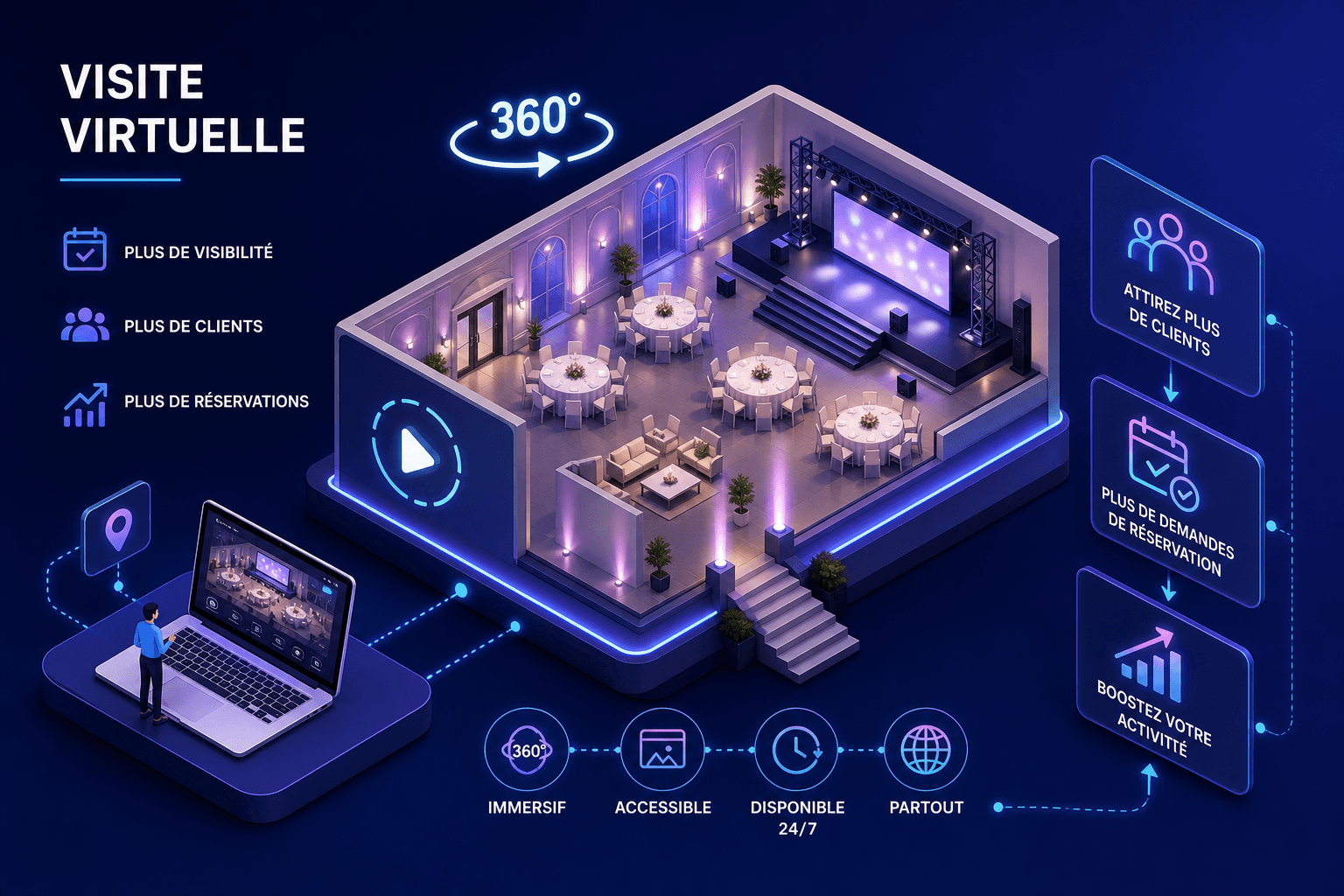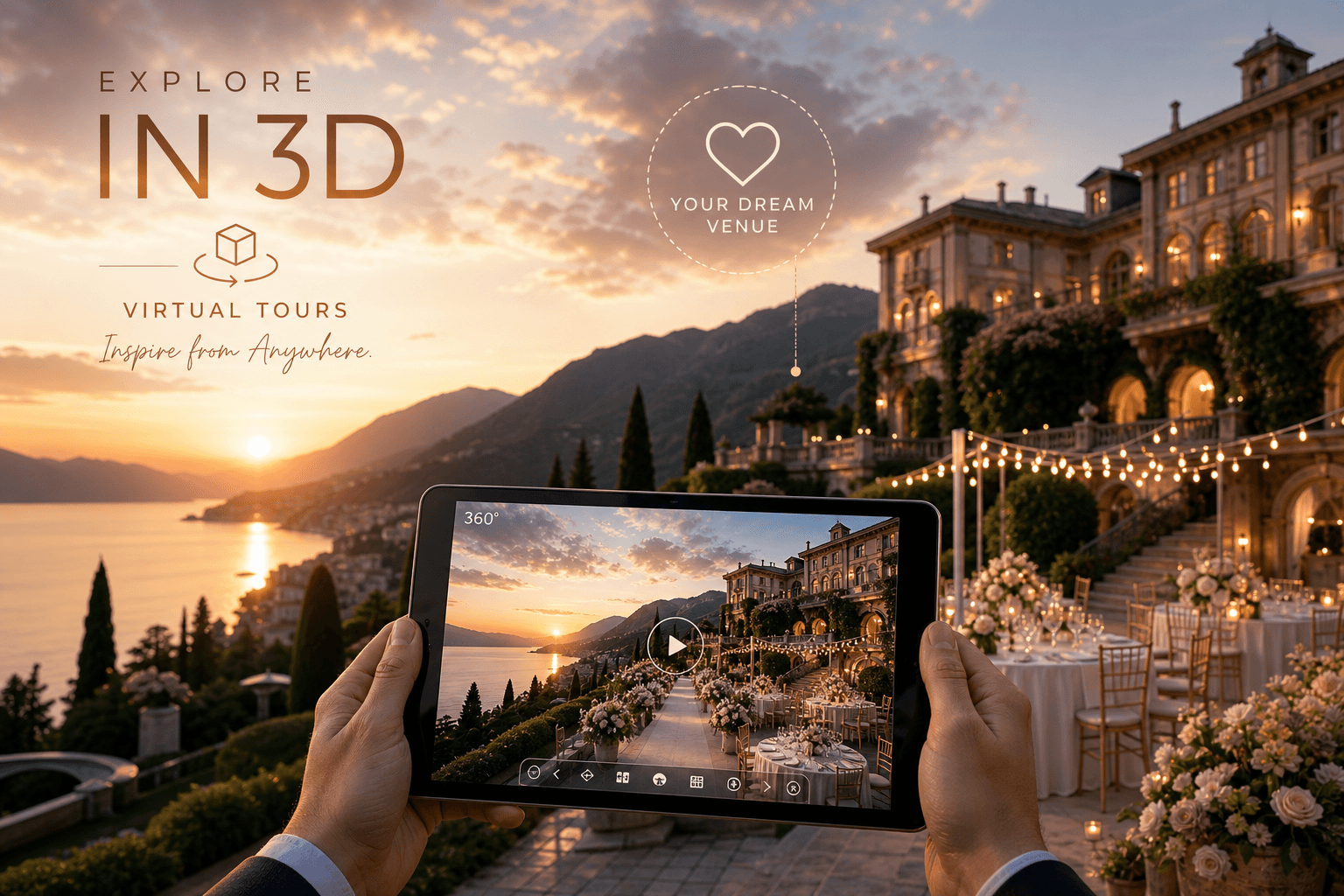
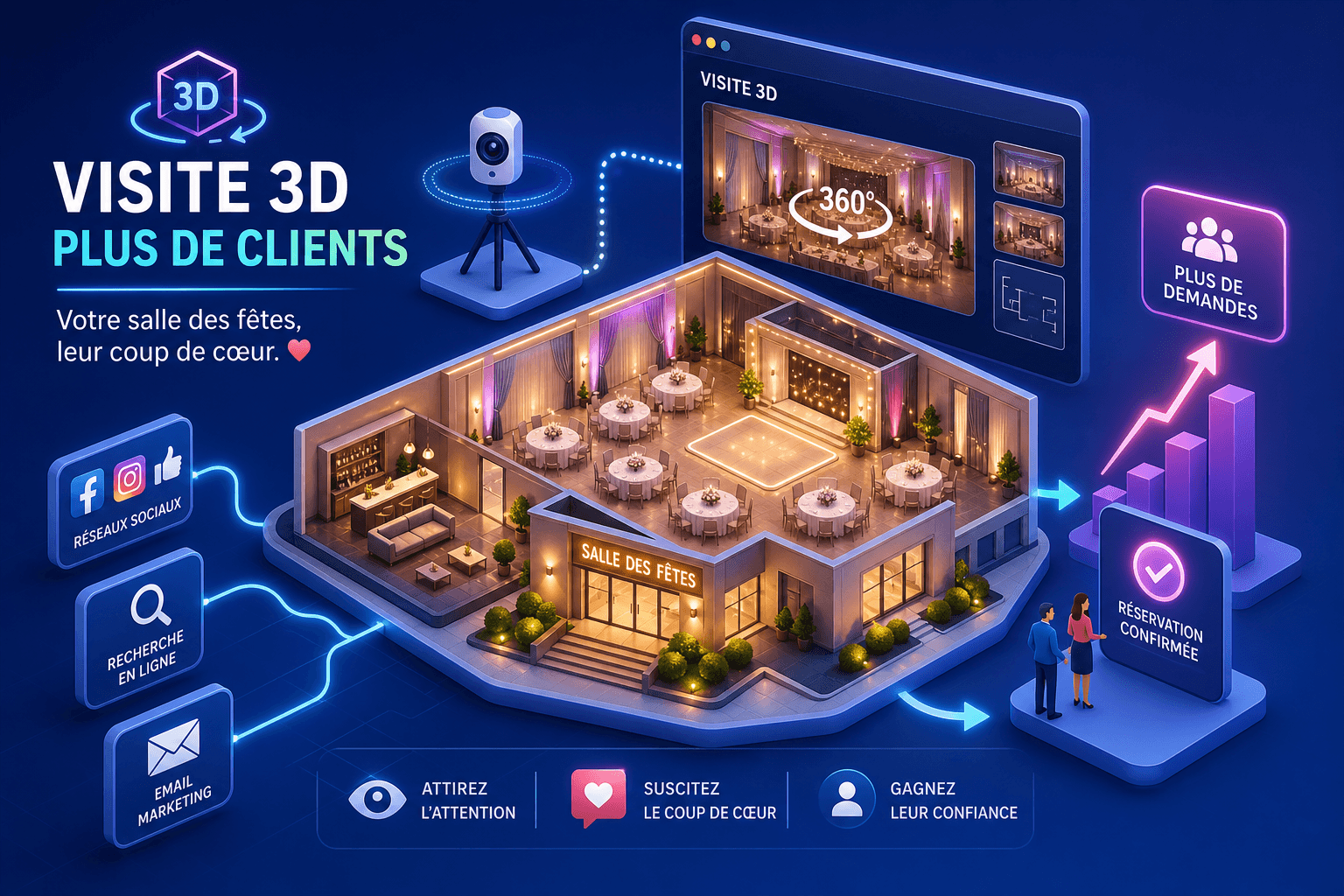
How do you attract clients for an event venue with a 3D tour? The answer starts with a simple observation: a growing number of couples and event organizers choose their venue without ever visiting it in person first. They decide based on what they see online, from their couch, often comparing three or four addresses at the same time. If your venue does not hook them in a few seconds, they move on to the next one.
The problem is that photos no longer convince. A beautiful photo shows one angle, freezes a chosen light, and gives no sense of ceiling height or how traffic flows between spaces. For a client trying to picture 200 guests in your space, that is not enough. Uncertainty sets in, and uncertainty delays or kills the booking.
An immersive 3D tour directly solves this problem. It gives tours of your venue 24/7, from any screen, with complete freedom of navigation. This is exactly the type of tool we produce at Immersio for event venues across Morocco. In this article, you will learn how to attract clients for an event venue with a 3D tour: how to create the tour, integrate it across your channels, promote it, and turn every virtual exploration into a real booking.
What photos alone cannot convey to future clients
When a client compares several venues from their phone, they do it fast and without patience. A well-executed photo does not give them a sense of the space — the depth of the dance floor, the way natural light comes in late in the afternoon, the feeling of openness in a decorated room. These elements directly influence their decision, and they cannot perceive them through a static gallery.
The absence of immersion creates hesitation, and hesitation has a direct cost. Visitors who access a page with an interactive tour spend significantly more time on that page than on a standard photo gallery. According to data published by Matterport (2023), event spaces that include a virtual tour see engagement increase by up to 400%, with visitors spending 4.5 times longer on the page. That extra time translates into confidence, and confidence translates into quote requests.
A 3D tour works like a salesperson available around the clock. It presents the venue, answers questions about the layout, sets the ambiance — and does it at 3am if that is when the client is searching. For couples coming from another city, or corporate organizers planning an event from abroad, it is often the only preview they will have of your space before signing. Make it count.
How to attract event venue clients with a 3D tour: creating the tour
A good 3D tour is not limited to scanning the main room. Clients exploring your space online want to see everything, precisely because they cannot come in person. A client who sees everything suspects less. Every scanned space builds trust and reduces questions at the point of contact.
Spaces to prioritize during the scan
Some areas influence a client's decision more than others. At the top of the list: the entrance and reception hall, then the main room with its visible capacity. Next come the bridal preparation room, outdoor or terrace spaces, and restrooms. The latter may seem secondary, but their presence in the tour signals total transparency — and that reassures. Any serious organizer will look for them.
Interactive features that make the difference
Clickable hotspots allow you to add contextual information to each space directly within the tour: seating capacity, available decoration options, table configurations. A "Request a quote" hotspot placed in the right spot captures the visitor at the exact moment they are most engaged in the exploration.
The 3D dollhouse view offers an overview of the entire venue in seconds. No aerial photo can do this with the same precision and interactivity. Free navigation then lets the client explore at their own pace, as if they were really on site, without having to click on an imposed arrow.
Working with a specialist for fast production
At Immersio, we use Matterport technology combined with AI-assisted post-production to deliver a complete tour on short timelines — where most providers in the Moroccan market still count in weeks. Capturing the light in a room decorated with zellige or an open-sky patio requires specific expertise: it is not the same as scanning a standard room with a rectangular layout. This is what our teams do every day, in medinas, palaces, and event venues across the country.
Integrating your 3D tour on your website and Google listing
Creating a quality 3D tour is pointless if it remains inaccessible or poorly distributed. Integration on your owned channels is the first step to make it work for you.
Adding the tour to your site in minutes
The tour is provided as an embeddable link — an iFrame — that integrates into any site, WordPress or otherwise, by copying and pasting a single line of code. Place it on your homepage and on your "Our Venue" page: that is where clients are trying to picture themselves, and that is where the tour will have the greatest impact on time spent and contact rate.
Make sure it loads quickly and works on mobile, since most traffic comes from smartphones. A tour that lags on a phone is worse than a photo gallery.
Activating the tour on your Google Business Profile
Add a link to your 3D tour in the "Photos" or "Website" section of your Google Business Profile. The local SEO impact is tangible: a profile enriched with interactive content sends positive engagement signals that improve your ranking in local searches and on Google Maps. Several industry sources report click-through rate increases of 20 to 50% for listings with immersive content. Also consider Google Street View as a complementary option: it lets you appear directly in search results with an embedded immersive experience, without the client having to leave Google.
Sharing your tour on social media and event platforms
A 3D tour shared only on your website only reaches people who are already looking for you. To attract new clients, it needs to circulate beyond your owned channels.
Strategies by social network
On Facebook and Instagram, publish a video clip of the tour with a clear call to action: "Explore the full venue — link in bio." Carousels with screenshots of key spaces work well for generating clicks and quickly presenting the different areas of the venue.
On TikTok and Instagram Reels, record a screen capture of your navigation with a short voiceover: "Here's how our venue transforms on a wedding evening..." This format grabs attention in under three seconds, humanizes the space, and generates organic shares. Keep the video to 20–40 seconds and end with a call to action pointing to the link in bio.
On LinkedIn, a post with a direct link to the tour and a professional hook is enough to attract companies organizing seminars, galas, or corporate events. It is a channel often overlooked by event venues, yet it directly reaches decision-makers managing significant event budgets.
Publishing on specialist event platforms
Platforms like Zafafi Planner or Wedding Planner Marrakech are among the sector references in Morocco. If their interface allows it, including a link to your 3D tour in your profile immediately sets you apart from competitors who only display static photos — check the options available on each platform. Also share the link in Facebook groups dedicated to wedding and event planning in your region: these communities are active and recommendations spread fast.
Turning virtual visits into measurable bookings
A heavily visited 3D tour that generates no bookings has no commercial value. Conversion does not happen on its own: it requires well-placed contact points and indicators to monitor.
Placing calls to action inside and around the tour
A "Request a quote" or "Book a physical visit" hotspot placed in the main room view captures the visitor at the moment they are most engaged. That is where their eyes are wide open and their intent is strongest. On your site, the page embedding the tour should offer a short form right below or next to it — not after three other pages. A WhatsApp number visible during navigation also reduces the friction between "I like what I see" and "I'm contacting them now."
Tracking metrics to optimize
The indicators to watch are straightforward: average time spent on the tour page, bounce rate, clicks on embedded CTAs, and the number of inquiries generated each week. A quick test is to compare the weeks before and after integrating the tour on your key pages, in terms of contacts received. Results are generally visible within the first few weeks.
The virtuous cycle works like this: a well-distributed 3D tour generates qualified traffic, which spends more time on your site, which improves your organic ranking, which generates even more traffic. Every virtual tour is both a conversion tool and a long-term SEO investment.
Act before your competitors do
These four actions, done well, change how your venue is perceived before the first call: create a complete immersive tour, integrate it on your site and Google listing, share it on social media and event platforms, then convert virtual explorers into real clients with well-placed CTAs and tracked metrics.
A 3D tour is not a visual expense. It is an active presentation tool, available around the clock, that answers unspoken questions and shortens your clients' decision cycle. Field feedback in the event sector points to conversion increases of 20 to 35%, with some documented Matterport cases reaching a 30% direct increase in bookings — figures drawn from client cases and to be interpreted in context.
To learn how to attract clients for an event venue with a 3D tour, Immersio supports you from production to distribution, with field expertise in Morocco and integration ready to deploy across all your channels. Every week without a 3D tour is a week a competitor convinces in your place. Contact us now.