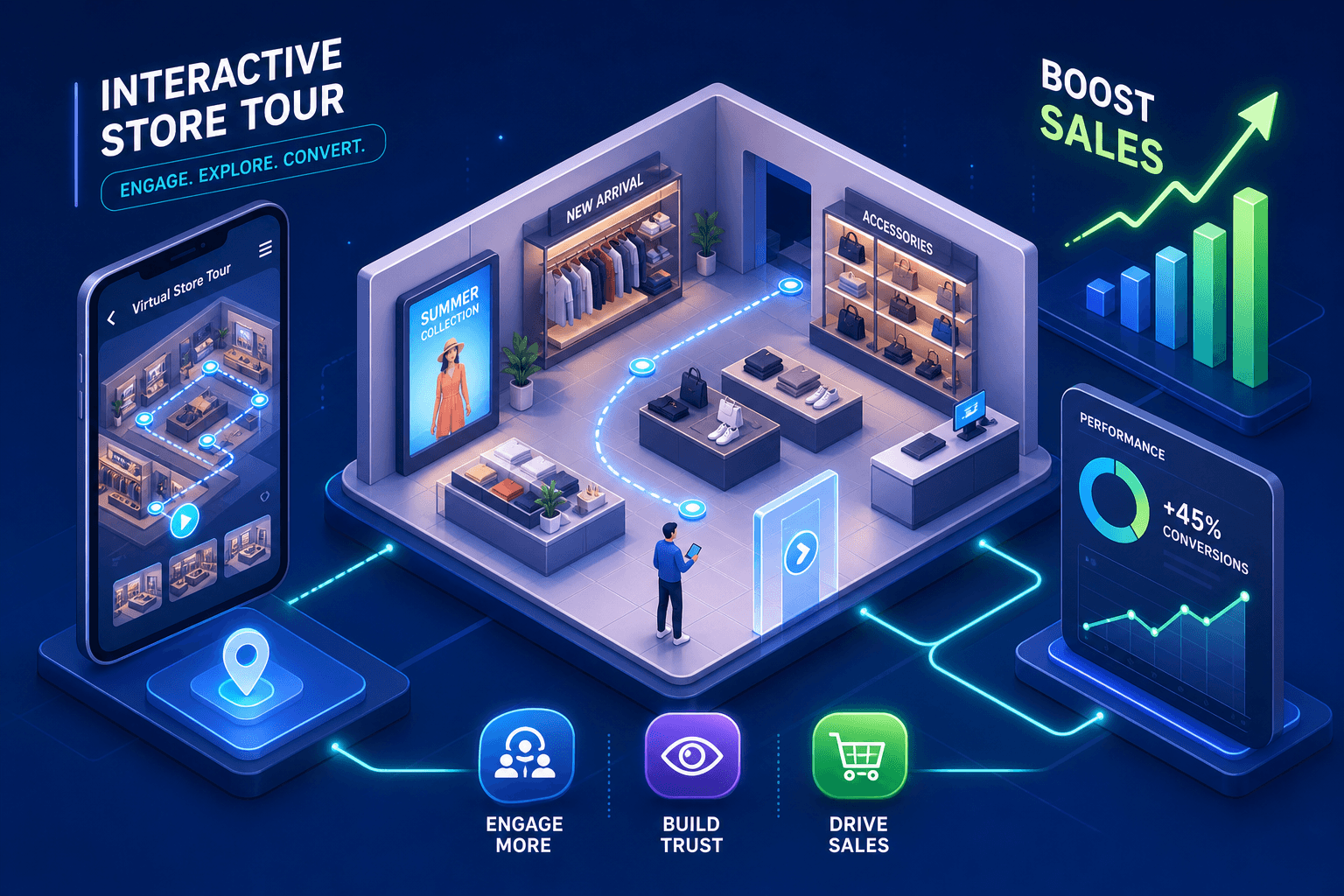
Your clients make their decision well before they walk through your door. In 2026, that decision forms online, often from a phone, very quickly. If your store does not yet offer the option to visit the space remotely, you risk losing qualified buyers to competitors who have already integrated this reality. An interactive store tour changes that dynamic: it gives the buyer the freedom to explore your space as if they were physically present, with no opening-hours or travel constraints.
This guide is for retailers, showroom managers, and physical boutique owners who want to convert more online. You will discover why the data supports this tool, how the technology behind these tours works, what budget to plan for, and how to concretely measure the impact on your sales.
What the numbers say about virtual tours in retail
Engagement, traffic, and conversions: the data that matters
Studies and field feedback consistently show gains in engagement and visibility. Visitors who explore a space in 360° immersion spend 5 to 10 times longer on a website than with static photos (source: behavioral studies on virtual tours, 2023, 2024). This extended engagement time sends a strong signal to search engines, simultaneously improving your local SEO. According to Google/Ipsos data, 41% of consumers who discover a business via enriched mapping physically visit it. These are not just digital trends — they are changes in buying behavior that directly affect your revenue.
On the conversions side, listings integrating a virtual tour record up to 40% more bookings compared to those that do not (sector data, hospitality and retail, 2024). Product return rates also tend to drop in sectors where clients explore the space before buying, because they arrive with a precise understanding of what they ordered. These two combined effects can reduce your operating costs while increasing your net margin.
Why the modern buyer wants to explore before purchasing
The buyer wants to eliminate uncertainty before traveling or pulling out their card. An immersive tour addresses this need in a way that neither photos nor videos can match: it gives access to the real dimensions of the space, the layout of the aisles, the lighting ambiance, and the product arrangement. This level of spatial understanding is precisely what turns a hesitant prospect into a qualified visitor — decided and ready to buy.
For a furniture or fashion boutique, this translates concretely: fewer exploratory visits with no purchase intent, more store visits to close the deal. The customer journey becomes shorter, more predictable, and more profitable.
How an interactive store tour is created in practice
From 3D scan to integration on your site
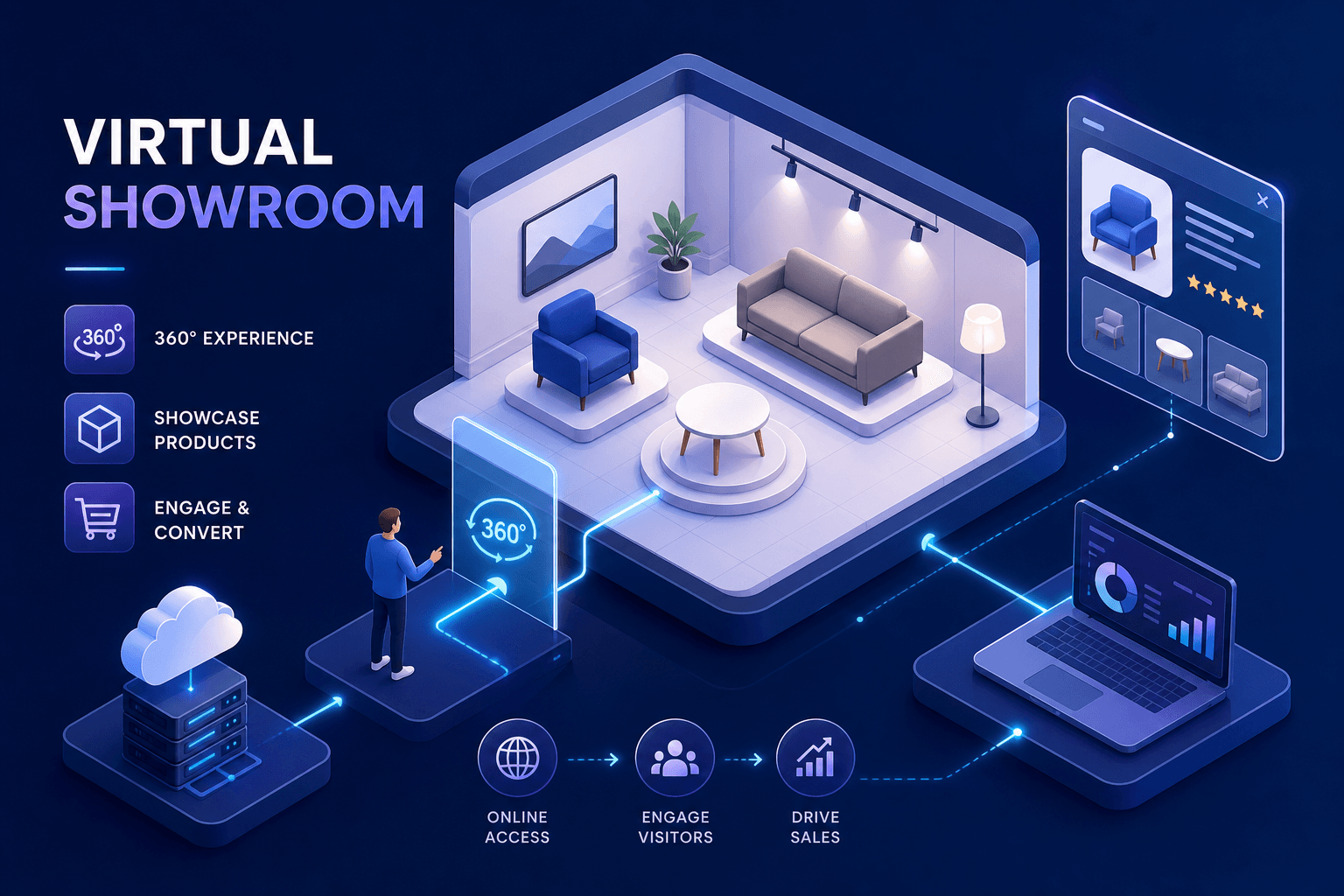
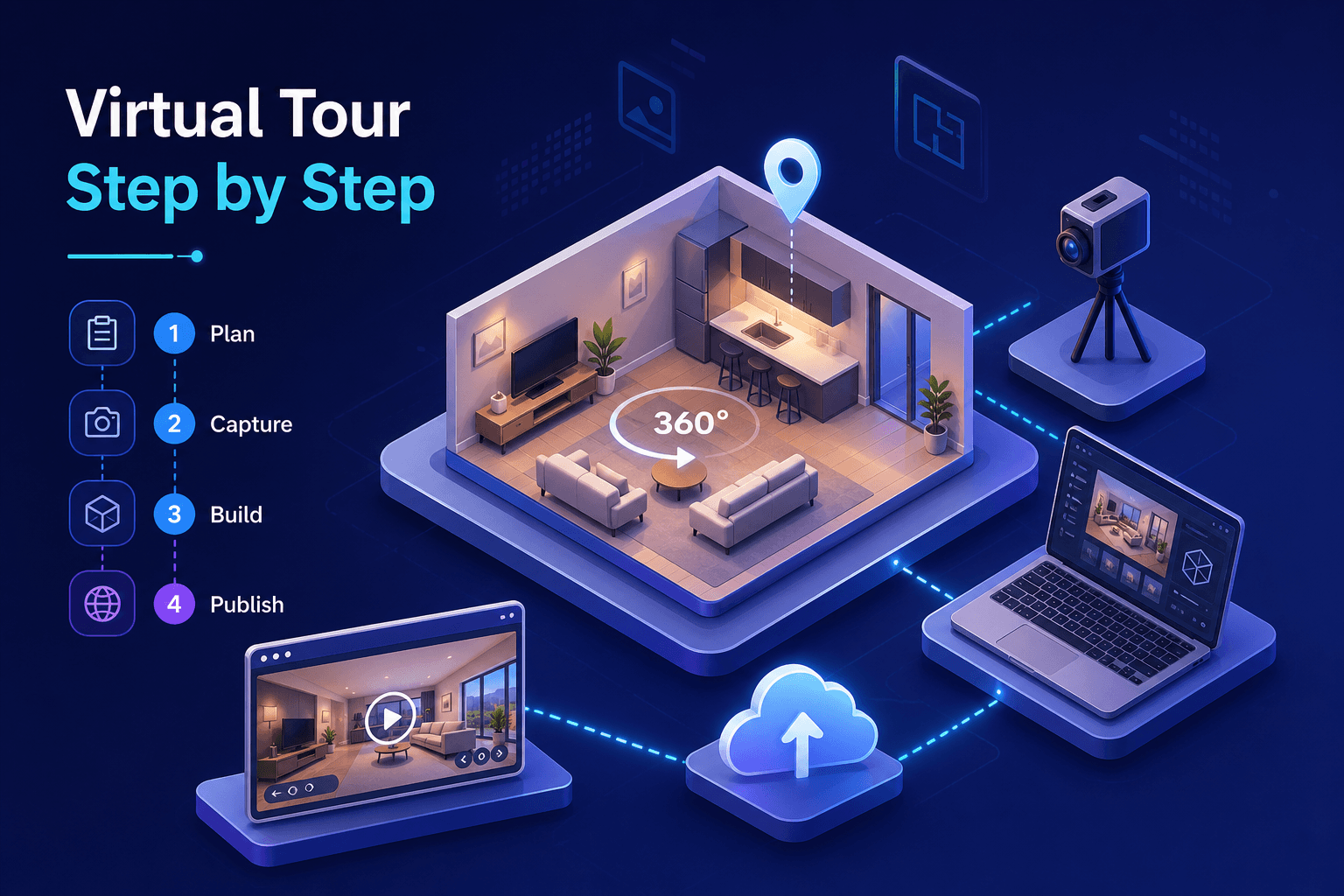
The process is simpler than imagined. A team arrives at your space with a professional scanning camera and captures your entire store from multiple positions. The 360° tour software then assembles this data into a fully navigable tour, including free navigation, a dollhouse view (3D aerial overview of the entire space), and precise 2D floor plans. The final result comes as a link embeddable directly on any page of your website.
The technology relies on render fidelity. The space is reproduced with its exact proportions, its real light, and its organization as it exists. No cleverly chosen camera angle, no filter — your store as it is, accessible around the clock.
Product tags and hotspots: what turns the tour into a sales tool
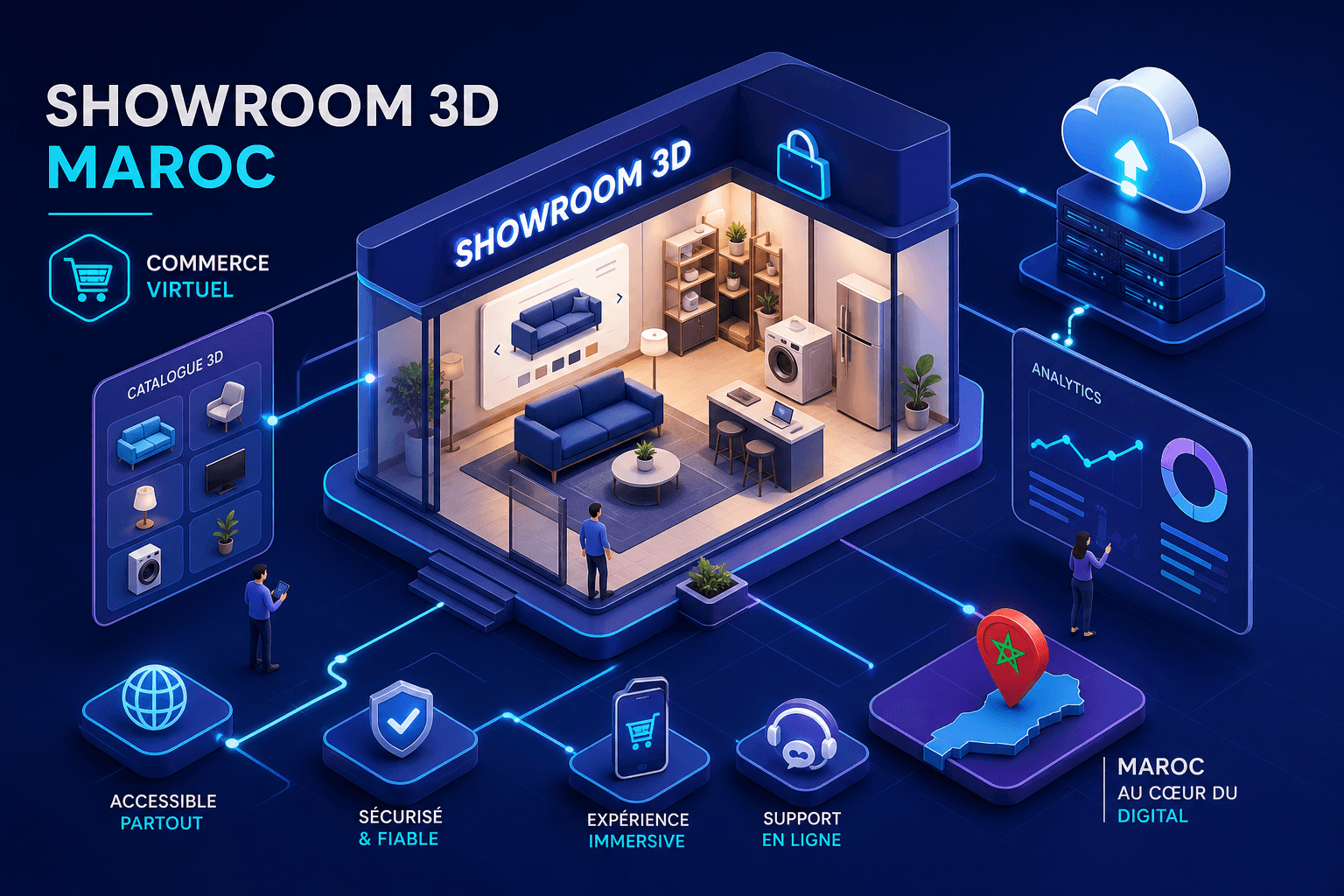
This commercial layer is what changes the nature of the tool — and not just a visual showcase. Some providers, including Immersio, which produces interactive store tours for showrooms and commercial spaces across Morocco, integrate product tags directly in the tour: clicking on a displayed piece of furniture or a shelf item opens the product sheet and price. Depending on the e-commerce integration options chosen, it can also redirect to your online store. This feature turns a passive visual tour into an interactive sales window, permanently operational from any device.
Hotspots also allow adding contextual information: a promotions zone, a click-and-collect area, or instructions to contact your team via WhatsApp. The tour stops being passive and becomes a self-service buying journey.
Which interactive tour solution to choose for your commercial space
Panoramic 360° vs 3D scan: the real differences
Standard 360° photos (similar to Google Street View) are images linked by navigation points. They give an impression of immersion but remain photographic panoramas with no depth data. A 3D scan generates a complete spatial model: real depth, dollhouse view, smooth navigation in all directions, and usable dimensional precision. For a store that wants a converting virtual tour solution — not just a Google Maps listing — the difference is significant in terms of engagement and perceived credibility.
A visitor navigating a 3D scan understands the space as if they were there. A visitor clicking between 360° panoramas is looking at linked photos. It is not the same experience, and it is not the same commercial result.
What to actually evaluate before choosing a provider
Here are the criteria that separate a good from a poor virtual tour provider:
- Quality of the scanning equipment used (certified professional camera)
- Real delivery timeline (some providers offer 48-hour delivery)
- Ability to integrate hotspots and product tags
- Native mobile compatibility and simplified web integration
- Support for distribution on Google Business Profile and social media
A good provider does not just scan your space. They ensure the final result integrates into your existing digital ecosystem and generates measurable results. Systematically request a portfolio of commercial projects before committing.
Budget and return on investment: what to plan for
Realistic price ranges by store size
For a small store of 50–150 sqm, professional rates sit between €450 and €1,000 ex-VAT. For a medium surface of 150–500 sqm, expect €1,000 to €2,500 ex-VAT. Enriched options (product tags, multilingual annotations, BIM floor plans) generally add 20 to 50% to the base budget. Annual hosting fees run around €125 to €250 per year depending on the chosen platform. These ranges reflect consolidated market data for 2026; verify price grids with several local providers to validate variations by region.
These figures are stable in 2026, or even slightly decreasing thanks to automation in scanning and post-production tools. This is no longer an investment reserved for major chains. A mid-sized showroom can now access a professional-quality interactive store tour for a budget comparable to a few days of digital advertising spend.
How to estimate payback before you start
The ROI reasoning is straightforward. Take a concrete example: a showroom with an €800 average basket and 200 monthly web visitors converting at 3%. With an interactive tour raising that rate to 4%, that is two additional conversions per month — €1,600 in additional revenue. Against a €1,200 upfront investment, payback happens in under a month. In more conservative scenarios — a 20% conversion increase on moderate traffic — payback occurs in 1 to 3 months.
The key is to precisely measure your current conversion rate before launch, to have a reliable comparison baseline after integrating the tour.
Integrating and measuring the impact of your interactive store tour
Where to distribute your tour for immediate impact
Three channels concentrate most of the results, and each deserves a distinct approach.
- On your website: create a dedicated /virtual-tour page with a responsive iFrame, and place a visible CTA after the tour (booking, WhatsApp contact, or catalog access).
- On Google Business Profile: add the link to your listing and upload the panoramas directly — data shows a 42% increase in direction requests for listings enriched with a 360° store tour (Google/Ipsos, 2024).
- On social media: post 15-second video clips in Reels or Stories with the link in bio.
Consistency of information across all these platforms is essential. A business name, address, or hours that differ from one platform to another hurts your local SEO.
The metrics that prove it is working
Set up tracking from launch day. In Google Analytics, monitor average time spent on the tour page: a score above 2 minutes is a positive engagement signal. Track clicks on embedded product tags, the conversion rate variation before and after integration, and the evolution of direction requests in GBP Insights. These four indicators are enough to assess real impact and adjust your distribution strategy if needed.
What field experience teaches
Observed results from interactive store tours
The spaces that get the best results from an interactive virtual tour share several common characteristics. Furniture and decor showrooms frequently report a drop in repetitive pre-visit questions: clients arrive already informed about dimensions and the layout of the space. Boutiques that have integrated product tags see an improvement in the quality of physical visitors — those who make the trip have already identified the products they are interested in and are closer to a purchase decision.
In the luxury hospitality sector, properties that offer a tour of their integrated boutiques report a better overall guest experience: the virtual tour extends the relationship beyond the stay, which can encourage distance purchases in the weeks that follow.
What these results reveal for launching your own
An undistributed interactive tour remains an invisible tool. The stores that extract the most value from theirs are those that activate the available commercial features — product tags, clear post-tour CTAs — and maintain regular distribution on Google Business Profile and social media, without treating these actions as a one-time checklist item. The tour does not replace the in-store experience; it prepares it, qualifies the visitor, and reduces the delay between online discovery and the purchase decision.
Next steps for your commercial space
An interactive store tour has become a measurable commercial lever, not a visual gimmick. The data confirms it, the technology is accessible today, and the budget pays back quickly on a store with average traffic volume. Retailers who truly benefit from it distribute their tour across all the right channels, activate available commercial features, and track results with discipline — treating these as ongoing practices, not one-time configuration.
The first steps take a single day: assess your space's floor area, identify the features you need (free navigation, product tags, multilingual support), and request a quote from a competent local provider. If you operate in Morocco, Immersio produces interactive tours of this type for showrooms, boutiques, and commercial spaces in the country's major cities — with fast delivery and a web-ready integration. For sector-specific examples, also check out our page on 3D Tour: Showrooms & Retail.