Today, a well-designed virtual showroom tour allows your clients to begin their journey from their living room — often from their phone, sometimes from another country. A client looking for a high-end sofa or fitted kitchen no longer starts their journey in your physical space. They compare, they zoom, they imagine. And they only visit in person once they are already convinced. This shift in behavior is not a passing trend: it is the new reality of furniture and design sales in 2026.
A virtual showroom tour responds exactly to this need. Thanks to HDR photography and laser scanning, it recreates the physical experience of your space online — light captured at the time of the shoot, real staging, and volume sensation reproduced with precision. At Immersio, we have supported Moroccan showrooms through this transition for several years. In practice, results observed with our clients include fewer low-quality exploratory visits, prospects who arrive better prepared, and a globally shorter sales cycle.
In this article, you will find everything you need to launch an effective virtual showroom project: the two major available technologies, the integrations that turn the tour into a sales channel, realistic budgets to plan for, and the KPIs to track to measure your return on investment.
What a virtual tour genuinely changes for a showroom
The fundamental difference between a photo gallery and an immersive tour is scale. A client navigating freely through your space can observe a sofa from every angle, visually assess whether a table fits in their living room, and understand how natural light plays on your materials. No photo series, however professional, conveys this information as intuitively.
This shift completely reconfigures the role of the physical visit. Instead of being an exploration point, it becomes a confirmation stage. The client who pushes open your door has already made their mental selection — they know which products interest them, and they are ready to act. In practice, your sales teams spend less time presenting and more time closing.
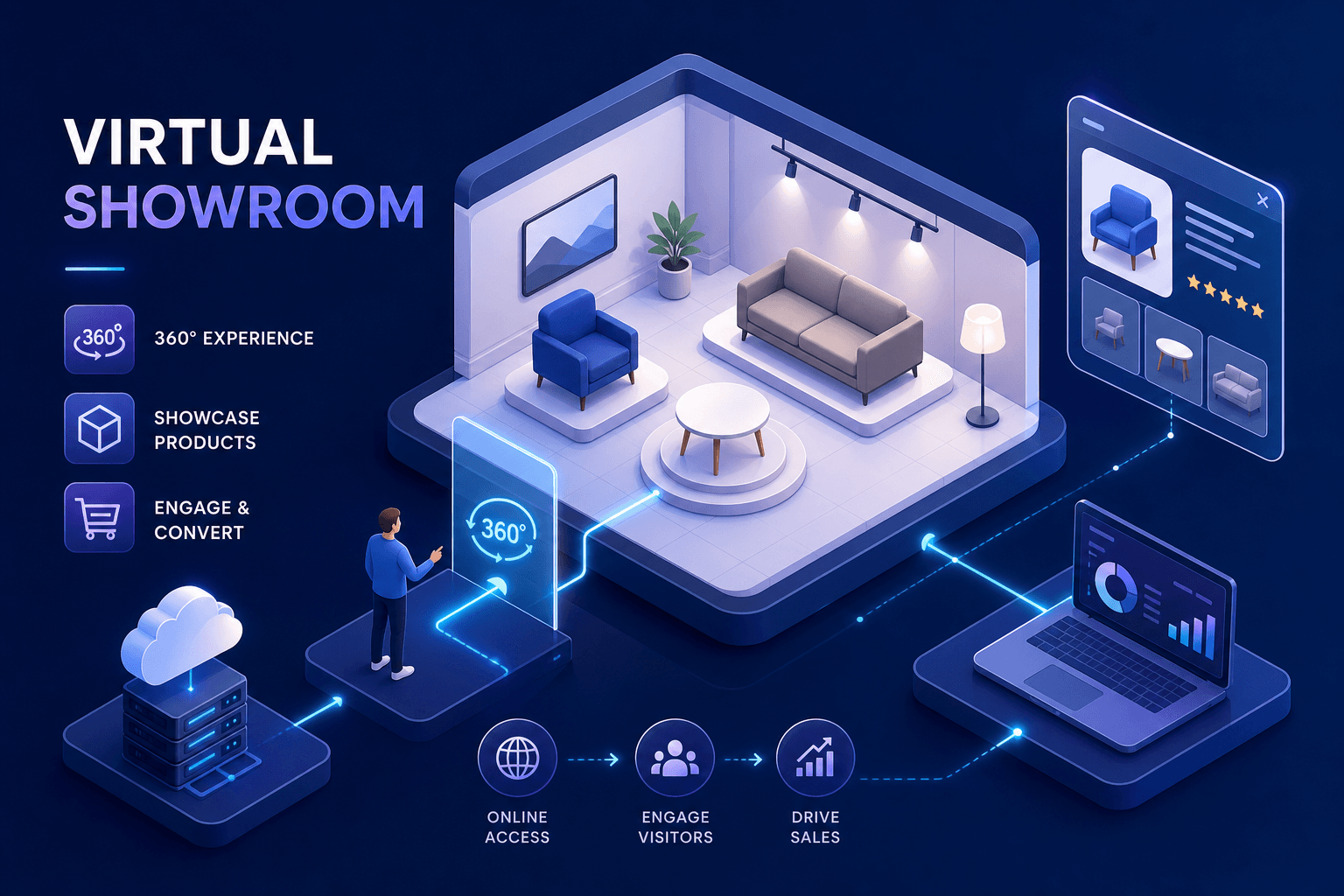
The benefits are particularly clear in furniture and interior decor. A high-end furniture showroom can present its complete collections in their real staging, with no opening-hours constraints. An interior decor space can show several atmospheres in a single tour — bedroom, lounge, dining room — with smooth transitions between spaces. And for international or geographically distant clients, the immersive tour often becomes the most realistic and practical way to qualify their interest before any commercial contact.
Virtual showroom tour: 360° or Matterport 3D?
Both technologies are serious, but they do not serve the same needs. A 360° tour is built from spherical panoramic photos assembled together. Navigation moves from point to point via arrows or hotspots. The result loads quickly, is easily customizable (video inserts, texts, clickable links), and remains financially accessible.
A Matterport 3D tour works differently. A laser scanner captures the space in depth and generates a complete three-dimensional model — including the "Dollhouse" view, an aerial view of the entire showroom, plus the ability for the user to navigate freely, get real-time measurements, and grasp volumes with precision. In terms of spatial immersion, Matterport is the high-end format in the sector, where 360° offers more creative flexibility and faster deployment.
The right choice depends on your priority. For a furniture or design showroom where volumes, proportions, and staging are at the heart of the client experience, the Matterport 3D tour is the fitting format. For a more compact space seeking quick ROI with product hotspots pointing to specs or a shopping cart, interactive 360° remains an effective option. Note: while both technologies embed on a website and work on mobile, Matterport tours may require loading optimizations (CDN, lazy loading) to ensure a smooth experience on limited mobile connections.
Product tags for your virtual showroom tour: turning the visit into an active sales tool
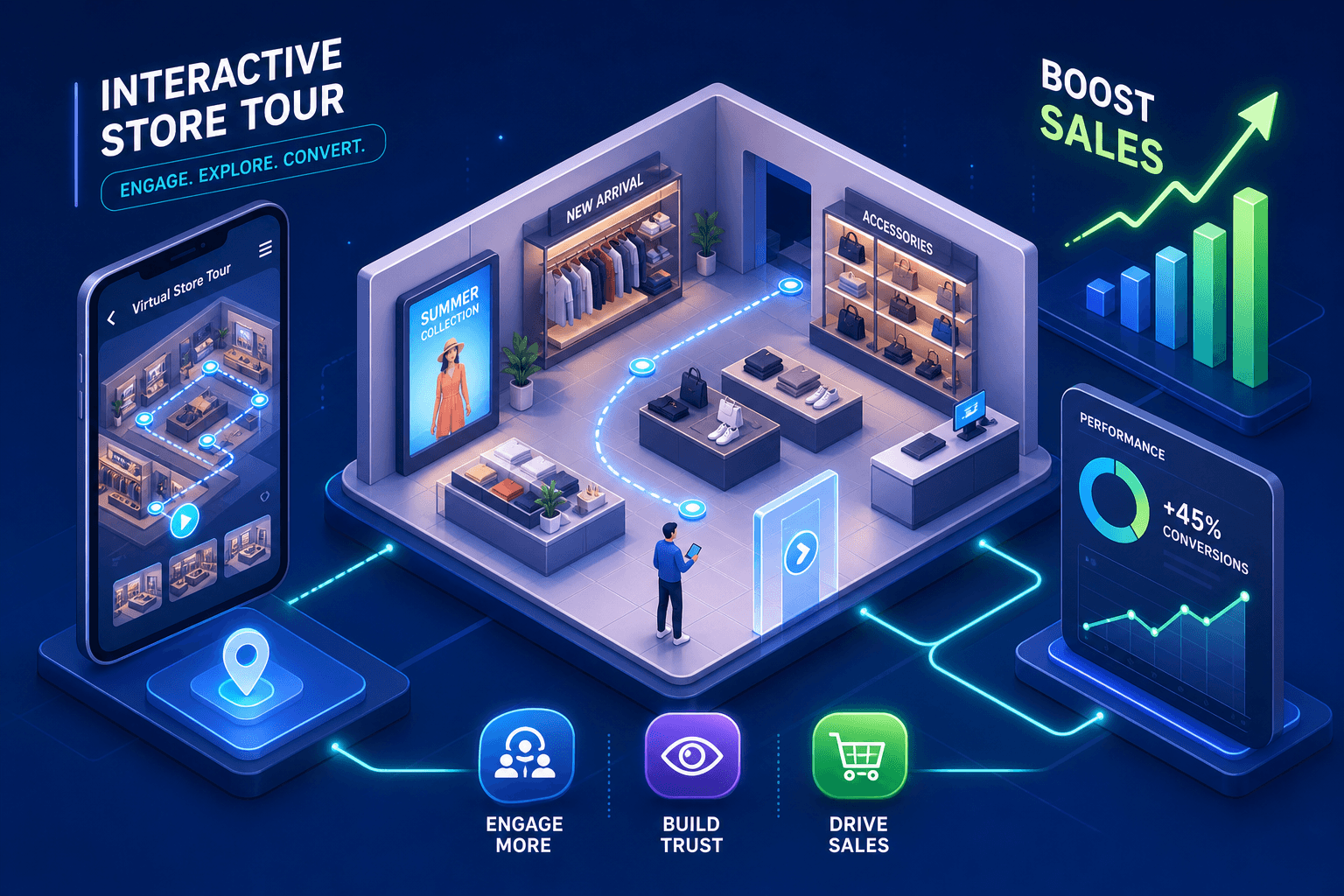
A virtual tour without commercial integration is a beautiful window without a checkout. Product tags (or product hotspots) are what change the game. Placed directly on a piece of furniture, a lamp, or an accessory in the tour, these interactive labels open a contextual window on click: product sheet, price, dimensions, or contact form. Depending on configuration, these windows open in overlay within the tour or redirect to your product page — the key is that information is accessible without friction.
E-commerce integration
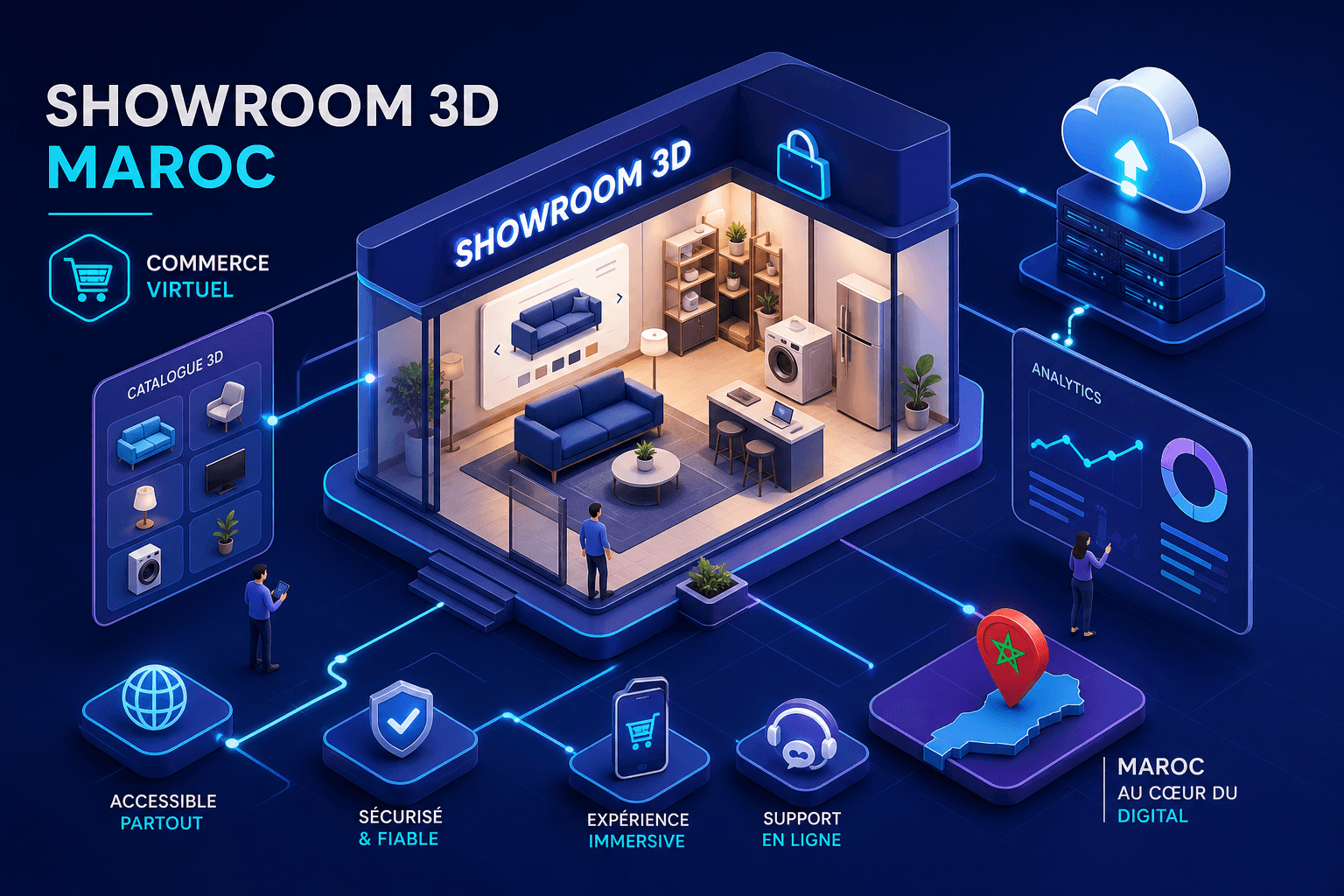
This feature concretely turns the virtual showroom demo into an active shopping experience. Tours are compatible with the main e-commerce platforms — Shopify, WooCommerce, PrestaShop — to synchronize stock, prices, and purchase links in real time. For Moroccan showrooms that want to reach international clientele without multiplying back-and-forth, this is an immediately operational lever.
CRM integration
Navigation data — most viewed products, time spent by zone, click rates on tags — feeds your analytics tools and CRM. Solutions like HubSpot or Zoho CRM allow you to capture leads generated from the tour and trigger targeted automated follow-ups. The tour then becomes a full commercial channel, active 24 hours a day. For insight into the technical and operational issues around CRM integration in your sales process, this article offers practical guidance.
Immersio integrates clickable product tags into every 3D tour produced for a showroom, with an embeddable link ready to insert directly on your site — delivered within 48 hours of the scan session under standard conditions.
Budget and timelines: concrete figures to plan your project
Price ranges vary by chosen technology. For a standard 360° tour with interactive hotspots on a 50–200 sqm showroom, prices generally sit between €1,500 and €8,000 depending on the interactivity level and number of spheres — more complex or interactive projects approaching the top of this range, or beyond, for multi-space deployments.
For a complete Matterport 3D tour on the same surface, rates oscillate between €2.50 and €7 per sqm — roughly €500 to €1,400 for a 200 sqm showroom — to which hosting and option costs like product tags are added. Integrating these tags generally represents a 20 to 50% surcharge. According to provider feedback in the sector, this type of integration can pay back fairly quickly when the tour generates a regular volume of quote requests or online sales — though ROI timelines depend on traffic and each showroom's sales cycle.
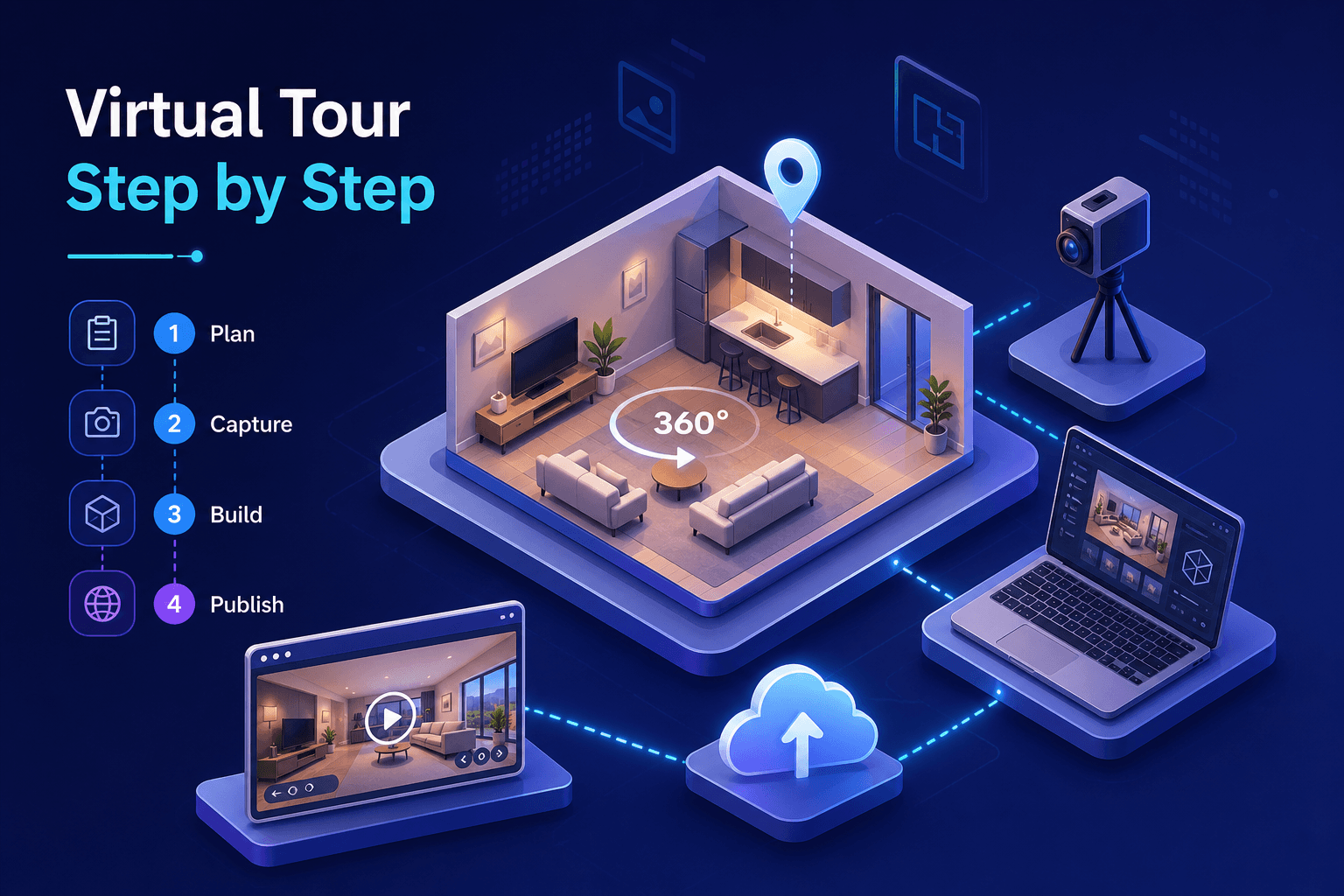
On timelines, producing a tour for a medium-sized showroom follows three phases: on-site photography or scanning (1 to 2 hours for 150–200 sqm), post-production including data processing and tag integration, then final link delivery. With a Matterport Pro3, a structured team, and standard scan conditions, full delivery generally takes under 48 hours after the scan session. That is the standard Immersio aims to deliver — a turnaround that remains uncommon among most local providers. To learn more about our method, visit How It Works — 3D Tours in Morocco | Immersio.
Plan ahead for a scouting session if your showroom is large or has a complex layout — this step, typically 1 to 2 hours, avoids day-of surprises and secures delivery timelines. Also plan for an annual update to reflect new collections, especially if you work with seasonally refreshed ranges.
How to choose your provider and track results after launch
A good virtual showroom tour provider masters both sides of the craft: capture (professional equipment, light mastery, handling of complex surfaces) and post-production (polished render, tag integration, mobile compatibility). Systematically ask for examples of showroom projects — not just real estate or hospitality references. Sector experience in furniture or interior decor genuinely changes the quality of the final output.
A serious provider delivers a ready-to-use embeddable link, guarantees delivery within a stated timeline, and supports integration on your site. They must also be able to explain how product tags work and how to connect them to your existing product pages — without you having to handle the technical side alone. For dedicated showroom service references, see our 3D Tour: Showrooms & Retail | Immersio page.
Once the tour is live, track these indicators to evaluate its impact:
- Number of sessions on the tour (incoming traffic volume)
- Average time spent in the tour (engagement indicator)
- Click rate on product tags (measures purchase intent)
- Leads generated from the tour: forms filled, contacts initiated
- Overall conversion rate: virtual tour to appointment request or order
Compare this data month by month to identify which zones or products perform best. Google Analytics 4, combined with your tour platform's native analytics and, if needed, heatmapping tools or your CRM connector, is enough to build an actionable dashboard. The goal is not to collect figures for the sake of it — it is to continuously adjust your strategy: highlight products generating the most clicks, reposition tags in the most visited zones, or create special offers tied to the most viewed products.
Conclusion: your showroom should work for you outside opening hours
A well-executed virtual showroom tour is not a visual gimmick. It is a commercial tool that works in your place at any hour, qualifies your prospects before the first contact, and concretely reduces your sales cycle. Between interactive 360° — ideal for rapid deployment with clickable product hotspots — and Matterport 3D — the high-end format for spaces where volumes and ambiance are central — you have two solid options, each suited to a specific context.
Real value does not come from the chosen technology alone, but from the integrations surrounding the tour: product tags linked to your pages, analytics data connected to your CRM, and an embeddable link integrated on your site. Together, this system turns an immersive tour into a durable conversion lever. For technical equipment questions to plan for during capture, this guide offers useful recommendations: what equipment to use for a virtual tour.
If you manage a showroom in Morocco and want to act, the Immersio team produces your virtual showroom tour with product tag integration and delivers your link in the shortest possible time. Contact us for a quote tailored to your space. For additional reading on expected virtual tour ROI by sector, consult this sector analysis on virtual tour return on investment.